

THE BOOK OF REVELATION:
- crossroadscaloundr
- Apr 6
- 7 min read
Updated: May 11
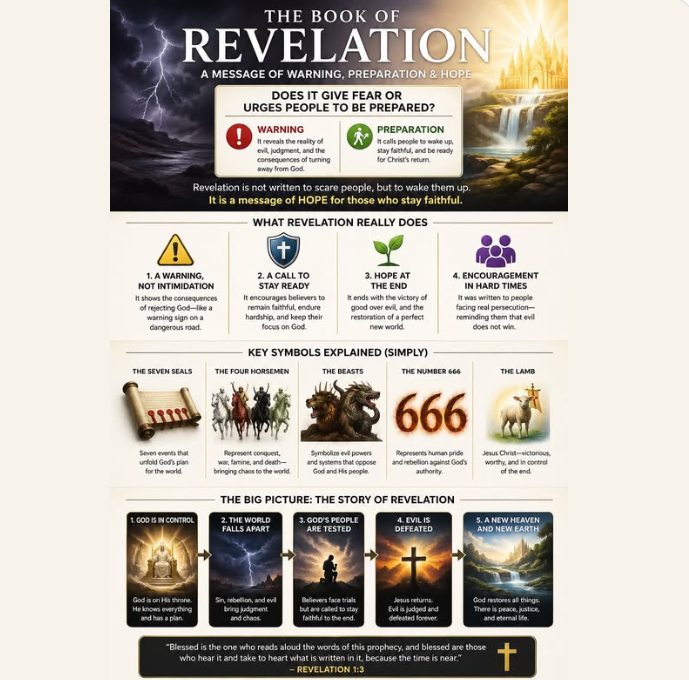
A lot of people talk about Revelation like it is some impossible book, like God gave it to confuse believers, divide churches, and keep everybody guessing.
That is already a bad way to come to it.
The word Revelation comes from the Greek word apokalypsis, which means unveiling. This is not God covering truth up. This is God pulling the curtain back. He is showing His servants who Jesus Christ is in glory, what kind of world we are living in, how evil will be judged, how history will end, and who will stand when it is over.
Revelation is not meant to hide Christ. It is meant to reveal Him.
And one reason so many people cannot read Revelation fluently is because they try to read the last book of the Bible while being weak in the first part of it. The Bible is roughly 70 percent Old Testament, and Revelation makes hundreds of allusions back into it. That is why the book feels foreign to so many people. They are trying to understand the end while neglecting the foundation God used to build it. Revelation keeps reaching back into Isaiah, Ezekiel, Daniel, Zechariah, Exodus, Joel, the Psalms, and the prophets. John is not inventing a brand new symbolic world. He is drawing together what God had already been saying for generations. So when a man says Revelation is too confusing, a lot of the time what he is really revealing is that he has not done enough study in the Scriptures Revelation is pulling from.
That is also why Revelation does not mainly send you to the newspaper. It sends you back to your Bible.
Then right at the front of the book, God places a blessing on it.
“Blessed is he that readeth, and they that hear the words of this prophecy, and keep those things which are written therein: for the time is at hand.” Revelation 1:3
That should settle a lot. God did not place a blessing on the reading, hearing, and keeping of a book He never intended believers to understand at all. He wants this book read. He wants it heard. He wants it obeyed.
Then Jesus gives the outline of the book Himself in Revelation 1:19:
“Write the things which thou hast seen, and the things which are, and the things which shall be hereafter.”
That is the divine outline.
The things which thou hast seen — the vision of the glorified Christ in chapter 1.
The things which are — the seven churches in chapters 2 and 3.
The things which shall be hereafter — literally, after these things, beginning in chapter 4.
That structure matters because Christ Himself gave it. In Revelation 4:1, after the letters to the churches are finished, John says, “After this I looked,” and then he hears a voice like a trumpet saying, “Come up hither.” The phrase meta tauta, “after these things,” marks the transition. Chapters 1 through 3 deal with the church on earth. Then the scene shifts.
A lot of believers, and I believe rightly, hear in that trumpet-like voice a preview of what Paul describes in 1 Thessalonians 4:16–17. Whether a man sees Revelation 4:1 as a direct picture of the rapture or not, the structure of the book is still plain enough. The church is central in chapters 1 through 3. Then from chapter 4 through chapter 19, the focus moves to heaven’s throne room, judgment, wrath, and the final dealings of God with the earth. Then in chapter 19, Christ returns in glory, and His saints are with Him.
That lines up with Revelation 3:10:
“Because thou hast kept the word of my patience, I also will keep thee from the hour of temptation, which shall come upon all the world, to try them that dwell upon the earth.”
That is not a light promise. The language points to being kept from the hour itself, not merely preserved inside it. Paul says the same thing from another angle when he says believers are not appointed to wrath in 1 Thessalonians 5:9. That is why the church’s absence in Revelation 6 through 19 becomes so noticeable once you read carefully. Those chapters are not describing ordinary hardship. They are describing divine wrath being poured out on a rebellious world. The church is not appointed to that wrath.
But none of that means Revelation had no first-century meaning.
It did.
John was writing to real churches under real pressure in a real historical setting. Rome was not an irrelevant backdrop. Rome was functioning as a kind of Babylon. The seven hills imagery was known in the ancient world. The woman clothed in luxury and drunk with the blood of saints fits an empire intoxicated with power and persecution. And yes, many have pointed out the connection between 666 and Neron Kaisar through Hebrew gematria. So there is a real historical anchor there.
But Rome is not the final limit of the book.
Rome was one more expression of the same old rebellion.
Babylon is larger than one city, one empire, or one century. Babylon is the recurring pattern of organized human pride against God. It is man building power, wealth, religion, and culture in defiance of heaven. It is the world system saying, “We will rule without God.” That spirit showed up at Babel. It showed up in ancient Babylon. It showed up in Rome. It shows up in every age. And it will show up in its final form before Christ destroys it completely.
But the centre of Revelation is not Babylon.
It is not the beast.
It is not the dragon.
It is the Lamb.
One of the greatest moments in the whole book comes when John hears about the Lion of the tribe of Judah. He turns, and what he sees is a Lamb standing as though it had been slain.
That is the glory of Jesus Christ.
He is the Lion, and He conquered as the Lamb.
He wins through sacrifice. He triumphs through the cross. He overcomes through obedience, holiness, truth, and His own blood. The world thinks power only looks like visible force, intimidation, and domination. God reveals true power in the crucified and risen Christ.
That also tells believers how conquest works.
The saints do not overcome by becoming beasts themselves. They do not conquer by using Babylon’s methods. They overcome by faithful witness, endurance, holiness, and loyalty to Christ even unto death. Revelation was written to steady suffering churches. Some were compromising. Some were fearful. Some were lukewarm. Some were under persecution. John’s message was that Caesar was not lord, Rome was not ultimate, Babylon would fall, and the throne in heaven was not empty.
When you move through the seals, trumpets, and bowls, John is not simply giving a flat little timeline with no depth. He is showing the final drama of judgment as rebellion hardens and God answers with justice. The seals open the scroll of history under the authority of the Lamb. The trumpets sound warnings like covenant judgments, echoing Exodus while men still refuse to repent. The bowls pour out final, unmixed wrath on a world that has hardened itself fully against God. The rebellion grows darker. The judgments intensify. The justice of God is displayed without apology.
Then you come to Armageddon.
People use that word like it only means one modern battlefield or one news headline. But in Revelation it points to the final gathering of the kings of the earth in rebellion against God. It is the concentrated climax of human defiance. The nations gather against the Lamb, and the outcome is never in doubt. Christ does not barely survive the conflict. Heaven does not scrape together a narrow victory. The King appears, speaks, and crushes His enemies. The sword from His mouth shows His authority. His word is enough.
Then Revelation 20 gives the thousand-year reign, Satan’s binding, the vindication of the saints, the final revolt, and the last judgment. Even after a thousand years, when rebellion is given one final opening, fallen man still proves what he is apart from grace. Then judgment falls, and death and hell are cast into the lake of fire.
Death itself is judged.
And then comes the end every believer longs for.
A new heaven and a new earth.
No more curse.
No more tears.
No more mourning.
No more pain.
No more night.
No more death.
The holy city descends as a bride adorned for her husband. God dwells with His people. The river of life flows. The tree of life appears again. The Lamb is the light. What was lost in Eden is not merely patched up. It is brought to full and eternal fulfillment in Christ.
That is where the whole Bible has been going.
Revelation is not some strange appendix for people obsessed with prophecy charts. It is the capstone of the whole story. It shows the final defeat of the serpent, the overthrow of Babylon, the vindication of the saints, the reign of Christ, the removal of the curse, and the eternal dwelling of God with His people.
And the invitation at the end is still open:
“And the Spirit and the bride say, Come… And let him that is athirst come.” Revelation 22:17
That call is still going out right now.
So when you read Revelation, do not read it like it is meant to keep you in fear.
Read it as the unveiling of Jesus Christ.
Read it as the exposure of Babylon.
Read it as the comfort of suffering saints.
Read it as the certainty that every beastly kingdom has an expiration date.
Every Babylon will fall.
Every proud empire will collapse.
Every enemy of Christ will be put down.
And Jesus Christ will return, visibly, bodily, gloriously, to rule and reign.
So hold fast.
Keep the words of this prophecy.
Do not bow to the spirit of the age.
Do not get drunk on Babylon.
Do not panic when evil looks strong.
The throne is occupied.
The Lamb has already won.
And the King is coming.
“Surely I come quickly.”
Even so, come, Lord Jesus.


Comments