

Iran in Bible Prophecy: Persia, Elam, and the End Times
For more details see my message on YouTube:
Or my post on Facebook:
Or more recent updates on this prophetically important nation:

When people talk about Iran in Bible prophecy, they are not engaging in mere speculation or modern politics disguised as theology. Scripture itself repeatedly references this region under its ancient names—Persia and Elam—placing it squarely within God’s prophetic timeline. Iran has been part of the biblical narrative from the beginning of Israel’s exile to the birth of the Church. It has not disappeared from prophecy concerning the last days.
Iran in the Old Testament
In the Old Testament, Iran first appears as Elam. This region lies east of Babylon, west of Persia proper, and south of Media. The prophet Jeremiah pronounced judgment on Elam, foretelling both its destruction and its eventual restoration:
“I will break the bow of Elam… Yet it shall come to pass in the latter days: I will bring back the captives of Elam.” (Jeremiah 49:35, 39)
This prophecy unfolded with remarkable precision. Babylon conquered Elam in 596 BC, but Elam did not vanish. Instead, its people were absorbed into the rising Medo-Persian Empire, which went on to overthrow Babylon in 539 BC—exactly as Isaiah foretold:
“Go up, O Elam! Lay siege, O Media!” (Isaiah 21:2)
The Role of Daniel
This transition happened during Daniel’s lifetime. He personally witnessed the fall of Babylon (Daniel 5) and later recorded visions while living in the province of Elam (Daniel 8:2). Persia was not merely a background nation—it became the stage on which God worked powerfully for His people. Under Persian rule, Israel was allowed to return home, rebuild the Temple, and restore Jerusalem.
The books of Esther and Nehemiah are entirely set within Persia’s royal courts. Persia’s dominance eventually gave way to Greece under Alexander the Great, fulfilling Daniel’s prophetic vision of the ram and the goat in Daniel 8. From that point forward, Persia passed through many hands—Seleucid, Parthian, Sassanian, Roman, Byzantine, and Islamic—until the modern nation of Iran formally emerged in AD 1501. Yet throughout these shifts, the region never left God’s prophetic map.
Iran's Presence in the New Testament
The New Testament quietly confirms Persia’s continued relevance. On the Day of Pentecost, Luke records that “Parthians, Medes, and Elamites” were present in Jerusalem (Acts 2:9). These were Jews from what is now Iran—devout worshipers who witnessed the outpouring of the Holy Spirit and carried the gospel back east. Iran was present at the very birth of the Church.
End-Time Prophecy and Iran
But the most sobering references appear in end-time prophecy. In Ezekiel 38–39, Persia is named explicitly as part of a future military alliance led by Gog of Magog. This coalition includes nations corresponding to modern Russia, Turkey, Sudan, and Libya, and it will move against Israel at a time when Israel is described as dwelling securely and unsuspecting.
“Persia, Cush, and Put are with them… all of them with shield and helmet.” (Ezekiel 38:5)
This invasion will not succeed. God Himself intervenes, not through diplomacy or military alliances, but through supernatural judgment. The invading armies are destroyed on the mountains of Israel, not to glorify Israel’s strength, but to reveal God’s holiness to the nations:
“I will magnify Myself and sanctify Myself, and I will be known in the eyes of many nations. Then they shall know that I am the Lord.” (Ezekiel 38:23)
Iran’s modern hostility toward Israel is not the cause of this prophecy—it is a confirmation that the players are aligning exactly where Scripture said they would be. Yet the focus of the prophecy is not fear, war, or politics. The focus is God’s sovereignty.
“I will make My holy name known in the midst of My people Israel… and the nations shall know that I am the Lord, the Holy One in Israel.” (Ezekiel 39:7)
Understanding Current Events
Bible prophecy does not exist to make us anxious. It exists to remind us that history is not random, God is not reacting, and the future is already written by the One who declares the end from the beginning.
Watch the headlines—but interpret them through Scripture, not speculation.
Is Today’s Iran/US Crisis Part of Bible Prophecy?
A powerful nation with a Biblical heritage suddenly on the brink of war with the United States—could this be part of God’s prophetic timeline?
Friends, the headlines feel like something straight out of the book of Ezekiel, Daniel, and Isaiah. But before fear spreads, let’s look at what God’s Word actually says—with wisdom, not sensationalism:
Iran: From Biblical Elam to Modern Nation
The nation we now call Iran was known in the Bible by several names:
Elam — referenced in prophetic warnings of scattering and future restoration (Jeremiah 49).
Persia — the empire that liberated the Jews from Babylonian exile (Cyrus) and allowed the temple to be rebuilt.
Parthians/Medes — peoples mentioned at Pentecost as being present when the Church was born (Acts 2:9).
God’s Word shows Iran’s land and peoples repeatedly in Scripture—not as an accident, but as part of God’s unfolding plan: judgment, exile, restoration, and covenant fulfillment.
Why This Matters in Prophecy
Several Bible passages are often connected to nations in this region:
Jeremiah 49:34–39 — God prophesies against Elam (ancient Iran) and promises restoration in the last days.
Daniel 8 — Persia is symbolized in visions about kingdoms rising and falling, as part of God’s sovereign control over history.
Ezekiel 38–39 — A future coalition including Persia comes against Israel; God supernaturally defeats them.
Acts 2:9 — The presence of Medes, Elamites, and Parthians at Pentecost reminds us God is already moving among these nations spiritually.
What Does Prophecy Really Say?
God intends prophecy to inform our hope, not fuel fear.
Scripture shows conflict and restoration. Elam/Persia is both judged and promised blessing—God’s arc is toward redemption.
Ezekiel 38–39’s war comes after Israel is at peace and secure—not necessarily the same war the world headlines today.
A Christian Response to Today’s Tensions
Believers should not panic—but pray with wisdom and urgency:
Pray for peace, not war (1 Tim. 2:1–2).
Pray for Iranian citizens suffering under repression and economic hardship.
Pray for diplomatic wisdom that honors life.
Pray for Israel, America, and all nations caught in this storm.
Remember: God is sovereign over kingdoms, presidents, and empires. Persia freed God’s people once—God is not done with the peoples of that ancient land.
Conclusion
Iran appears in Bible history more than you realized.
Prophecy involves Iran—but not in the simplistic, fear-driven “headline fulfillment” way.
Today’s tensions are serious—but God’s purposes go beyond a single conflict.
The Bible both warns of wars and points to ultimate peace in Jesus Christ.

“Persia, Ethiopia, and Libya with them, all of them with shield and helmet…”
— Ezekiel 38:5 (NKJV)
Who is “Persia” in the Bible?
The Bible refers to the ancient empire known as Persia, whose territory and identity correspond to modern-day Iran. The name Persia was used in Scripture and world history, while the modern nation officially adopted the name Iran in 1935. In biblical prophecy, Persia = Iran is a recognizable geopolitical entity linked to end-time events described by the prophet Ezekiel.
The Prophecy of Gog and Magog
Ezekiel chapters 38–39 describe a powerful leader called Gog, from the land of Magog, who leads a coalition of nations against Israel in the “latter days.” This coalition specifically includes Persia, making Iran the only nation in the prophecy still known today by essentially the same geographic identity.
Key Prophetic Details Include:
Israel dwelling securely in the land.
A multi-nation alliance rising against her.
God supernaturally intervening to defend Israel and glorify His name among the nations.
What This Means (Interpretive Summary)
Persia’s Role
Persia is clearly listed as part of the end-times alliance that comes against Israel. This event is commonly referred to as the Battle of Gog and Magog.
Iran Today
Modern Iran’s leadership has openly expressed hostility toward Israel. Many Bible teachers see this hostility as consistent with the role Persia plays in Ezekiel’s prophecy.
Important note: Scripture names Persia, not modern political movements. Any modern application is interpretive, not dogmatic.
A Larger Biblical Pattern
Persia in History
Persia once played a God-ordained role in blessing Israel. Cyrus the Great, king of Persia, was used by God to free the Jewish exiles and allow the rebuilding of the Temple (Ezra 1; Isaiah 45).
Persia in Prophecy
In Ezekiel, Persia appears again, this time aligned against Israel. This shift highlights God’s sovereignty over nations across different eras. God raises nations up, uses them for His purposes, and holds them accountable in His perfect timing.
Final Thoughts
God is fully sovereign over history and prophecy. The inclusion of Persia (Iran) in Ezekiel 38–39 does not mean every modern conflict is prophetic fulfillment, but it does call believers to watch, pray, and remain anchored in Scripture. The ultimate message of Gog and Magog is not fear, but God’s glory, faithfulness, and protection of His covenant promises.
Study Tip
Read Ezekiel 38–39 slowly and alongside Israel’s modern history. Pay attention to what God says He will do, not just what the nations plan to do.

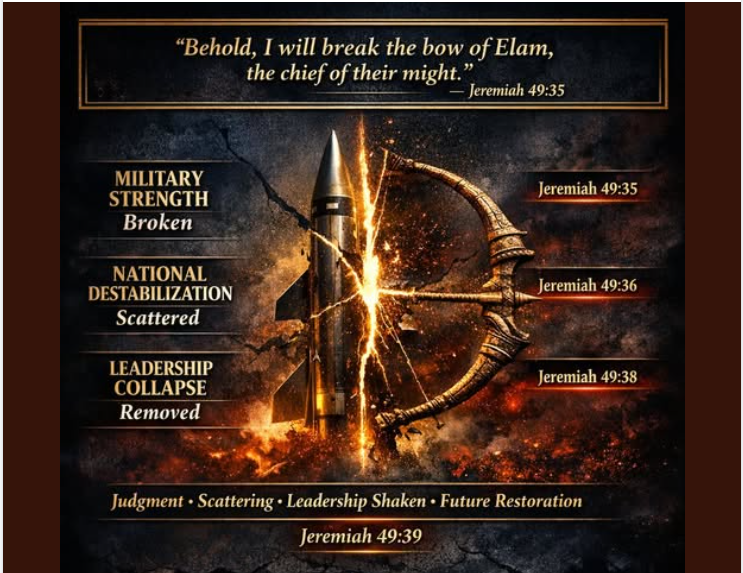
The Bow of Elam: (Jeremiah 49:34–39)
The prophecy of the Bow of Elam is one of the most overlooked passages in Scripture, yet it is remarkably specific and carefully worded. Elam was an ancient kingdom east of Babylon, centered around Susa, in what is now southwestern Iran. In the Bible, Elam was known for its archers. Their military strength was symbolized by the bow, which is why the imagery in Jeremiah is so intentional.
“Behold, I will break the bow of Elam, the chief of their might.”
(Jeremiah 49:35)
In prophetic language, the bow represents military power and the ability to wage war. God is not merely predicting a lost battle. He is declaring the removal of Elam’s war-making capacity. What Elam trusted in most is what God addresses directly.
The prophecy then describes Elam being scattered in all directions. This language points to dispersion, loss of unity, and regional destabilization. Elam does not simply lose strength; it loses cohesion and centralized power.
Jeremiah also speaks of terror and collapse coming upon Elam. Fear, confusion, and political unraveling accompany the judgment. This is not only a military defeat but a national shaking. Yet the prophecy does not end there. God declares that He will set His throne in Elam. This statement signals divine sovereignty. God does not merely defeat Elam; He asserts His authority over the region. The purpose is rule, not eradication.
Finally, the passage closes with hope. In the latter days, God promises to restore Elam. Judgment is not the final word. God preserves a future for the people and the land, showing once again that His judgments are measured and redemptive.
The larger message is clear. God breaks what nations trust in most. Military power does not decide history. The Lord does!


For more details see my message on YouTube:
Or my post on Facebook:
Or more recent updates on this prophetically important nation:


Comments