

The final nail in the "flat earth" coffin
- crossroadscaloundr
- Jan 11
- 16 min read
Updated: Jun 4

Understanding the Deeper Issues
There’s a deeper issue with Christians promoting flat-earth content. It’s not just that the claim is scientifically false. The real problem is what it communicates about God, truth, and our witness to the world.
When believers publicly reject basic, measurable realities that anyone can test, it doesn’t make us look faithful. It makes us appear unlearned, reactionary, and disconnected from reality. Scripture never calls us to reject knowledge. Instead, it encourages us to test all things, love God with our minds, and walk wisely among outsiders. When Christians attach themselves to easily disproven claims, we don’t elevate God—we unintentionally shrink Him.
The Nature of God and His Creation
God is not honored by fragile belief systems that collapse under simple observation. The God of Scripture is the Creator of order, law, measure, and consistency. The heavens declare His glory not because they are mysterious nonsense, but because they operate with precision, reliability, and intelligible structure. Gravity, motion, geometry, and time are not enemies of faith. They are part of God’s design.
When Christians promote flat-earth ideas, it tells the watching world that faith requires denial of evidence. It suggests that belief in God is incompatible with learning and that Scripture cannot withstand investigation. None of that is biblical. Christianity gave birth to modern science because believers trusted that a rational God created a rational universe worth studying.
The Distraction from the Gospel
Worse still, these posts distract from the Gospel. Instead of people seeing Christ as Lord, Redeemer, and Truth, they see Christians arguing against satellites, gravity, and basic physics. The conversation shifts from salvation and transformation to damage control. Not because the world hates truth—but because it recognizes error.
The Bible never teaches a flat earth. It uses poetic language, phenomenological descriptions, and ancient observational terms—just like we still say “the sun rises” today without meaning it literally or scientifically. Confusing poetic language with scientific claims doesn’t make us more biblical; it makes us careless interpreters of Scripture.
The Power of Truth
God does not need conspiracy theories to defend Him. Truth stands on its own. A faith that requires rejecting reality is not stronger faith—it is weaker faith pretending to be bold. If we want to honor God, we should be people who love truth wherever it is found. We should not be afraid of investigation and should reflect the wisdom of the Creator in how we think, speak, and teach.
The world isn’t rejecting Christianity because God is small. It’s rejecting caricatures of Christianity that make Him look that way.

The Scientific Reality of Our World
The Flat Earth Claim
The “flat earth” claim doesn’t fail because of one clever argument. It fails because the physical world keeps giving the same answer from a thousand angles. In physics, the most reliable conclusions are the ones that are overdetermined: multiple independent measurements, using different methods, all converge on the same result. That’s exactly what happens here. The Earth is a rotating, gravitating spheroid (an oblate sphere), and the evidence is not subtle.
Understanding Horizons
Start with the simplest geometry: horizons. On a flat plane, the horizon is either infinite or limited only by haze and the resolving power of your eyes and camera. But in reality, the horizon behaves like a geometric occlusion. As distance increases, the bottom of objects disappears first. That “bottom-first” loss is what you get when a curved surface blocks the line of sight. You can test this in the real world with shoreline skylines, distant buildings, or ships. Zooming in doesn’t bring back what’s hidden behind the horizon because it’s not a “resolution” problem; it’s a line-of-sight problem. If the Earth were flat, increasing magnification should recover the whole object (subject to atmospheric blur). Instead, you recover detail in the visible part while the hidden part remains hidden, because the surface is in the way.
The Dynamics of Gravity
Now move from geometry to dynamics: gravity. A flat earth model has a brutal physics issue: mass attracts mass. If you had a large flat disk of Earth-mass, gravity would not pull “straight down” everywhere. Near the center, “down” would be roughly perpendicular to the disk; near the edges, gravity would lean inward toward the center. That means plumb lines, building levels, and “down” would measurably tilt depending on location. In a round-earth model, local gravity points toward Earth’s center of mass, which matches what we observe: “down” is locally radial, not globally parallel. The fact that vertical is locally consistent everywhere is exactly what you expect on a sphere under gravity.
Precision in Measurement
Even more, Earth’s gravity field has been measured with exquisite precision. The acceleration due to gravity is about 9.8 m/s², but it varies slightly with latitude and altitude in the exact way predicted by a rotating oblate spheroid: Earth bulges at the equator (increasing radius, reducing g) and rotation reduces effective weight slightly more at the equator than at the poles. Those variations are not philosophical; they are measurable and are used in geophysics, surveying, and inertial navigation.
The Coriolis Effect
Speaking of rotation: the Coriolis effect is not a “theory,” it’s a consequence of motion in a rotating frame. If Earth rotates, moving air and water should deflect relative to the surface: to the right in the northern hemisphere and to the left in the southern. That is exactly what we see in the handedness of large-scale cyclones and the structure of ocean gyres. More importantly, the Coriolis effect can be measured directly in controlled settings. Artillery tables, long-range ballistics, and even high-precision engineering account for Earth’s rotation. A flat, non-rotating Earth doesn’t give you a consistent global Coriolis framework; a rotating sphere does.
The Foucault Pendulum
A classic, clean physics demonstration is the Foucault pendulum. It’s a simple pendulum set swinging in a fixed plane, and the Earth rotates beneath it. The pendulum’s plane appears to rotate at a rate that depends on latitude: zero at the equator, maximum at the poles, proportional to the sine of latitude. This is not “perspective” or “camera tricks.” It is inertial physics. The latitude dependence is the key: it matches a rotating sphere, not a flat plane with ad hoc motion.
Observing the Sky
Then there’s the sky itself, which is essentially a giant physics lab. On a sphere, observers at different latitudes see different portions of the celestial sphere. That’s why the altitude of Polaris changes with latitude in the northern hemisphere and why the southern sky has different constellations, with a different “pole” near Sigma Octantis. On a flat Earth with a small “nearby” sun and dome-like sky, you can’t simultaneously preserve the angular relationships, apparent rotations, and consistent stellar navigation across vast distances. Yet celestial navigation works because the sky behaves like it’s effectively at infinity, and Earth’s surface is curved beneath it.
The Geometry of Time Zones
Time zones are another geometry slam. If the sun were a small lamp sweeping over a plane, you’d expect odd distortions in solar angles and day-night boundaries. You’d have trouble explaining the crispness and shape of the terminator (the moving boundary between day and night). On a sphere lit by a distant sun, the terminator is the intersection of sunlight with a sphere, and its behavior matches what we see, including seasonal shifts.
The Impact of Seasons
Seasonal changes themselves are deadly to flat models without constant patchwork. The length of day changes with latitude through the year, and in polar regions, you get continuous daylight or darkness for extended periods. That behavior drops naturally out of a tilted rotating sphere orbiting the sun. Flat models end up inventing complicated sun paths and spotlight beams that still fail to reproduce the observed timing and geometry consistently for both hemispheres.
The Role of Satellites
Now let’s talk about the most “physics” proof of all: radio and satellites. Modern communication relies on orbital mechanics. Orbit is not a magic hover; it’s free-fall around a massive body. The reason satellites stay up is that they’re moving sideways fast enough that as they fall, the Earth curves away beneath them. GPS is especially crushing because it requires not just satellites existing, but precision timing consistent with relativity. GPS satellites’ clocks tick at different rates compared to Earth clocks due to both special relativity (motion) and general relativity (weaker gravity at altitude). The system must correct for these effects to maintain meter-level accuracy. That is physics operating on a curved gravitational field around a roughly spherical Earth. A flat Earth model has no coherent replacement that reproduces working GPS at a global scale.
DIY Measurements
If you want a “you can do it yourself” measurement that doesn’t require trusting institutions, do this: travel north-south a few hundred miles and measure the angle of Polaris above the horizon using a simple inclinometer app or a homemade protractor and string. On a spherical Earth, that angle changes about one degree per 69 miles (111 km). That relationship is geometry of a sphere. It’s consistent, repeatable, and doesn’t care what anyone believes.
Another DIY proof is to watch a lunar eclipse. The Earth’s shadow on the moon is always circular. A disk can cast a circular shadow only in special orientations, but a sphere casts a circular shadow from every orientation. If Earth were a flat disk, over time, across countless eclipses, you would not always see a round shadow. Yet you do. That’s not a photograph; it’s observable with your own eyes.
The Importance of Perspective
Also notice this: different observers can see different horizons simultaneously, and the angles to distant objects behave like they’re on a curved surface. Surveying and geodesy are built on this. Engineers correct for curvature on long projects, from canals to bridges to high-precision mapping. Not because of ideology, but because instruments and math demand it.

Conclusion: The Call to Embrace Truth
What’s the takeaway? The Earth isn’t “not flat” because NASA said so. The Earth isn’t flat because gravity, rotation, geometry, optics, astronomy, orbital mechanics, and relativity all agree. They agree in ways that generate working technologies and repeatable measurements. Flat Earth models survive only by rejecting large chunks of physics or inventing mechanisms that don’t produce the same predictive power.
If someone wants to debate, here’s the honest standard: bring a flat model that simultaneously explains the horizon, gravity direction, latitude-dependent pendulum precession, Coriolis dynamics, seasons, polar day/night, lunar eclipses, and GPS timing. Not one or two. All of it, with equations and predictions that match measurements. That’s what real science demands. And when you hold both models to that standard, the result is not close.
Update after releasing a video about a rescued astronaut being a Christian,
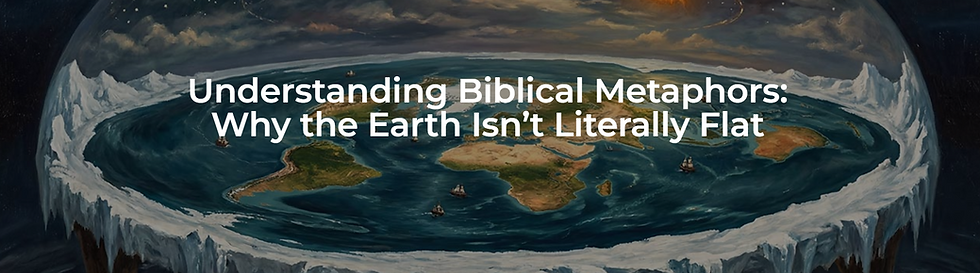
many "Christians" commented about him being a liar and that any talk of space existing was fake. Many of these sincere folk adamantly believe that the Earth is flat. This is because there are verses in Scripture saying that the Earth has foundations and pillars. There are also verses saying that the Earth cannot be moved. That means that any talk of it being round or moving through space is a conspiratorial lie.
For those who believe that those verses can only mean that we are on a flat Earth sitting on an unmovable foundation, here’s an experiment. See if you can move the Earth by jumping on it or somehow pushing it. It can’t be moved, just as the Bible says.
“Examples of biblical metaphors include Jesus saying that He was the door (John 10:9), that He was bread (John 6:35), and that He was a grapevine (John 15:1). Other metaphors in the Bible are seen where God calls the earth His footstool (Isaiah 66:1) and where the Bible says God is the Rock (Deuteronomy 32:4).”
The verses regarding pillars and foundations are clearly metaphoric. For those who may not know, a metaphor is a figure of speech that makes a comparison between two unlike things, often by stating that one thing is actually another, rather than using the word “like.”
“The world is a stage” is a metaphor. It expresses the idea that life is like a theatrical play, where people are actors playing different roles. This concept is articulated by William Shakespeare in As You Like It:
“All the world’s a stage, And all the men and women merely players; They have their exits and their entrances; And one man in his time plays many parts…”
This means that life consists of different phases, much like scenes in a play. People adopt various roles throughout life—such as child, parent, worker, or leader—often influenced by circumstances beyond their control. It also suggests that much of human behavior is performance-like, shaped by societal expectations.
Examples of biblical metaphors include Jesus saying that He was the door (John 10:9), that He was bread (John 6:35), and that He was a grapevine (John 15:1). Other metaphors in the Bible are seen where God calls the earth His footstool (Isaiah 66:1) and where the Bible says God is the Rock (Deuteronomy 32:4).
The earth isn’t an actual footstool upon which God rests His feet. Neither is our Creator made of rock. Nor is Jesus a physical door that has hinges and opens and closes. He is not made of bread, nor is He an actual grapevine. These are obviously metaphorical statements, and so are the verses about the Earth having actual pillars and foundations.
This wouldn’t be an issue if those who take these verses literally kept their beliefs to themselves. But many don’t. They insist on shouting it from the housetops—as though a flat Earth was the central doctrine of the gospel of salvation. How, then, can we expect an unbelieving world to trust in Jesus when they hear that the Earth is pancake flat and sits on super strong and massively heavy pillars that sit on nothing? And if the pillars sit on an enormously large foundation, what does that sit on? Such irrational beliefs make the Bible believer look like a fool, in the same category as someone who believes that the moon is made of cheese. And if you do think the moon is made of cheese, please keep it to yourself.

THE FLAT EARTH DOCTRINE MAKES CHRISTIANS LOOK FOOLISH:
I’m going to say this plainly.
Flat earth isn’t biblical.
It isn’t scientific.
It isn’t hidden wisdom.
It’s bad interpretation wrapped in conspiracy thinking, and Christians need to stop dragging the Bible into it.
The Bible isn’t the problem. Bad Bible handling is the problem.
God’s Word doesn’t need help from YouTube prophets, TikTok mathematicians, or men who think every pilot, sailor, astronomer, navigator, surveyor, airline company, shipping route, eclipse calculation, time zone, and weather system on earth is secretly part of one giant lie.
That isn’t discernment.
The earth is a sphere, more precisely an oblate spheroid, slightly wider at the equator because it rotates. This isn’t new information. Eratosthenes calculated the earth’s circumference more than 2,000 years ago using shadows, angles, and basic geometry.
The math isn’t complicated.
The earth’s circumference is about 24,901 miles.
There are 360 degrees in a circle.
24,901 ÷ 360 = about 69.17 miles per degree.
That means if you travel north or south about 69 miles, the stars shift by about one degree in the sky.
And that’s exactly what happens.
Polaris gets higher as you travel north and lower as you travel south.
On a flat earth, that falls apart.
Time zones destroy flat earth too.
The earth rotates once every 24 hours.
360 degrees ÷ 24 hours = 15 degrees per hour.
That’s why the sun rises and sets at different times across the world. It’s rotation. It’s measurable. It’s predictable.
The horizon also proves curvature.
A simple approximation is:
Distance to horizon in miles = 1.22 × √height in feet
If your eyes are 6 feet above sea level:
√6 = 2.45
2.45 × 1.22 = about 3 miles
That means your horizon is roughly 3 miles away.
Climb higher, and you see farther.
That’s why ships disappear bottom-first. That’s why mountains become visible from higher elevations. That’s why pilots see farther than people standing on the beach.
Flat earth can’t explain that without inventing nonsense.
The curve drop is simple too.
A rough formula is:
8 inches per mile squared
At 1 mile: about 8 inches.
At 10 miles: about 800 inches, which is about 66 feet.
At 20 miles: about 3,200 inches, which is about 267 feet.
Yes, atmospheric refraction can bend light and slightly change what you see near the horizon. But refraction doesn’t erase the globe. It’s just another measurable part of the world God made.
Then there are eclipses.
A lunar eclipse happens when the earth passes between the sun and the moon. The earth’s shadow on the moon is always round.
Every time.
From every angle.
A flat disc doesn’t always cast a round shadow.
A sphere does.
Then there are the stars.
In the northern hemisphere, stars rotate around Polaris.
In the southern hemisphere, they rotate around the southern celestial pole.
Different constellations are visible in different parts of the world. Australia doesn’t see the sky the same way Alaska does.
That makes perfect sense on a globe.
It makes no sense on a flat pizza map.
Flight routes also destroy it.
Southern hemisphere flights make sense on a globe. They become ridiculous on most flat earth maps. Shipping lanes, GPS, military navigation, airline fuel planning, satellite communication, weather tracking, undersea cable mapping, and long-distance surveying all operate on globe math every single day.
Flat earth only survives by saying everybody is lying. That isn’t an argument.
Now let’s talk about the Great Pyramid of Giza, because this is where flat earthers really step on their own rake.
The Great Pyramid is incredible. No serious person has to deny that.
Its original height was about 481 feet, and its base was roughly 756 feet per side, giving it a base perimeter around 3,024 feet.
Now watch the math.
Base perimeter: about 3,024 feet
Original height: about 481 feet
3,024 ÷ 481 = about 6.28
And 2π = 6.28318
That means the pyramid’s perimeter-to-height ratio is extremely close to 2π.
Why is that interesting?
Because the circumference of a circle divided by its radius is 2π.
So if the pyramid’s perimeter represents a circumference, then the pyramid’s height represents a radius..That’s a globe.
The scale factor often discussed with the Great Pyramid is 43,200.
43,200.
Take the pyramid’s base perimeter:
3,024 feet × 43,200 = 130,636,800 feet
Now divide by feet in a mile:
130,636,800 ÷ 5,280 = about 24,742 miles
The earth’s equatorial circumference is about 24,901 miles.
That’s very, very close..
Now take the pyramid’s height:
481 feet × 43,200 = 20,779,200 feet
Divide by 5,280:
20,779,200 ÷ 5,280 = about 3,935 miles
The earth’s polar radius is about 3,950 miles.
Again, very close.
The Great Pyramid is actually giving us a globe, and it's math. Pretty interesting...
If the builders encoded earth measurements into the pyramid, they weren’t encoding a dinner plate.
They were encoding geometry that lines up with a globe.
Don’t bring the Great Pyramid to a flat earth fight.
It betrays you.
It testifies for the globe.
Now let’s deal with the Bible verses..
Flat earthers love to say, “The Bible says four corners of the earth.”
Yes, it does.
Isaiah 11:12 says:
“And gather together the dispersed of Judah from the four corners of the earth.”
That’s an idiom.
We still say sunrise, sunset, the ends of the earth, and the four corners of the world.
Nobody thinks the earth has literal corners.
It’s normal human language.
Revelation 7:1 says angels stand on the “four corners of the earth,” holding the “four winds.”
Fine. Then be consistent.
If “four corners” means a literal square earth, then “four winds” must mean only four literal winds exist.
Nobody actually reads it that way because the language is symbolic and directional.
North.
South.
East.
West.
Then they bring up “the circle of the earth.”
Isaiah 40:22 says:
“It is he that sitteth upon the circle of the earth…”
The Hebrew word is חוּג - chug. It can carry the idea of a circle, circuit, horizon, or compass.
Flat earthers say, “See, a circle is flat.”
But Isaiah isn’t giving a geometry lecture. He’s describing God enthroned above the earth in majestic language.
And there’s a simple answer they ignore.
From a distance, a sphere presents as a circle.
Look at the moon. It appears as a circle, but it’s a sphere.
Calling something a circle doesn’t prove a flat disc.
Then they bring up the firmament.
Genesis 1:6 says:
“And God said, Let there be a firmament in the midst of the waters…”
The Hebrew word is רָקִיעַ - raqia.
It carries the idea of something spread out, stretched out, or extended. English translations handle it differently: firmament, expanse, sky, or heavens.
But Genesis 1 isn’t teaching that we live under a metal snow globe.
The same chapter says God put lights in the firmament of heaven for signs, seasons, days, and years.
Genesis 1:14 says:
“And God said, Let there be lights in the firmament of the heaven to divide the day from the night…”
Then they bring up “foundations of the earth.”
Psalm 104:5 says:
“Who laid the foundations of the earth, that it should not be removed for ever.”
This isn’t saying the earth is sitting on concrete footings floating in space.
God founded the earth.
God established the earth.
God governs creation.
The same poetic books say mountains skip like rams, floods clap their hands, trees rejoice, and wisdom cries in the streets.
You don’t read poetry like a shop manual.
Then they bring up pillars.
Job 9:6 says:
“Which shakes the earth out of her place, and the pillars thereof tremble.”
So where are these literal pillars?
What are they made of?
Who drilled into one?
The point is obvious. Scripture uses poetic, observational, and symbolic language. God speaks to man in language man can understand.
Then they bring up “ends of the earth.”
Acts 1:8 says:
“…and unto the uttermost part of the earth.”
Jesus wasn’t teaching geography has a hard edge people could fall off. He was commanding global witness.
The Gospel goes to all nations.
Not to the lip of a plate.
Then they try Matthew 4, where Satan shows Jesus “all the kingdoms of the world.”
Matthew 4:8 says:
“Again, the devil taketh him up into an exceeding high mountain, and sheweth him all the kingdoms of the world…”
Flat earthers say, “See? You could only see all kingdoms from a high mountain if the earth were flat.”
No. Just no.
That was a supernatural temptation involving Satan showing Christ the kingdoms of the world and the glory of them. There’s no mountain tall enough on any model, flat or globe, where you can physically see every kingdom on earth with your eyeballs.
Then they run to Greek words.
They’ll mention γῆ - ge, meaning earth, land, or ground.
They’ll mention οἰκουμένη - oikoumene, meaning the inhabited world.
They’ll mention κόσμος - kosmos, meaning world, order, or world-system.
None of those words teach flat earth.
They describe land, the inhabited world, mankind, or the ordered world depending on context.
Greek doesn’t rescue flat earth.
Hebrew doesn’t rescue flat earth.
Bad interpretation creates flat earth, then goes hunting for verses to baptize it.
That’s backwards.
The Bible is true.
Flat earth is not.
Christians need to be careful here because when we attach foolish claims to Scripture, unbelievers don’t only laugh at the claim. They laugh at the Bible we stapled it to.
That’s the problem.
When we make the Bible say something it doesn’t say, then defend it like doctrine, we hand mockers free ammunition.
The Gospel is already offensive enough to the natural man.
Christ crucified is already a stumblingblock.
The resurrection is already supernatural.
The virgin birth is already miraculous.
Creation itself already points to the living God.
We don’t need fake science and bad exegesis added to the pile.
The Bible never commands me to believe the earth is flat.
It commands me to believe Jesus Christ died for sinners, was buried, rose again the third day, and is coming again.
That’s where I’m planting my flag.
On Christ.
Not a YouTube map.
Not a fake dome.
Not a conspiracy chart.
Here’s the final nail:
The math doesn’t support flat earth.
Navigation doesn’t support flat earth.
The stars don’t support flat earth.
Eclipses don’t support flat earth.
Time zones don’t support flat earth.
Flight routes don’t support flat earth.
The Great Pyramid doesn’t support flat earth.
Hebrew doesn’t support flat earth.
Greek doesn’t support flat earth.
And the Bible doesn’t support flat earth.
God made the heavens and the earth.
That should make us worship Him deeper, not twist His Word into nonsense.
Christians should be the clearest thinkers in the room because we know the Author of truth.
So let’s stop making the faith look foolish.
Believe the Bible.
Handle it rightly.
Preach Christ.
Leave the pancake earth in the trash where it belongs.


Comments