

Tithing: What the Bible actually says
- crossroadscaloundr
- Mar 18
- 5 min read
Updated: Jun 7

Tithing: (What The Bible Actually Says)
Tithing is one of the most misunderstood topics in the church today.
Some pastors teach that if you give 10% God will make you wealthy.
Others claim tithing was only for Israel and Christians should ignore it completely.
Both positions usually leave out huge portions of Scripture.
So let’s walk through the full biblical picture.
Ft, the word tithe literally means “a tenth.”
In Hebrew the word is ma'aser, which simply means a tenth portion set apart.
But the important question is not what the word means.
The real question is how the Bible actually used it.
Tithing appears in Scripture before the Law, but it was not a commanded system yet.
Abraham gave a tenth to Melchizedek after rescuing Lot.
Genesis 14:20 says, “And he gave him tithes of all.”
But this was a voluntary act. It was not commanded,
and Scripture never records Abraham practicing a lifelong mandatory ten percent system.
Later Jacob made a vow.
Genesis 28:22 “Of all that You give me I will surely give a tenth to You.”
Again, this was voluntary. It was not a command for all people.the becomes an official system under the Mosaic Law, when Israel becomes a covenant nation.
At this point the tithe functioned almost like a national support system.
It supported the priesthood, funded worship festivals, and provided for the poor.
And here is something many people do not realize.
Israel did not just have one tithe. They had multiple tithes.
Numbers 18 explains the tithe given to the Levites, because the tribe of Levi did not receive land like the other tribes.
Deuteronomy 14 describes another tithe used for the national worship festivals in Jerusalem.
Then every third year another tithe was stored locally to care for widows, orphans, foreigners, and the poor.
When you add them all together, Israel was not giving ten percent.
Many scholars estimate it was closer to twenty to twenty-three percent.
It functioned very much like a national taxation system for Israel's covenant nation.
Now fast forward to the passage most often quoted in churches.
Malachi 3. “Will a man rob God? Yet you have robbed Me… in tithes and offerings.”
This verse is constantly used to pressure Christians. But look at the context.
God is speaking to Israel under the Law, rebuking priests and the nation for breaking the covenant.
The promise of blessing tied to that tithe was connected to Israel’s covenant relationship with the land.
It was never given as a universal promise that if you give money God will make you rich.
That idea is the foundation of the prosperity gospel, and it twists Scripture.
Jesus did mention tithing, but notice the context again.
Matthew 23:23 “You tithe mint and dill and cumin, and have neglected the weightier matters of the law: justice, mercy, and faithfulness.”
Jesus was speaking to Pharisees who were still living under the Law.
His issue was not the tithe. His issue was their hypocrisy.
They carefully counted their herbs but ignored justice, mercy, and faith.
Then the cross happens.
And something changes.
The New Testament never commands Christians to tithe.
Instead, it teaches something deeper. Generous giving.
2 Corinthians 9:7 says, “Each one must give as he has decided in his heart, not reluctantly or under compulsion, for God loves a cheerful giver.”
Notice the difference. Not pressure, manipulation, or religious tax, but a willing heart.
The New Testament still teaches that ministry should be supported.
Galatians 6:6 says the one who is taught the Word should share with the one who teaches.
1 Timothy 5:18 say's “The labourer deserves his wages.”
And believers are also called to care for the poor.
In Acts 4 we read that the early church shared so freely that there were no needy people among them.
In fact, New Testament generosity often went beyond ten percent, because it flowed from love instead of obligation.
This is where the prosperity gospel completely misses the point.
Some teachers say, “Sow your seed and God will multiply your money.”
But Scripture warns about people who treat godliness as a way to get rich.
1 Timothy 6:5 warns about those who think faith is a means of financial gain.
That is not the heart of biblical giving.
Giving is worship. Giving is gratitude.
Giving is recognizing that everything we have already belongs to God.
Psalm 24:1 says, “The earth is the Lord’s, and everything in it.”
So the real question for Christians today is not,
“How little am I required to give?”
The real question is, “How can I honour God with what He has entrusted to me?”
Tithing was part of Israel’s covenant system.
Christian giving is something deeper.
It is generosity flowing from grace.
And when giving flows from a heart that truly understands the Gospel,
it stops being about percentages and starts being about worship.








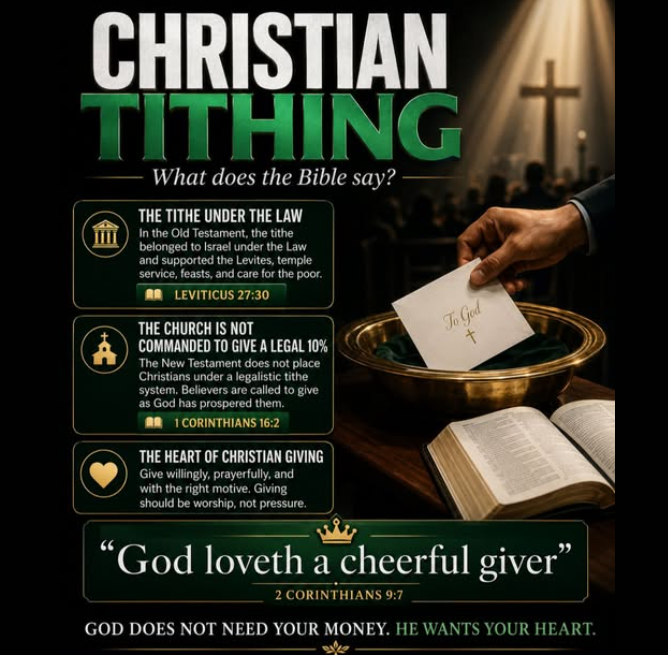
WHAT DOES THE BIBLE SAY ABOUT TITHING?
A lot of Christians get this wrong.
Some churches hammer giving so hard it turns into pressure, guilt, and manipulation. Then on the other side, some Christians use that abuse as an excuse to ignore giving altogether.
Both are wrong.
The tithe was an Old Testament command under the Law. Israel gave a tenth of crops and livestock for the support of the tabernacle, the temple, the Levites, the feasts, and care for the poor.
Leviticus 27:30 says:
“And all the tithe of the land… is the LORD’S: it is holy unto the LORD.”
That was Israel under the Law.
But Christians are not Israel under the Mosaic covenant.
Jesus Christ fulfilled the Law. We are under grace, not under the old covenant system.
That means the New Testament never commands the Church to pay a legal ten percent tithe like Israel did. You will not find Paul telling the Body of Christ, “You must give exactly ten percent or you are robbing God.”
Christian giving is willing, purposeful, worshipful, and tied to the heart.
1 Corinthians 16:2 says:
“Upon the first day of the week let every one of you lay by him in store, as God hath prospered him…”
That means giving should be according to how God has prospered you. Not fake, forced, and not for show.
Then 2 Corinthians 9:7 gives the heart of New Testament giving..
“Every man according as he purposed in his heart, so let him give; not grudgingly, or of necessity: for God loveth a cheerful giver.”
There it is.
Not grudgingly, or under compulsion.
Not because a preacher squeezed you.
Not because somebody made you feel cursed if you did not hit a number.
Give because you love the Lord. Give because the work of the ministry needs support. Give because the body of Christ has real needs. Give because everything you have came from God anyway.
For some believers, giving ten percent may be a good starting point. For others, there may be seasons where they cannot give that much. For others, they may be able to give far more.
The issue is not a percentage.
The issue is the heart before God.
A greedy Christian hiding behind “we are not under the tithe” still has a problem.
A church using the tithe like a spiritual bill collector also has a problem.
New Testament giving is not legalism, and it is not laziness.
It is grace working through a generous heart.
Pray. Be honest before God. Take care of your responsibilities. Support sound ministry. Help real needs. Give as God has prospered you.
And do it with worship, not pressure.
Because God does not need your money.
He wants your heart.


Wonderful insights... Appreciate the truthful teachings from you... Amen!!!