

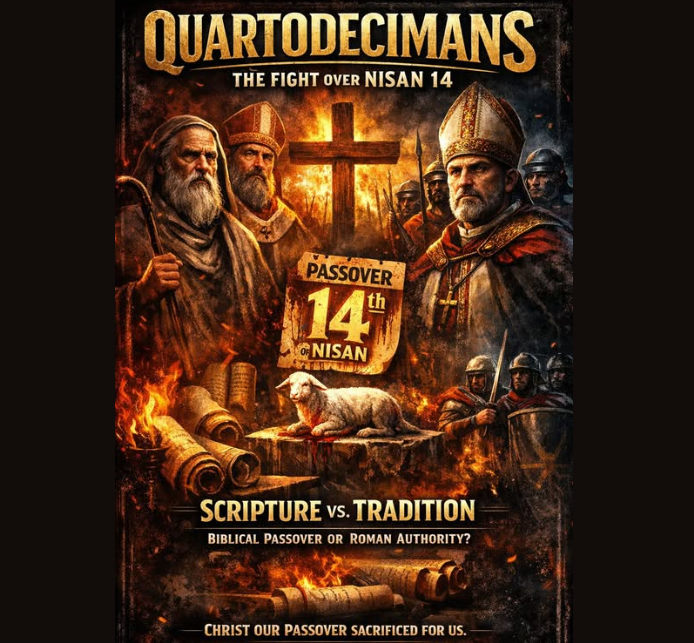
QUARTODECIMANS: (THE EARLY CHURCH FIGHT OVER THE 14TH OF NISAN)
- crossroadscaloundr
- Apr 1
- 3 min read
Updated: Apr 4
Most Christians have never heard of the Quartodecimans, but this was not some tiny church argument over nothing. This was one of the earliest major controversies in post-apostolic Christianity, and it centered on a serious question: Should the church remember Christ’s Passover on the actual biblical date of Passover, Nisan 14, or should it move the observance to Sunday?
The word Quartodeciman comes from the Latin for “fourteenth.” That is why some people call it “14ism.” These were believers who kept the Christian Pascha on Nisan 14, the date of Passover, because they believed Christ fulfilled Passover and that the observance should stay tied to that date.
That issue matters more than people think.
This was not originally a denial of the death, burial, or resurrection of Christ. Both sides believed those things. The argument was over timing, authority, and faithfulness to what had been received.
The Quartodecimans, especially in Asia Minor, believed they were preserving an apostolic tradition. Men like Polycarp and later Polycrates defended the practice and said it had come down from earlier apostolic figures, especially John and Philip. Their argument was not, “We like this better.” Their argument was, “This is what we received, and we are not changing it just because Rome says so.”
A lot of church history gets taught like the early church was one smooth, unified stream that gradually developed with no real cracks. That is fantasy. The early church had real disputes, and this was one of them. It exposed tension between regional apostolic claims and growing centralized pressure.
One of the most important moments came when Polycarp met with Anicetus in Rome. They disagreed on the date of Pascha, but they did not break fellowship. Think about that. The disagreement was real, but it had not yet become an all-out fracture.
Later, that changed.
Victor of Rome took a much harder line and tried to force conformity. When the Asian churches refused to abandon the 14th-day observance, he moved to cut them off. Irenaeus stepped in and rebuked that severity, reminding him that earlier leaders had not treated the matter that way.
That is the bigger issue.
This stopped being just a date on a calendar and became a fight over who had the right to define the practice of the churches.
And biblically, you can see exactly why the Quartodecimans stood where they stood.
Paul says in 1 Corinthians 5:7, “For even Christ our passover is sacrificed for us.”
Christ is the fulfillment of Passover. The lamb pointed to Him. The blood pointed to Him. Deliverance through judgment pointed to Him. The whole Exodus pattern finds its fulfillment in Christ. So the instinct to keep the remembrance tied to Passover itself, on Nisan 14, was not weird. It was not random. It was rooted in the actual biblical framework.
Now to be fair, the other side had an argument too.
Christ rose on the first day of the week, and Sunday already had importance in Christian worship. So many believers argued that the observance should be tied to the resurrection day rather than the Passover date. Over time, that view became dominant.
But do not miss what this proves.
The Quartodecimans were not some fringe cult inventing nonsense out in the woods. They were early believers with serious historical roots, and they were convinced that they were holding to a tradition received from apostolic men. That means the history is not nearly as clean as a lot of people pretend.
And it also forces a question that still stings:
What happens when church tradition starts drifting away from the biblical calendar framework that gave the original event its meaning?
Because that is really what this controversy exposes.
It exposes the pressure to move from a biblical Passover framework into a broader church-controlled system of observance. It exposes the battle between what was claimed as received tradition and what was being enforced for uniformity. And it reminds us that very early on, the post-apostolic church was already wrestling with the tension between Scripture, tradition, and institutional control.
So the bottom line is this:
The Quartodecimans were early Christians who observed Pascha on Nisan 14 because Christ is our Passover. The controversy over that practice was not minor. It revealed a deeper struggle over authority, tradition, and whether the church would stay tied to the biblical Passover framework or move toward a different pattern.
That is why this still matters.
Because once you see that some of the earliest believers wanted the remembrance of Christ’s death anchored to the very date Passover pointed to, you start realizing this was never just about a calendar.
It was about who gets to define faithfulness.
1 Corinthians 5:7
“For even Christ our Passover is sacrificed for us.”
If Christ is our Passover, then it is not hard to understand why some of the earliest believers insisted on keeping that remembrance on the 14th.


Comments