

More about Iran (Persia / Elam)
- crossroadscaloundr
- Apr 21
- 35 min read
Updated: Jun 15
Why is it so important to stay update on this:
1)The fake / false media in the West is working overtime to blame Israel &
to make it look like the US is losing.
2) Iran is important in Biblical prophecy & narratives regarding past, present & future.

𝟒𝟕 𝐘𝐄𝐀𝐑𝐒 𝐎𝐅 𝐈𝐑𝐀𝐍𝐈𝐀𝐍 𝐓𝐄𝐑𝐑𝐎𝐑 𝐀𝐑𝐄 𝐄𝐍𝐃𝐈𝐍𝐆 𝐈𝐍 𝟏𝟒 𝐏𝐎𝐈𝐍𝐓𝐒. 𝐀𝐗𝐈𝐎𝐒 𝐑𝐄𝐏𝐎𝐑𝐓𝐒 𝐀 𝐔.𝐒.-𝐈𝐑𝐀𝐍 𝐌𝐎𝐔 𝐂𝐎𝐔𝐋𝐃 𝐁𝐄 𝐒𝐈𝐆𝐍𝐄𝐃 𝐖𝐈𝐓𝐇𝐈𝐍 𝟒𝟖 𝐇𝐎𝐔𝐑𝐒 𝐖𝐈𝐓𝐇 𝐀𝐍 𝐄𝐍𝐑𝐈𝐂𝐇𝐌𝐄𝐍𝐓 𝐌𝐎𝐑𝐀𝐓𝐎𝐑𝐈𝐔𝐌 𝐀𝐍𝐃 𝐓𝐇𝐄 𝐒𝐓𝐑𝐀𝐈𝐓 𝐎𝐅 𝐇𝐎𝐑𝐌𝐔𝐙 𝐑𝐄𝐎𝐏𝐄𝐍𝐈𝐍𝐆. 𝐄𝐈𝐆𝐇𝐓 𝐀𝐌𝐄𝐑𝐈𝐂𝐀𝐍 𝐏𝐑𝐄𝐒𝐈𝐃𝐄𝐍𝐓𝐒 𝐂𝐎𝐔𝐋𝐃𝐍’𝐓 𝐃𝐎 𝐓𝐇𝐈𝐒. 𝐓𝐑𝐔𝐌𝐏 𝐃𝐈𝐃 𝐈𝐓 𝐈𝐍 𝟔𝟕 𝐃𝐀𝐘𝐒.
Yesterday, Fox News’ Trey Yingst confirmed 𝐀𝐱𝐢𝐨𝐬 𝐫𝐞𝐩𝐨𝐫𝐭𝐢𝐧𝐠 that a 14-point U.S.-Iran Memorandum of Understanding could be reached within 48 hours — including an enrichment moratorium and the eventual reopening of the Strait of Hormuz. Energy Secretary Chris Wright told the cameras: “𝘞𝘩𝘢𝘵 𝘵𝘩𝘦 𝘐𝘳𝘢𝘯𝘪𝘢𝘯𝘴 𝘴𝘢𝘸 𝘸𝘪𝘵𝘩 𝘗𝘳𝘰𝘫𝘦𝘤𝘵 𝘍𝘳𝘦𝘦𝘥𝘰𝘮 𝘪𝘴 𝘰𝘯𝘦 𝘸𝘢𝘺 𝘰𝘳 𝘵𝘩𝘦 𝘰𝘵𝘩𝘦𝘳, 𝘵𝘩𝘦 𝘜𝘯𝘪𝘵𝘦𝘥 𝘚𝘵𝘢𝘵𝘦𝘴 𝘪𝘴 𝘨𝘰𝘪𝘯𝘨 𝘵𝘰 𝘩𝘢𝘷𝘦 𝘧𝘳𝘦𝘦 𝘧𝘭𝘰𝘸 𝘰𝘧 𝘵𝘳𝘢𝘧𝘧𝘪𝘤 𝘵𝘩𝘳𝘰𝘶𝘨𝘩 𝘵𝘩𝘦 𝘚𝘵𝘳𝘢𝘪𝘵 𝘰𝘧 𝘏𝘰𝘳𝘮𝘶𝘻. 𝘞𝘪𝘵𝘩 𝘰𝘳 𝘸𝘪𝘵𝘩𝘰𝘶𝘵 𝘐𝘳𝘢𝘯’𝘴 𝘢𝘨𝘳𝘦𝘦𝘮𝘦𝘯𝘵.” 𝐈𝐫𝐚𝐧 𝐡𝐚𝐬 𝐧𝐨𝐰 𝐫𝐞𝐚𝐥𝐢𝐳𝐞𝐝 𝐢𝐭 𝐡𝐚𝐬 𝐧𝐨 𝐫𝐞𝐦𝐚𝐢𝐧𝐢𝐧𝐠 𝐥𝐞𝐯𝐞𝐫𝐚𝐠𝐞. 𝐓𝐡𝐞 𝐫𝐞𝐠𝐢𝐦𝐞 𝐢𝐬 𝐦𝐚𝐧𝐚𝐠𝐢𝐧𝐠 𝐢𝐭𝐬 𝐨𝐰𝐧 𝐬𝐮𝐫𝐫𝐞𝐧𝐝𝐞𝐫.
𝐓𝐨 𝐮𝐧𝐝𝐞𝐫𝐬𝐭𝐚𝐧𝐝 𝐰𝐡𝐚𝐭 𝐣𝐮𝐬𝐭 𝐡𝐚𝐩𝐩𝐞𝐧𝐞𝐝, 𝐰𝐚𝐥𝐤 𝐢𝐭 𝐛𝐚𝐜𝐤 𝐭𝐡𝐫𝐨𝐮𝐠𝐡 𝟒𝟕 𝐲𝐞𝐚𝐫𝐬 𝐨𝐟 𝐈𝐫𝐚𝐧𝐢𝐚𝐧-𝐀𝐦𝐞𝐫𝐢𝐜𝐚𝐧 𝐡𝐨𝐬𝐭𝐢𝐥𝐢𝐭𝐲.
𝐍𝐎𝐕𝐄𝐌𝐁𝐄𝐑 𝟒, 𝟏𝟗𝟕𝟗 — 𝐓𝐇𝐄 𝐁𝐄𝐆𝐈𝐍𝐍𝐈𝐍𝐆. Iranian revolutionary students stormed the U.S. Embassy in Tehran and took 52 American diplomats hostage. They held them for 444 days. The Iranian regime founded its national identity on the chant “𝘋𝘦𝘢𝘵𝘩 𝘵𝘰 𝘈𝘮𝘦𝘳𝘪𝘤𝘢”. 𝐓𝐡𝐞 𝐂𝐚𝐫𝐭𝐞𝐫 𝐚𝐝𝐦𝐢𝐧𝐢𝐬𝐭𝐫𝐚𝐭𝐢𝐨𝐧 𝐫𝐞𝐬𝐩𝐨𝐧𝐝𝐞𝐝 𝐰𝐢𝐭𝐡 𝐚 𝐟𝐚𝐢𝐥𝐞𝐝 𝐡𝐞𝐥𝐢𝐜𝐨𝐩𝐭𝐞𝐫 𝐫𝐞𝐬𝐜𝐮𝐞 𝐚𝐧𝐝 𝟏𝟒 𝐦𝐨𝐧𝐭𝐡𝐬 𝐨𝐟 𝐢𝐦𝐩𝐨𝐭𝐞𝐧𝐭 𝐝𝐢𝐩𝐥𝐨𝐦𝐚𝐜𝐲. The hostages were finally released on January 20, 1981 — minutes after Reagan was sworn in. The regime had taken Carter’s measure. Carter was finished.
𝐎𝐂𝐓𝐎𝐁𝐄𝐑 𝟐𝟑, 𝟏𝟗𝟖𝟑 — 𝐁𝐄𝐈𝐑𝐔𝐓. An IRGC-trained, IRGC-funded Hezbollah suicide bomber drove a truck packed with 12,000 pounds of explosives into the U.S. Marine barracks in Beirut. 𝟐𝟒𝟏 𝐀𝐦𝐞𝐫𝐢𝐜𝐚𝐧 𝐬𝐞𝐫𝐯𝐢𝐜𝐞𝐦𝐞𝐧 𝐰𝐞𝐫𝐞 𝐤!𝐥𝐥𝐞𝐝 𝐢𝐧 𝐭𝐡𝐞𝐢𝐫 𝐬𝐥𝐞𝐞𝐩. It remains the deadliest single-day attack on the U.S. military since Iwo Jima. Reagan responded with a naval bombardment of Druze positions. He never punished Iran. 𝐓𝐡𝐞 𝐫𝐞𝐠𝐢𝐦𝐞 𝐜𝐨𝐧𝐜𝐥𝐮𝐝𝐞𝐝 𝐭𝐡𝐚𝐭 𝐀𝐦𝐞𝐫𝐢𝐜𝐚𝐧 𝐛𝐥𝐨𝐨𝐝 𝐰𝐚𝐬 𝐧𝐞𝐠𝐨𝐭𝐢𝐚𝐛𝐥𝐞. 𝐓𝐡𝐞𝐲 𝐰𝐞𝐫𝐞 𝐫𝐢𝐠𝐡𝐭 𝐟𝐨𝐫 𝐭𝐡𝐞 𝐧𝐞𝐱𝐭 𝟒𝟎 𝐲𝐞𝐚𝐫𝐬.
𝐉𝐔𝐍𝐄 𝟐𝟓, 𝟏𝟗𝟗𝟔 — 𝐊𝐇𝐎𝐁𝐀𝐑 𝐓𝐎𝐖𝐄𝐑𝐒. IRGC operatives bombed the U.S. Air Force housing complex at Khobar Towers in Saudi Arabia. 𝟏𝟗 𝐀𝐦𝐞𝐫𝐢𝐜𝐚𝐧 𝐬𝐞𝐫𝐯𝐢𝐜𝐞𝐦𝐞𝐧 𝐰𝐞𝐫𝐞 𝐤!𝐥𝐥𝐞𝐝. The Clinton administration knew within months that the Iranian regime had ordered the attack. They chose not to act. 𝐁𝐢𝐥𝐥 𝐂𝐥𝐢𝐧𝐭𝐨𝐧 𝐬𝐞𝐧𝐭 𝐩𝐫𝐨𝐬𝐞𝐜𝐮𝐭𝐨𝐫𝐬 𝐭𝐨 𝐨𝐛𝐭𝐚𝐢𝐧 𝐚 𝟐𝟎𝟎𝟏 𝐢𝐧𝐝𝐢𝐜𝐭𝐦𝐞𝐧𝐭. 𝐇𝐞 𝐧𝐞𝐯𝐞𝐫 𝐚𝐮𝐭𝐡𝐨𝐫𝐢𝐳𝐞𝐝 𝐚 𝐦𝐢𝐥𝐢𝐭𝐚𝐫𝐲 𝐫𝐞𝐬𝐩𝐨𝐧𝐬𝐞. Iran’s reading of American resolve hardened.
𝟐𝟎𝟎𝟑-𝟐𝟎𝟏𝟏 — 𝐓𝐇𝐄 𝐈𝐑𝐀𝐐 𝐊𝐈𝐋𝐋𝐈𝐍𝐆 𝐅𝐈𝐄𝐋𝐃𝐒. The IRGC’s Quds Force — under Qassem Soleimani — supplied the Shia militias of Iraq with the explosively-formed-penetrator (EFP) IEDs that punched through American Bradley armour. 𝐌𝐨𝐫𝐞 𝐭𝐡𝐚𝐧 𝟔𝟎𝟎 𝐀𝐦𝐞𝐫𝐢𝐜𝐚𝐧 𝐬𝐨𝐥𝐝𝐢𝐞𝐫𝐬 𝐰𝐞𝐫𝐞 𝐤!𝐥𝐥𝐞𝐝 𝐢𝐧 𝐈𝐫𝐚𝐪 𝐛𝐲 𝐈𝐫𝐚𝐧𝐢𝐚𝐧-𝐬𝐮𝐩𝐩𝐥𝐢𝐞𝐝 𝐰𝐞𝐚𝐩𝐨𝐧𝐬. Hundreds more in Afghanistan. The Bush and Obama administrations chose not to act. 𝐈𝐫𝐚𝐧 𝐫𝐚𝐧 𝐚 𝟏𝟎-𝐲𝐞𝐚𝐫 𝐜𝐚𝐦𝐩𝐚𝐢𝐠𝐧 𝐚𝐠𝐚𝐢𝐧𝐬𝐭 𝐔.𝐒. 𝐭𝐫𝐨𝐨𝐩𝐬 𝐨𝐧 𝐭𝐡𝐞 𝐛𝐚𝐭𝐭𝐥𝐞𝐟𝐢𝐞𝐥𝐝 𝐚𝐧𝐝 𝐭𝐡𝐞 𝐈𝐫𝐚𝐧𝐢𝐚𝐧 𝐫𝐞𝐠𝐢𝐦𝐞 𝐩𝐚𝐢𝐝 𝐧𝐨 𝐩𝐫𝐢𝐜𝐞.
𝐉𝐔𝐋𝐘 𝟏𝟒, 𝟐𝟎𝟏𝟓 — 𝐓𝐇𝐄 𝐎𝐁𝐀𝐌𝐀 𝐉𝐂𝐏𝐎𝐀. Barack Obama signed the Joint Comprehensive Plan of Action — the deal that unfroze tens of billions in Iranian assets, lifted U.N. sanctions, removed the U.S. embargo, and put a 10-year sunset on Iran’s nuclear constraints. 𝐓𝐡𝐞 𝐬𝐢𝐧𝐠𝐥𝐞 𝐥𝐚𝐫𝐠𝐞𝐬𝐭 𝐩𝐫𝐨-𝐈𝐫𝐚𝐧𝐢𝐚𝐧 𝐟𝐨𝐫𝐞𝐢𝐠𝐧-𝐩𝐨𝐥𝐢𝐜𝐲 𝐝𝐞𝐜𝐢𝐬𝐢𝐨𝐧 𝐬𝐢𝐧𝐜𝐞 𝐭𝐡𝐞 𝟏𝟗𝟕𝟗 𝐡𝐨𝐬𝐭𝐚𝐠𝐞 𝐜𝐫𝐢𝐬𝐢𝐬. Obama personally lobbied senior Senate Democrats to block congressional review. The deal funded the next decade of Iranian regional aggression — H∗zb∗llah expansion in Lebanon, the Houthi war in Yemen, the Iraqi militia takeover, the Syrian civil war intervention. 𝐄𝐯𝐞𝐫𝐲 𝐀𝐦𝐞𝐫𝐢𝐜𝐚𝐧 𝐜𝐚𝐬𝐮𝐚𝐥𝐭𝐲 𝐈𝐫𝐚𝐧 𝐜𝐚𝐮𝐬𝐞𝐝 𝐛𝐞𝐭𝐰𝐞𝐞𝐧 𝟐𝟎𝟏𝟓 𝐚𝐧𝐝 𝟐𝟎𝟐𝟓 𝐰𝐚𝐬 𝐩𝐚𝐢𝐝 𝐟𝐨𝐫 𝐰𝐢𝐭𝐡 𝐭𝐡𝐞 𝐜𝐚𝐬𝐡 𝐎𝐛𝐚𝐦𝐚 𝐮𝐧𝐟𝐫𝐨𝐳𝐞.
𝐌𝐀𝐘 𝟖, 𝟐𝟎𝟏𝟖 — 𝐓𝐑𝐔𝐌𝐏 𝐖𝐈𝐓𝐇𝐃𝐑𝐀𝐖𝐒. Trump withdrew the United States from the JCPOA in his first term and re-imposed the secondary sanctions Obama had lifted. The Iranian economy collapsed. The rial lost 90% of its value. The regime’s domestic protests began their first serious wave.
𝐉𝐀𝐍𝐔𝐀𝐑𝐘 𝟑, 𝟐𝟎𝟐𝟎 — 𝐒𝐎𝐋𝐄𝐈𝐌𝐀𝐍𝐈. Trump ordered the strike that killed Qassem Soleimani at Baghdad airport — the most consequential American military decapitation of an enemy commander since Yamamoto in 1943. 𝐈𝐫𝐚𝐧 𝐫𝐞𝐬𝐩𝐨𝐧𝐝𝐞𝐝 𝐰𝐢𝐭𝐡 𝐚 𝐦𝐢𝐬𝐬𝐢𝐥𝐞 𝐛𝐚𝐫𝐫𝐚𝐠𝐞 𝐚𝐭 𝐔.𝐒. 𝐟𝐨𝐫𝐜𝐞𝐬 𝐢𝐧 𝐈𝐫𝐚𝐪. 𝐍𝐨 𝐀𝐦𝐞𝐫𝐢𝐜𝐚𝐧𝐬 𝐰𝐞𝐫𝐞 𝐤!𝐥𝐥𝐞𝐝. 𝐓𝐫𝐮𝐦𝐩 𝐝𝐢𝐝 𝐧𝐨𝐭 𝐫𝐞𝐭𝐚𝐥𝐢𝐚𝐭𝐞 𝐟𝐮𝐫𝐭𝐡𝐞𝐫. 𝐓𝐡𝐞 𝐫𝐞𝐠𝐢𝐦𝐞 𝐮𝐧𝐝𝐞𝐫𝐬𝐭𝐨𝐨𝐝 𝐟𝐨𝐫 𝐭𝐡𝐞 𝐟𝐢𝐫𝐬𝐭 𝐭𝐢𝐦𝐞 𝐢𝐧 𝟒𝟏 𝐲𝐞𝐚𝐫𝐬 𝐭𝐡𝐚𝐭 𝐚𝐧 𝐀𝐦𝐞𝐫𝐢𝐜𝐚𝐧 𝐩𝐫𝐞𝐬𝐢𝐝𝐞𝐧𝐭 𝐜𝐨𝐮𝐥𝐝 𝐚𝐧𝐝 𝐰𝐨𝐮𝐥𝐝 𝐤!𝐥𝐥 𝐢𝐭𝐬 𝐭𝐨𝐩 𝐦𝐢𝐥𝐢𝐭𝐚𝐫𝐲 𝐨𝐟𝐟𝐢𝐜𝐞𝐫.
𝐎𝐂𝐓𝐎𝐁𝐄𝐑 𝟕, 𝟐𝟎𝟐𝟑 — 𝐓𝐇𝐄 𝐇∗𝐌∗𝐒 𝐀𝐓𝐓𝐀𝐂𝐊. Iran-funded Hamas slaughtered 1,200 Israeli civilians and took 250 hostages. Joe Biden — who had spent 2021-2023 unfreezing $6 billion in Iranian assets in a hostage deal and quietly resuming JCPOA-era engagement — issued condolences and called for restraint. 𝐈𝐫𝐚𝐧’𝐬 𝐬𝐭𝐫𝐚𝐭𝐞𝐠𝐢𝐜 𝐩𝐨𝐬𝐢𝐭𝐢𝐨𝐧 𝐰𝐚𝐬 𝐭𝐡𝐞 𝐬𝐭𝐫𝐨𝐧𝐠𝐞𝐬𝐭 𝐢𝐭 𝐡𝐚𝐝 𝐛𝐞𝐞𝐧 𝐬𝐢𝐧𝐜𝐞 𝟏𝟗𝟕𝟗.
𝐅𝐄𝐁𝐑𝐔𝐀𝐑𝐘 𝟐𝟖, 𝟐𝟎𝟐𝟔 — 𝐓𝐇𝐄 𝐖𝐀𝐑 𝐁𝐄𝐆𝐈𝐍𝐒. Operation Rising Lion. American and Israeli forces launch coordinated strikes against Iranian nuclear infrastructure, IRGC missile production, and the Iranian Navy. Within 40 days the Iranian military was destroyed. IRGC commander Hossein Salami was k!lled June 13, 2025 in the opening days. By Day 60, Iran had launched 2,800+ missiles and drones at the UAE, 1,500+ at Israel — 95% of which were intercepted. 𝐈𝐫𝐚𝐧’𝐬 𝐬𝐭𝐫𝐚𝐭𝐞𝐠𝐢𝐜 𝐭𝐡𝐫𝐞𝐚𝐭 𝐰𝐚𝐬 𝐫𝐞𝐝𝐮𝐜𝐞𝐝 𝐭𝐨 𝐬𝐦𝐚𝐥𝐥-𝐚𝐫𝐦𝐬 𝐡𝐚𝐫𝐚𝐬𝐬𝐦𝐞𝐧𝐭 𝐟𝐫𝐨𝐦 𝐫𝐮𝐛𝐛𝐞𝐫 𝐛𝐨𝐚𝐭𝐬.
𝐌𝐀𝐘 𝟓, 𝟐𝟎𝟐𝟔 — 𝐓𝐇𝐄 𝐁𝐋𝐎𝐂𝐊𝐀𝐃𝐄 𝐖𝐎𝐑𝐊𝐒. Project Freedom — the U.S. Navy’s safe-passage corridor through the Strait of Hormuz — escorts two American-flagged merchant ships under live fire. Six Iranian Mosquito Fleet boats are destroyed by Apache and Seahawk fire. 100+ allied vessels queue for safe passage. 𝐈𝐫𝐚𝐧’𝐬 𝐥𝐚𝐬𝐭 𝐥𝐞𝐯𝐞𝐫𝐚𝐠𝐞 𝐩𝐨𝐢𝐧𝐭 — 𝐭𝐡𝐞 𝐭𝐡𝐫𝐞𝐚𝐭 𝐨𝐟 𝐜𝐥𝐨𝐬𝐢𝐧𝐠 𝐭𝐡𝐞 𝐒𝐭𝐫𝐚𝐢𝐭 — 𝐞𝐯𝐚𝐩𝐨𝐫𝐚𝐭𝐞𝐬.
𝐌𝐀𝐘 𝟔, 𝟐𝟎𝟐𝟔 — 𝐓𝐇𝐄 𝐌𝐎𝐔. Axios reports a 14-point U.S.-Iran memorandum of understanding within 48 hours. Enrichment moratorium. Strait reopens. 30-day window to a broader deal. 𝐓𝐫𝐮𝐦𝐩 𝐩𝐚𝐮𝐬𝐞𝐬 𝐏𝐫𝐨𝐣𝐞𝐜𝐭 𝐅𝐫𝐞𝐞𝐝𝐨𝐦 𝐭𝐞𝐦𝐩𝐨𝐫𝐚𝐫𝐢𝐥𝐲 — 𝐧𝐨𝐭 𝐚𝐬 𝐜𝐨𝐧𝐜𝐞𝐬𝐬𝐢𝐨𝐧, 𝐛𝐮𝐭 𝐚𝐬 𝐨𝐟𝐟-𝐫𝐚𝐦𝐩. 𝐓𝐡𝐞 𝐛𝐥𝐨𝐜𝐤𝐚𝐝𝐞 𝐬𝐭𝐚𝐲𝐬. 𝐓𝐡𝐞 𝐫𝐞𝐠𝐢𝐦𝐞 𝐧𝐨𝐰 𝐝𝐞𝐜𝐢𝐝𝐞𝐬 𝐰𝐡𝐞𝐭𝐡𝐞𝐫 𝐭𝐨 𝐬𝐢𝐠𝐧 𝐨𝐫 𝐛𝐞 𝐝𝐞𝐬𝐭𝐫𝐨𝐲𝐞𝐝 𝐚𝐭 “𝐚 𝐦𝐮𝐜𝐡 𝐡𝐢𝐠𝐡𝐞𝐫 𝐥𝐞𝐯𝐞𝐥 𝐚𝐧𝐝 𝐢𝐧𝐭𝐞𝐧𝐬𝐢𝐭𝐲 𝐭𝐡𝐚𝐧 𝐛𝐞𝐟𝐨𝐫𝐞.”
𝐓𝐇𝐄 𝐑𝐄𝐂𝐄𝐈𝐏𝐓. Carter couldn’t end this. Reagan didn’t end it (Beirut). Bush 41 didn’t end it. Clinton wouldn’t end it (Khobar). Bush 43 didn’t end it (Iraq EFPs). Obama appeased it (JCPOA). Biden funded it ($6B). 𝐄𝐢𝐠𝐡𝐭 𝐀𝐦𝐞𝐫𝐢𝐜𝐚𝐧 𝐩𝐫𝐞𝐬𝐢𝐝𝐞𝐧𝐭𝐬 𝐨𝐯𝐞𝐫 𝟒𝟕 𝐲𝐞𝐚𝐫𝐬 𝐰𝐞𝐫𝐞 𝐭𝐞𝐬𝐭𝐞𝐝 𝐛𝐲 𝐭𝐡𝐞 𝐈𝐫𝐚𝐧𝐢𝐚𝐧 𝐫𝐞𝐠𝐢𝐦𝐞. 𝐄𝐢𝐠𝐡𝐭 𝐩𝐫𝐞𝐬𝐢𝐝𝐞𝐧𝐭𝐬 𝐥𝐨𝐬𝐭.
𝐓𝐫𝐮𝐦𝐩 𝐰𝐨𝐧. 𝐈𝐧 𝟔𝟕 𝐝𝐚𝐲𝐬.
𝐑𝐞𝐚𝐠𝐚𝐧 𝐞𝐧𝐝𝐞𝐝 𝐭𝐡𝐞 𝐒𝐨𝐯𝐢𝐞𝐭 𝐂𝐨𝐥𝐝 𝐖𝐚𝐫 𝐰𝐢𝐭𝐡 𝐚 𝐁𝐞𝐫𝐥𝐢𝐧 𝐬𝐩𝐞𝐞𝐜𝐡. The Berlin Wall fell two years later. Reagan never lived to see the full collapse. 𝐓𝐫𝐮𝐦𝐩 𝐢𝐬 𝐞𝐧𝐝𝐢𝐧𝐠 𝐭𝐡𝐞 𝐈𝐫𝐚𝐧𝐢𝐚𝐧 𝐂𝐨𝐥𝐝 𝐖𝐚𝐫 𝐰𝐢𝐭𝐡 𝐚 𝐨𝐧𝐞-𝐩𝐚𝐠𝐞 𝐦𝐞𝐦𝐨. The Strait reopens to Iranian shipping if the regime signs. The bombing resumes if it doesn’t. 𝟒𝟕 𝐲𝐞𝐚𝐫𝐬 𝐨𝐟 “𝐃𝐞𝐚𝐭𝐡 𝐭𝐨 𝐀𝐦𝐞𝐫𝐢𝐜𝐚” 𝐞𝐧𝐝𝐞𝐝 𝐛𝐲 𝐚𝐧 𝐀𝐦𝐞𝐫𝐢𝐜𝐚𝐧 𝐩𝐫𝐞𝐬𝐢𝐝𝐞𝐧𝐭 𝐰𝐡𝐨 𝐝𝐞𝐜𝐢𝐝𝐞𝐝 𝐭𝐡𝐞 𝐬𝐥𝐨𝐠𝐚𝐧 𝐰𝐚𝐬 𝐚 𝐥𝐢𝐭𝐞𝐫𝐚𝐥 𝐭𝐡𝐫𝐞𝐚𝐭 𝐭𝐡𝐚𝐭 𝐝𝐞𝐬𝐞𝐫𝐯𝐞𝐝 𝐚 𝐥𝐢𝐭𝐞𝐫𝐚𝐥 𝐚𝐧𝐬𝐰𝐞𝐫.
𝐈𝐫𝐚𝐧’𝐬 𝐫𝐢𝐚𝐥 𝐡𝐚𝐬 𝐜𝐨𝐥𝐥𝐚𝐩𝐬𝐞𝐝 𝟗𝟗% 𝐢𝐧 𝐟𝐢𝐯𝐞 𝐲𝐞𝐚𝐫𝐬. 𝐈𝐫𝐚𝐧’𝐬 𝐧𝐮𝐜𝐥𝐞𝐚𝐫 𝐩𝐫𝐨𝐠𝐫𝐚𝐦 𝐢𝐬 𝐝𝐞𝐬𝐭𝐫𝐨𝐲𝐞𝐝. 𝐈𝐫𝐚𝐧’𝐬 𝐧𝐚𝐯𝐲 𝐢𝐬 𝐚𝐭 𝐭𝐡𝐞 𝐛𝐨𝐭𝐭𝐨𝐦 𝐨𝐟 𝐭𝐡𝐞 𝐆𝐮𝐥𝐟. 𝐈𝐫𝐚𝐧’𝐬 𝐈𝐑𝐆𝐂 𝐜𝐨𝐦𝐦𝐚𝐧𝐝𝐞𝐫 𝐢𝐬 𝐝𝐞𝐚𝐝. 𝐈𝐫𝐚𝐧’𝐬 𝐂𝐡𝐢𝐧𝐞𝐬𝐞 𝐥𝐢𝐟𝐞𝐥𝐢𝐧𝐞 𝐢𝐬 𝐛𝐞𝐢𝐧𝐠 𝐬𝐞𝐯𝐞𝐫𝐞𝐝 𝐛𝐲 𝐓𝐫𝐮𝐦𝐩’𝐬 𝐬𝐭𝐚𝐭𝐞-𝐯𝐢𝐬𝐢𝐭 𝐥𝐞𝐯𝐞𝐫𝐚𝐠𝐞. 𝐈𝐫𝐚𝐧’𝐬 𝟏𝟒-𝐩𝐨𝐢𝐧𝐭 𝐬𝐮𝐫𝐫𝐞𝐧𝐝𝐞𝐫 𝐝𝐨𝐜𝐮𝐦𝐞𝐧𝐭 𝐢𝐬 𝐨𝐧 𝐭𝐡𝐞 𝐭𝐚𝐛𝐥𝐞.
𝐄𝐢𝐠𝐡𝐭 𝐩𝐫𝐞𝐬𝐢𝐝𝐞𝐧𝐭𝐬. 𝟒𝟕 𝐲𝐞𝐚𝐫𝐬. 𝐇𝐮𝐧𝐝𝐫𝐞𝐝𝐬 𝐨𝐟 𝐝𝐞𝐚𝐝 𝐀𝐦𝐞𝐫𝐢𝐜𝐚𝐧𝐬. 𝐓𝐡𝐞 𝐂𝐚𝐫𝐭𝐞𝐫 𝐡𝐮𝐦𝐢𝐥𝐢𝐚𝐭𝐢𝐨𝐧. 𝐓𝐡𝐞 𝐁𝐞𝐢𝐫𝐮𝐭 𝐛𝐚𝐫𝐫𝐚𝐜𝐤𝐬. 𝐓𝐡𝐞 𝐊𝐡𝐨𝐛𝐚𝐫 𝐓𝐨𝐰𝐞𝐫𝐬. 𝐓𝐡𝐞 𝐈𝐫𝐚𝐪 𝐄𝐅𝐏𝐬. 𝐓𝐡𝐞 𝐉𝐂𝐏𝐎𝐀 𝐜𝐚𝐩𝐢𝐭𝐮𝐥𝐚𝐭𝐢𝐨𝐧. 𝐓𝐡𝐞 𝐁𝐢𝐝𝐞𝐧 𝐡𝐨𝐬𝐭𝐚𝐠𝐞 𝐝𝐞𝐚𝐥. 𝐀𝐥𝐥 𝐨𝐟 𝐢𝐭 𝐞𝐧𝐝𝐢𝐧𝐠. 𝐑𝐢𝐠𝐡𝐭 𝐧𝐨𝐰. 𝐈𝐧 𝟏𝟒 𝐩𝐨𝐢𝐧𝐭𝐬. 𝐖𝐢𝐭𝐡 𝐨𝐫 𝐰𝐢𝐭𝐡𝐨𝐮𝐭 𝐈𝐫𝐚𝐧’𝐬 𝐬𝐢𝐠𝐧𝐚𝐭𝐮𝐫𝐞.
𝐓𝐫𝐮𝐦𝐩 𝐣𝐮𝐬𝐭 𝐰𝐨𝐧 𝐭𝐡𝐞 𝐰𝐚𝐫 𝐭𝐡𝐞 𝐞𝐱𝐩𝐞𝐫𝐭𝐬 𝐬𝐚𝐢𝐝 𝐰𝐚𝐬 𝐮𝐧𝐰𝐢𝐧𝐧𝐚𝐛𝐥𝐞. 𝐓𝐡𝐞 𝐫𝐞𝐠𝐢𝐦𝐞 𝐢𝐬 𝐦𝐚𝐧𝐚𝐠𝐢𝐧𝐠 𝐢𝐭𝐬 𝐨𝐰𝐧 𝐬𝐮𝐫𝐫𝐞𝐧𝐝𝐞𝐫. 𝐓𝐡𝐞 𝐫𝐞𝐜𝐞𝐢𝐩𝐭 𝐢𝐬 𝐨𝐧 𝐭𝐡𝐞 𝐭𝐚𝐛𝐥𝐞. 𝐓𝐡𝐞 𝐰𝐡𝐢𝐭𝐞 𝐟𝐥𝐚𝐠 𝐢𝐬 𝐭𝐡𝐞 𝐨𝐧𝐥𝐲 𝐨𝐩𝐭𝐢𝐨𝐧 𝐥𝐞𝐟𝐭.

𝐓𝐑𝐔𝐌𝐏 𝐄𝐗𝐓𝐄𝐍𝐃𝐒 𝐂𝐄𝐀𝐒𝐄𝐅𝐈𝐑𝐄 𝐖𝐈𝐓𝐇 𝐈𝐑𝐀𝐍 — 𝐁𝐔𝐓 𝐓𝐇𝐄 𝐁𝐋𝐎𝐂𝐊𝐀𝐃𝐄 𝐂𝐎𝐍𝐓𝐈𝐍𝐔𝐄𝐒 𝐀𝐍𝐃 𝐓𝐇𝐄 𝐌𝐈𝐋𝐈𝐓𝐀𝐑𝐘 𝐑𝐄𝐌𝐀𝐈𝐍𝐒 “𝐑𝐄𝐀𝐃𝐘 𝐀𝐍𝐃 𝐀𝐁𝐋𝐄”
“𝘉𝘢𝘴𝘦𝘥 𝘰𝘯 𝘵𝘩𝘦 𝘧𝘢𝘤𝘵 𝘵𝘩𝘢𝘵 𝘵𝘩𝘦 𝘎𝘰𝘷𝘦𝘳𝘯𝘮𝘦𝘯𝘵 𝘰𝘧 𝘐𝘳𝘢𝘯 𝘪𝘴 𝘴𝘦𝘳𝘪𝘰𝘶𝘴𝘭𝘺 𝘧𝘳𝘢𝘤𝘵𝘶𝘳𝘦𝘥, 𝘯𝘰𝘵 𝘶𝘯𝘦𝘹𝘱𝘦𝘤𝘵𝘦𝘥𝘭𝘺 𝘴𝘰, 𝘢𝘯𝘥 𝘶𝘱𝘰𝘯 𝘵𝘩𝘦 𝘳𝘦𝘲𝘶𝘦𝘴𝘵 𝘰𝘧 𝘍𝘪𝘦𝘭𝘥 𝘔𝘢𝘳𝘴𝘩𝘢𝘭 𝘈𝘴𝘪𝘮 𝘔𝘶𝘯𝘪𝘳 𝘢𝘯𝘥 𝘗𝘳𝘪𝘮𝘦 𝘔𝘪𝘯𝘪𝘴𝘵𝘦𝘳 𝘚𝘩𝘦𝘩𝘣𝘢𝘻 𝘚𝘩𝘢𝘳𝘪𝘧 𝘰𝘧 𝘗𝘢𝘬𝘪𝘴𝘵𝘢𝘯, 𝘸𝘦 𝘩𝘢𝘷𝘦 𝘣𝘦𝘦𝘯 𝘢𝘴𝘬𝘦𝘥 𝘵𝘰 𝘩𝘰𝘭𝘥 𝘰𝘶𝘳 𝘈𝘵𝘵𝘢𝘤𝘬 𝘰𝘯 𝘵𝘩𝘦 𝘊𝘰𝘶𝘯𝘵𝘳𝘺 𝘰𝘧 𝘐𝘳𝘢𝘯.”
Here’s what just happened:
— Iran’s government is 𝐬𝐞𝐫𝐢𝐨𝐮𝐬𝐥𝐲 𝐟𝐫𝐚𝐜𝐭𝐮𝐫𝐞𝐝 — Trump says “not unexpectedly”
— Pakistan’s Field Marshal and PM personally asked Trump to hold the attack
— Trump agreed — but 𝐭𝐡𝐞 𝐛𝐥𝐨𝐜𝐤𝐚𝐝𝐞 𝐜𝐨𝐧𝐭𝐢𝐧𝐮𝐞𝐬
— The military remains “𝐫𝐞𝐚𝐝𝐲 𝐚𝐧𝐝 𝐚𝐛𝐥𝐞” in all other respects
— The ceasefire extends 𝐨𝐧𝐥𝐲 𝐮𝐧𝐭𝐢𝐥 𝐈𝐫𝐚𝐧 𝐬𝐮𝐛𝐦𝐢𝐭𝐬 𝐚 𝐮𝐧𝐢𝐟𝐢𝐞𝐝 𝐩𝐫𝐨𝐩𝐨𝐬𝐚𝐥 and discussions conclude
Read between the lines: Iran couldn’t even put together a delegation because their own government is falling apart. Trump is giving them rope — 𝐧𝐨𝐭 𝐦𝐞𝐫𝐜𝐲. The blockade stays. The military stays ready. And the clock is still ticking.
𝐈𝐫𝐚𝐧 𝐢𝐬 𝐟𝐫𝐚𝐜𝐭𝐮𝐫𝐞𝐝. 𝐓𝐡𝐞 𝐛𝐥𝐨𝐜𝐤𝐚𝐝𝐞 𝐡𝐨𝐥𝐝𝐬. 𝐓𝐡𝐞 𝐦𝐢𝐥𝐢𝐭𝐚𝐫𝐲 𝐢𝐬 𝐥𝐨𝐜𝐤𝐞𝐝 𝐚𝐧𝐝 𝐥𝐨𝐚𝐝𝐞𝐝. 𝐓𝐫𝐮𝐦𝐩 𝐝𝐢𝐝𝐧’𝐭 𝐛𝐥𝐢𝐧𝐤 — 𝐡𝐞 𝐠𝐚𝐯𝐞 𝐈𝐫𝐚𝐧 𝐨𝐧𝐞 𝐦𝐨𝐫𝐞 𝐜𝐡𝐚𝐧𝐜𝐞 𝐭𝐨 𝐜𝐨𝐦𝐞 𝐭𝐨 𝐭𝐡𝐞 𝐭𝐚𝐛𝐥𝐞 𝐛𝐞𝐟𝐨𝐫𝐞 𝐭𝐡𝐞 𝐭𝐚𝐛𝐥𝐞 𝐠𝐞𝐭𝐬 𝐟𝐥𝐢𝐩𝐩𝐞𝐝.

You people squawking about how Trump "gave in" by extending the ceasefire are absolutely nuts.
We lose nothing by waiting a couple of days for the Iranian puppets to get their crap straightened out. In fact, it makes us look a bit more civilized. And while we wait, Iran is slowly strangled by the blockade.
Time is NOT an issue for us — it IS for Iran.
Stop your bellyaching. It makes you look foolish. The only one losing by extending the ceasefire a bit is Iran.

Utterly barbaric!
Where are the Human & Women's Rights Groups, Greta, the UN & all the woke Uni / College Students. Where is this Marxist, Biblically Illiterate Pope Leo.

𝐓𝐑𝐔𝐌𝐏: “𝐈𝐑𝐀𝐍 𝐖𝐈𝐋𝐋 𝐍𝐎𝐓 𝐇𝐀𝐕𝐄 𝐀 𝐍𝐔𝐂𝐋𝐄𝐀𝐑 𝐖𝐄𝐀𝐏𝐎𝐍”—𝐍𝐄𝐆𝐎𝐓𝐈𝐀𝐓𝐈𝐎𝐍𝐒 𝐎𝐕𝐄𝐑 𝐓𝐇𝐄 𝐖𝐄𝐄𝐊𝐄𝐍𝐃
“𝘔𝘢𝘯𝘺 𝘰𝘧 𝘵𝘩𝘦𝘴𝘦 𝘵𝘩𝘪𝘯𝘨𝘴 𝘩𝘢𝘷𝘦 𝘣𝘦𝘦𝘯 𝘯𝘦𝘨𝘰𝘵𝘪𝘢𝘵𝘦𝘥 𝘢𝘯𝘥 𝘢𝘨𝘳𝘦𝘦𝘥 𝘵𝘰. 𝘛𝘩𝘦 𝘮𝘢𝘪𝘯 𝘵𝘩𝘪𝘯𝘨 𝘪𝘴 𝘵𝘩𝘢𝘵 𝘐𝘳𝘢𝘯 𝘸𝘪𝘭𝘭 𝘯𝘰𝘵 𝘩𝘢𝘷𝘦 𝘢 𝘯𝘶𝘤𝘭𝘦𝘢𝘳 𝘸𝘦𝘢𝘱𝘰𝘯. 𝘛𝘩𝘢𝘵 𝘴𝘶𝘱𝘦𝘳𝘴𝘦𝘥𝘦𝘴 𝘦𝘷𝘦𝘳𝘺𝘵𝘩𝘪𝘯𝘨 𝘦𝘭𝘴𝘦.”
President Trump announced that Iran nuclear negotiations are accelerating, with talks continuing over the weekend. He confirmed the combination of 𝐟𝐢𝐯𝐞 𝐰𝐞𝐞𝐤𝐬 𝐨𝐟 𝐦𝐢𝐥𝐢𝐭𝐚𝐫𝐲 𝐬𝐭𝐫𝐢𝐤𝐞𝐬 𝐩𝐥𝐮𝐬 𝐭𝐡𝐞 𝐧𝐚𝐯𝐚𝐥 𝐛𝐥𝐨𝐜𝐤𝐚𝐝𝐞 has been “pretty lethal.”
When pressed on whether everything has been agreed to, Trump was direct: 𝐈𝐫𝐚𝐧 𝐡𝐚𝐬 𝐩𝐞𝐨𝐩𝐥𝐞 𝐭𝐡𝐞𝐲 𝐡𝐚𝐯𝐞 𝐭𝐨 𝐜𝐚𝐭𝐞𝐫 𝐭𝐨, so their public statements will differ—but the substance is moving forward.
He also teased “𝐩𝐫𝐞𝐭𝐭𝐲 𝐠𝐨𝐨𝐝 𝐧𝐞𝐰𝐬” 𝐫𝐞𝐜𝐞𝐢𝐯𝐞𝐝 𝟐𝟎 𝐦𝐢𝐧𝐮𝐭𝐞𝐬 𝐞𝐚𝐫𝐥𝐢𝐞𝐫—details to come shortly.
𝐍𝐨 𝐧𝐮𝐜𝐥𝐞𝐚𝐫 𝐰𝐞𝐚𝐩𝐨𝐧. 𝐍𝐨 𝐚𝐦𝐛𝐢𝐠𝐮𝐢𝐭𝐲. 𝐍𝐨 𝐦𝐨𝐫𝐞 𝟐𝟓 𝐲𝐞𝐚𝐫𝐬 𝐨𝐟 𝐞𝐦𝐩𝐭𝐲 𝐩𝐫𝐨𝐦𝐢𝐬𝐞𝐬.

𝐑𝐄𝐏. 𝐌𝐀𝐑𝐊 𝐆𝐑𝐄𝐄𝐍: “𝐓𝐇𝐈𝐒 𝐑𝐄𝐆𝐈𝐌𝐄 𝐇𝐀𝐒 𝐊i𝐋𝐋𝐄𝐃 𝟑𝟎,𝟎𝟎𝟎 𝐎𝐅 𝐈𝐓𝐒 𝐎𝐖𝐍 𝐏𝐄𝐎𝐏𝐋𝐄. 𝐅𝐎𝐑 𝐌𝐘 𝐏𝐑𝐎𝐆𝐑𝐄𝐒𝐒𝐈𝐕𝐄 𝐅𝐑𝐈𝐄𝐍𝐃𝐒 𝐂𝐎𝐍𝐂𝐄𝐑𝐍𝐄𝐃 𝐀𝐁𝐎𝐔𝐓 𝐇𝐔𝐌𝐀𝐍 𝐑𝐈𝐆𝐇𝐓𝐒 — 𝐓𝐇𝐈𝐒 𝐈𝐒 𝐎𝐍𝐄 𝐎𝐅 𝐓𝐇𝐄 𝐖𝐎𝐑𝐒𝐓 𝐑𝐄𝐂𝐎𝐑𝐃𝐒 𝐎𝐍 𝐏𝐋𝐀𝐍𝐄𝐓 𝐄𝐀𝐑𝐓𝐇”
“𝘈𝘭𝘭 𝘰𝘧 𝘶𝘴 𝘴𝘩𝘰𝘶𝘭𝘥 𝘣𝘦 𝘰𝘯 𝘛𝘦𝘢𝘮 𝘈𝘮𝘦𝘳𝘪𝘤𝘢, 𝘸𝘩𝘦𝘵𝘩𝘦𝘳 𝘺𝘰𝘶 𝘢𝘨𝘳𝘦𝘦 𝘰𝘳 𝘥𝘪𝘴𝘢𝘨𝘳𝘦𝘦 𝘸𝘪𝘵𝘩 𝘵𝘩𝘦 𝘗𝘳𝘦𝘴𝘪𝘥𝘦𝘯𝘵’𝘴 𝘱𝘰𝘭𝘪𝘤𝘺.”
Chairman Green responded to Sen. Murphy’s viral backlash over his social media post about the US blockade on Iran:
— Iran has 𝐤i𝐥𝐥𝐞𝐝 𝟑𝟎,𝟎𝟎𝟎 𝐨𝐟 𝐢𝐭𝐬 𝐨𝐰𝐧 𝐩𝐞𝐨𝐩𝐥𝐞 for protesting in the streets
— It has 𝐨𝐧𝐞 𝐨𝐟 𝐭𝐡𝐞 𝐰𝐨𝐫𝐬𝐭 𝐡𝐮𝐦𝐚𝐧 𝐫𝐢𝐠𝐡𝐭𝐬 𝐫𝐞𝐜𝐨𝐫𝐝𝐬 𝐢𝐧 𝐭𝐡𝐞 𝐡𝐢𝐬𝐭𝐨𝐫𝐲 𝐨𝐟 𝐩𝐥𝐚𝐧𝐞𝐭 𝐄𝐚𝐫𝐭𝐡
— Murphy’s post — which he now calls “sarcasm” — drew 𝐢𝐧𝐭𝐞𝐧𝐬𝐞 𝐛𝐚𝐜𝐤𝐥𝐚𝐬𝐡
— Green’s advice: “𝘓𝘦𝘨𝘪𝘴𝘭𝘢𝘵𝘰𝘳𝘴 𝘴𝘩𝘰𝘶𝘭𝘥 𝘴𝘱𝘦𝘯𝘥 𝘭𝘦𝘴𝘴 𝘵𝘪𝘮𝘦 𝘰𝘯 𝘴𝘰𝘤𝘪𝘢𝘭 𝘮𝘦𝘥𝘪𝘢 𝘢𝘯𝘥 𝘮𝘰𝘳𝘦 𝘵𝘪𝘮𝘦 𝘐𝘙𝘓.”
𝐈𝐫𝐚𝐧 𝐦𝐚𝐬𝐬𝐚𝐜𝐫𝐞𝐬 𝐢𝐭𝐬 𝐨𝐰𝐧 𝐜𝐢𝐯𝐢𝐥𝐢𝐚𝐧𝐬, 𝐟𝐮𝐧𝐝𝐬 𝐭𝐞𝐫𝐫𝐨𝐫𝐢𝐬𝐦 𝐚𝐜𝐫𝐨𝐬𝐬 𝐭𝐡𝐞 𝐠𝐥𝐨𝐛𝐞, 𝐚𝐧𝐝 𝐢𝐬 𝐩𝐮𝐫𝐬𝐮𝐢𝐧𝐠 𝐧𝐮𝐜𝐥𝐞𝐚𝐫 𝐰𝐞𝐚𝐩𝐨𝐧𝐬. 𝐀𝐧𝐝 𝐌𝐮𝐫𝐩𝐡𝐲’𝐬 𝐢𝐧𝐬𝐭𝐢𝐧𝐜𝐭 𝐰𝐚𝐬 𝐭𝐨 𝐦𝐨𝐜𝐤 𝐭𝐡𝐞 𝐛𝐥𝐨𝐜𝐤𝐚𝐝𝐞. “𝐒𝐚𝐫𝐜𝐚𝐬𝐦” 𝐝𝐨𝐞𝐬𝐧’𝐭 𝐜𝐮𝐭 𝐢𝐭.


Do you know what the Iranian regime actually believes? Their dream is for an apocalyptic jihad against Israel and the West.
These are hardcore "Twelver" Shia Muslims, utterly devoted to their radical religion and driven by a singular, apocalyptic belief. They are not interested in negotiation or coexistence.
Instead, they are actively preparing for the ultimate end-times confrontation: a global showdown that would summon the 12th Imam or Mahdi, their long-awaited Islamic messiah.
"Bottom line is the Mahdi is an eschatological mystical figure who is supposed to be ushered in at the End Times and to bring justice and goodness," said Middle East historian and author Raymond Ibrahim.

Prophecy News Watch: "More importantly, it will bring a new global monetary system online – one that’s indistinguishable in capability and function from the mark of the beast system we read about in Revelation 13. So if you’re a Christian, pay attention! This coming system is yet another indication of the times in which we …" Continue reading "12 Steps To The Mark Of The Beast – The Iran War Is Just The Trigger" https://ift.tt/t4ku9A2 #God #endtimes #onlinemoney #digital

Prophevcy News Watch – Melanie Phillips: "Few grasp that U.S. and Israeli intelligence had discovered that Iran was poised to create both a nuclear bomb and a missile arsenal so enormous and so buried underground that no one would ever be able to tackle the mortal threat posed by the regime. Instead, the American and …" Continue reading "The Growing Anti-Israel Animus & The War With Iran" https://ift.tt/dAX98OB #Iran #America #oilandgas #antisemitism
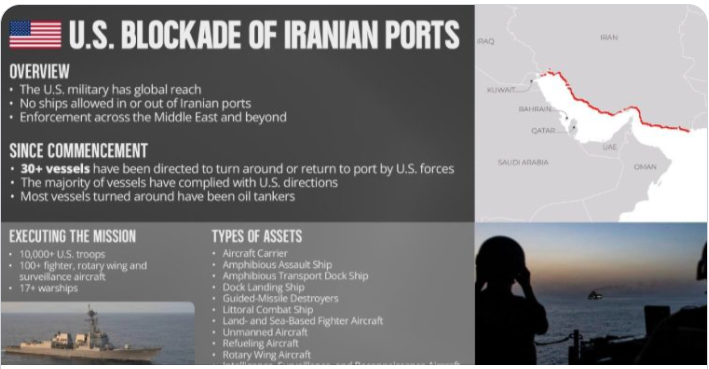
𝐂𝐄𝐍𝐓𝐂𝐎𝐌 𝐑𝐄𝐋𝐄𝐀𝐒𝐄𝐒 𝐅𝐔𝐋𝐋 𝐁𝐋𝐎𝐂𝐊𝐀𝐃𝐄 𝐈𝐍𝐅𝐎𝐆𝐑𝐀𝐏𝐇𝐈𝐂: 𝟑𝟏 𝐕𝐄𝐒𝐒𝐄𝐋𝐒 𝐓𝐔𝐑𝐍𝐄𝐃 𝐀𝐑𝐎𝐔𝐍𝐃, 𝟏𝟎,𝟎𝟎𝟎+ 𝐓𝐑𝐎𝐎𝐏𝐒, 𝟏𝟎𝟎+ 𝐀𝐈𝐑𝐂𝐑𝐀𝐅𝐓, 𝟏𝟕+ 𝐖𝐀𝐑𝐒𝐇𝐈𝐏𝐒 𝐄𝐍𝐅𝐎𝐑𝐂𝐈𝐍𝐆 𝐓𝐇𝐄 𝐁𝐋𝐎𝐂𝐊𝐀𝐃𝐄 𝐎𝐅 𝐈𝐑𝐀𝐍𝐈𝐀𝐍 𝐏𝐎𝐑𝐓𝐒
The numbers:
— 𝟑𝟏 𝐯𝐞𝐬𝐬𝐞𝐥𝐬 directed to turn around or return to port
— Most vessels turned around have been 𝐨𝐢𝐥 𝐭𝐚𝐧𝐤𝐞𝐫𝐬
— 𝟏𝟎,𝟎𝟎𝟎+ 𝐔𝐒 𝐭𝐫𝐨𝐨𝐩𝐬 executing the mission
— 𝟏𝟎𝟎+ 𝐟𝐢𝐠𝐡𝐭𝐞𝐫, 𝐫𝐨𝐭𝐚𝐫𝐲 𝐰𝐢𝐧𝐠, 𝐚𝐧𝐝 𝐬𝐮𝐫𝐯𝐞𝐢𝐥𝐥𝐚𝐧𝐜𝐞 𝐚𝐢𝐫𝐜𝐫𝐚𝐟𝐭
— 𝟏𝟕+ 𝐰𝐚𝐫𝐬𝐡𝐢𝐩𝐬 including aircraft carriers, guided-missile destroyers, amphibious assault ships, and dock landing ships
— Assets include 𝐥𝐚𝐧𝐝 𝐚𝐧𝐝 𝐬𝐞𝐚-𝐛𝐚𝐬𝐞𝐝 𝐟𝐢𝐠𝐡𝐭𝐞𝐫 𝐚𝐢𝐫𝐜𝐫𝐚𝐟𝐭, 𝐮𝐧𝐦𝐚𝐧𝐧𝐞𝐝 𝐚𝐢𝐫𝐜𝐫𝐚𝐟𝐭, 𝐈𝐒𝐑 𝐩𝐥𝐚𝐭𝐟𝐨𝐫𝐦𝐬, 𝐚𝐧𝐝 𝐫𝐞𝐟𝐮𝐞𝐥𝐢𝐧𝐠 𝐚𝐢𝐫𝐜𝐫𝐚𝐟𝐭
— No ships allowed in or out of Iranian ports
— Enforcement across the Middle East and beyond
𝐓𝐡𝐢𝐬 𝐢𝐬 𝐭𝐡𝐞 𝐦𝐨𝐬𝐭 𝐜𝐨𝐦𝐩𝐫𝐞𝐡𝐞𝐧𝐬𝐢𝐯𝐞 𝐧𝐚𝐯𝐚𝐥 𝐛𝐥𝐨𝐜𝐤𝐚𝐝𝐞 𝐬𝐢𝐧𝐜𝐞 𝐖𝐨𝐫𝐥𝐝 𝐖𝐚𝐫 𝐈𝐈. 𝟏𝟕+ 𝐰𝐚𝐫𝐬𝐡𝐢𝐩𝐬, 𝟏𝟎𝟎+ 𝐚𝐢𝐫𝐜𝐫𝐚𝐟𝐭, 𝐚𝐧𝐝 𝟏𝟎,𝟎𝟎𝟎 𝐭𝐫𝐨𝐨𝐩𝐬 𝐜𝐮𝐭𝐭𝐢𝐧𝐠 𝐨𝐟𝐟 𝐞𝐯𝐞𝐫𝐲 𝐝𝐫𝐨𝐩 𝐨𝐟 𝐈𝐫𝐚𝐧𝐢𝐚𝐧 𝐨𝐢𝐥. 𝐓𝐡𝐞 𝐦𝐚𝐣𝐨𝐫𝐢𝐭𝐲 𝐨𝐟 𝐯𝐞𝐬𝐬𝐞𝐥𝐬 𝐜𝐨𝐦𝐩𝐥𝐢𝐞𝐝 𝐰𝐢𝐭𝐡 𝐔𝐒 𝐝𝐢𝐫𝐞𝐜𝐭𝐢𝐨𝐧𝐬. 𝐓𝐡𝐞 𝐨𝐧𝐞𝐬 𝐭𝐡𝐚𝐭 𝐝𝐢𝐝𝐧’𝐭 𝐰𝐞𝐫𝐞 𝐭𝐮𝐫𝐧𝐞𝐝 𝐚𝐫𝐨𝐮𝐧𝐝 𝐚𝐧𝐲𝐰𝐚𝐲.

𝐓𝐑𝐔𝐌𝐏 𝐓𝐎 𝐅𝐎𝐗 𝐍𝐄𝐖𝐒: 𝐈𝐑𝐀𝐍 𝐇𝐀𝐒 𝐀𝐁𝐎𝐔𝐓 𝐓𝐇𝐑𝐄𝐄 𝐃𝐀𝐘𝐒 𝐁𝐄𝐅𝐎𝐑𝐄 𝐓𝐇𝐄𝐈𝐑 𝐎𝐈𝐋 𝐈𝐍𝐅𝐑𝐀𝐒𝐓𝐑𝐔𝐂𝐓𝐔𝐑𝐄 𝐄𝐗𝐏𝐋𝐎𝐃𝐄𝐒 — 𝐋𝐈𝐓𝐄𝐑𝐀𝐋𝐋𝐘
Trump, explaining what happens when a sanctions blockade meets a regime that cannot move its product:
“𝘞𝘩𝘦𝘯 𝘺𝘰𝘶 𝘩𝘢𝘷𝘦 𝘭𝘪𝘯𝘦𝘴 𝘰𝘧 𝘷𝘢𝘴𝘵 𝘢𝘮𝘰𝘶𝘯𝘵𝘴 𝘰𝘧 𝘰𝘪𝘭 𝘱𝘰𝘶𝘳𝘪𝘯𝘨 𝘵𝘩𝘳𝘰𝘶𝘨𝘩 𝘺𝘰𝘶𝘳 𝘴𝘺𝘴𝘵𝘦𝘮, 𝘪𝘧 𝘧𝘰𝘳 𝘢𝘯𝘺 𝘳𝘦𝘢𝘴𝘰𝘯 𝘵𝘩𝘢𝘵 𝘭𝘪𝘯𝘦 𝘪𝘴 𝘤𝘭𝘰𝘴𝘦𝘥 𝘣𝘦𝘤𝘢𝘶𝘴𝘦 𝘺𝘰𝘶 𝘤𝘢𝘯’𝘵 𝘤𝘰𝘯𝘵𝘪𝘯𝘶𝘦 𝘵𝘰 𝘱𝘶𝘵 𝘪𝘵 𝘪𝘯𝘵𝘰 𝘤𝘰𝘯𝘵𝘢𝘪𝘯𝘦𝘳𝘴 𝘰𝘳 𝘴𝘩𝘪𝘱𝘴 — 𝘸𝘩𝘪𝘤𝘩 𝘩𝘢𝘴 𝘩𝘢𝘱𝘱𝘦𝘯𝘦𝘥 𝘵𝘰 𝘵𝘩𝘦𝘮, 𝘵𝘩𝘦𝘺 𝘩𝘢𝘷𝘦 𝘯𝘰 𝘴𝘩𝘪𝘱𝘴 𝘣𝘦𝘤𝘢𝘶𝘴𝘦 𝘰𝘧 𝘵𝘩𝘦 𝘣𝘭𝘰𝘤𝘬𝘢𝘥𝘦 — 𝘸𝘩𝘢𝘵 𝘩𝘢𝘱𝘱𝘦𝘯𝘴 𝘪𝘴 𝘵𝘩𝘢𝘵 𝘭𝘪𝘯𝘦 𝘦𝘹𝘱𝘭𝘰𝘥𝘦𝘴 𝘧𝘳𝘰𝘮 𝘸𝘪𝘵𝘩𝘪𝘯, 𝘣𝘰𝘵𝘩 𝘮𝘦𝘤𝘩𝘢𝘯𝘪𝘤𝘢𝘭𝘭𝘺 𝘢𝘯𝘥 𝘪𝘯 𝘵𝘩𝘦 𝘦𝘢𝘳𝘵𝘩.”
“𝘈𝘯𝘥 𝘸𝘩𝘦𝘯 𝘪𝘵 𝘦𝘹𝘱𝘭𝘰𝘥𝘦𝘴, 𝘺𝘰𝘶 𝘤𝘢𝘯 𝘯𝘦𝘷𝘦𝘳 𝘳𝘦𝘣𝘶𝘪𝘭𝘥 𝘪𝘵 𝘵𝘩𝘦 𝘸𝘢𝘺 𝘪𝘵 𝘸𝘢𝘴. 𝘐𝘧 𝘺𝘰𝘶 𝘳𝘦𝘣𝘶𝘪𝘭𝘥 𝘪𝘵, 𝘪𝘵’𝘴 𝘰𝘯𝘭𝘺 𝘢𝘣𝘰𝘶𝘵 50% 𝘰𝘧 𝘸𝘩𝘢𝘵 𝘪𝘵 𝘪𝘴 𝘳𝘪𝘨𝘩𝘵 𝘯𝘰𝘸.”
𝐓𝐡𝐢𝐬 𝐢𝐬 𝐧𝐨𝐭 𝐫𝐡𝐞𝐭𝐨𝐫𝐢𝐜. 𝐓𝐡𝐢𝐬 𝐢𝐬 𝐭𝐡𝐞 𝐩𝐡𝐲𝐬𝐢𝐜𝐬 𝐨𝐟 𝐚 𝐜𝐫𝐮𝐝𝐞 𝐩𝐢𝐩𝐞𝐥𝐢𝐧𝐞 𝐰𝐢𝐭𝐡 𝐧𝐨 𝐝𝐨𝐰𝐧𝐬𝐭𝐫𝐞𝐚𝐦 𝐨𝐟𝐟𝐥𝐨𝐚𝐝. Iran is the world’s ninth-largest oil producer (EIA, 2025), pumping roughly 3.3 million barrels a day. With the U.S./Israeli naval blockade still cutting their export shipping, their onshore tank farms at Kharg Island and Bandar Abbas are 𝐚𝐭 𝐨𝐫 𝐧𝐞𝐚𝐫 𝐜𝐚𝐩𝐚𝐜𝐢𝐭𝐲.
“𝘛𝘩𝘦𝘺 𝘢𝘳𝘦 𝘫𝘶𝘴𝘵 𝘢𝘣𝘰𝘶𝘵 𝘧𝘪𝘯𝘪𝘴𝘩𝘦𝘥 𝘸𝘪𝘵𝘩 𝘴𝘵𝘰𝘳𝘢𝘨𝘦. 𝘈 𝘷𝘦𝘳𝘺 𝘣𝘢𝘥 𝘵𝘩𝘪𝘯𝘨 𝘪𝘴 𝘨𝘰𝘪𝘯𝘨 𝘵𝘰 𝘩𝘢𝘱𝘱𝘦𝘯. 𝘚𝘰 𝘐 𝘵𝘩𝘪𝘯𝘬 𝘵𝘩𝘦𝘺’𝘳𝘦 𝘶𝘯𝘥𝘦𝘳 𝘱𝘳𝘦𝘴𝘴𝘶𝘳𝘦.”
Translation: in roughly three days the regime either fires every centrifuge facility in the desert in a final tantrum, or they sue for terms.
𝐓𝐡𝐢𝐬 𝐢𝐬 𝐰𝐡𝐚𝐭 𝐞𝐜𝐨𝐧𝐨𝐦𝐢𝐜 𝐰𝐚𝐫𝐟𝐚𝐫𝐞 𝐥𝐨𝐨𝐤𝐬 𝐥𝐢𝐤𝐞 𝐰𝐡𝐞𝐧 𝐭𝐡𝐞 𝐏𝐫𝐞𝐬𝐢𝐝𝐞𝐧𝐭 𝐢𝐬 𝐧𝐨𝐭 𝐉𝐨𝐞 𝐁𝐢𝐝𝐞𝐧.

𝐈𝐑𝐀𝐍 𝐇𝐀𝐒 𝐑𝐔𝐍 𝐎𝐔𝐓 𝐎𝐅 𝐏𝐋𝐀𝐂𝐄𝐒 𝐓𝐎 𝐏𝐔𝐓 𝐓𝐇𝐄 𝐎𝐈𝐋. 𝐓𝐇𝐄 𝐋𝐀𝐒𝐓 𝐌𝐎𝐕𝐄𝐒 𝐀𝐑𝐄 𝐂𝐎𝐍𝐓𝐀𝐈𝐍𝐄𝐑𝐒, 𝐀 𝟑𝟎-𝐘𝐄𝐀𝐑-𝐎𝐋𝐃 𝐑𝐄𝐓𝐈𝐑𝐄𝐃 𝐕𝐋𝐂𝐂 𝐏𝐔𝐋𝐋𝐄𝐃 𝐅𝐑𝐎𝐌 𝐓𝐇𝐄 𝐁𝐑𝐄𝐀𝐊𝐄𝐑𝐒, 𝐀𝐍𝐃 𝐓𝐖𝐎 𝐑𝐀𝐈𝐋 𝐂𝐎𝐑𝐑𝐈𝐃𝐎𝐑𝐒 𝐓𝐇𝐀𝐓 𝐇𝐀𝐕𝐄 𝐍𝐄𝐕𝐄𝐑 𝐌𝐎𝐕𝐄𝐃 𝐏𝐄𝐓𝐑𝐎𝐋𝐄𝐔𝐌. 𝐓𝐇𝐄 𝐆𝐀𝐒𝐎𝐋𝐈𝐍𝐄-𝐒𝐇𝐎𝐑𝐓𝐀𝐆𝐄 𝐂𝐋𝐎𝐂𝐊 𝐈𝐒 𝐑𝐔𝐍𝐍𝐈𝐍𝐆.
Energy analyst Mia Dol Maleki published the technical receipts this morning, with on-the-ground confirmation from inside the regime’s own logistics network. Pulling them apart in order:
1. Iran is now using shipping containers and “𝘫𝘶𝘯𝘬 𝘴𝘵𝘰𝘳𝘢𝘨𝘦” — disused tanks in poor structural condition — at Ahvaz and Asaluyeh to absorb the oil it cannot ship.
2. Rail to China is a non-starter. Iran’s own senior rail-transport expert Morteza Naserian told Mehr News there are 𝐨𝐧𝐥𝐲 𝐭𝐰𝐨 𝐫𝐚𝐢𝐥 𝐜𝐨𝐫𝐫𝐢𝐝𝐨𝐫𝐬 𝐭𝐨 𝐂𝐡𝐢𝐧𝐚, 𝐧𝐞𝐯𝐞𝐫 𝐮𝐬𝐞𝐝 𝐟𝐨𝐫 𝐩𝐞𝐭𝐫𝐨𝐥𝐞𝐮𝐦, 𝐰𝐢𝐭𝐡 𝐬𝐞𝐯𝐞𝐫𝐞𝐥𝐲 𝐥𝐢𝐦𝐢𝐭𝐞𝐝 𝐜𝐚𝐩𝐚𝐜𝐢𝐭𝐲 𝐚𝐧𝐝 𝐳𝐞𝐫𝐨 𝐛𝐮𝐥𝐤-𝐜𝐫𝐮𝐝𝐞 𝐢𝐧𝐟𝐫𝐚𝐬𝐭𝐫𝐮𝐜𝐭𝐮𝐫𝐞.
3. The floating-storage “𝘧𝘪𝘹” is paper-thin. Iran pulled NASHA (IMO 9079107), a 30-year-old retired VLCC, out of the ship-breakers. NASHA buys roughly 48 hours.
4. Jask terminal’s onshore tanks 𝐡𝐢𝐭 𝐦𝐚𝐱𝐢𝐦𝐮𝐦 𝐜𝐚𝐩𝐚𝐜𝐢𝐭𝐲 𝐀𝐩𝐫𝐢𝐥 𝟐𝟓. Some tankers are now anchored near Kharg as improvised overflow — a fleet the IRGC cannot replicate at scale.
5. The 2020 precedent — 85% storage utilization, 120 million barrels afloat — was managed under sanctions but 𝐰𝐢𝐭𝐡𝐨𝐮𝐭 𝐚 𝐧𝐚𝐯𝐚𝐥 𝐛𝐥𝐨𝐜𝐤𝐚𝐝𝐞 𝐚𝐧𝐝 𝐰𝐢𝐭𝐡 𝐞𝐱𝐩𝐨𝐫𝐭 𝐜𝐡𝐚𝐧𝐧𝐞𝐥𝐬 𝐬𝐭𝐢𝐥𝐥 𝐩𝐚𝐫𝐭𝐢𝐚𝐥𝐥𝐲 𝐨𝐩𝐞𝐧. Both escape valves are closed now. Iran’s ghost fleet is already filled with 166M barrels.
Containers, junk tanks, retired VLCCs, and rail fantasies are not a storage strategy. They are the last moves of a system running out of room — exactly on the timeline that Treasury, Pentagon, and Bessent’s economic-fury team estimated.
𝐓𝐡𝐞 𝐠𝐚𝐬𝐨𝐥𝐢𝐧𝐞 𝐬𝐡𝐨𝐫𝐭𝐚𝐠𝐞 𝐜𝐥𝐨𝐜𝐤 𝐬𝐭𝐚𝐫𝐭𝐬 𝐚𝐭 𝐬𝐭𝐨𝐫𝐚𝐠𝐞 𝐬𝐚𝐭𝐮𝐫𝐚𝐭𝐢𝐨𝐧. 𝐒𝐭𝐨𝐫𝐚𝐠𝐞 𝐢𝐬 𝐚𝐭 𝐬𝐚𝐭𝐮𝐫𝐚𝐭𝐢𝐨𝐧. 𝐓𝐡𝐞 𝐜𝐥𝐨𝐜𝐤 𝐡𝐚𝐬 𝐬𝐭𝐚𝐫𝐭𝐞𝐝.

𝐎𝐈𝐋 𝐈𝐒𝐍'𝐓 𝐀 𝐅𝐀𝐔𝐂𝐄𝐓. 𝐀𝐍𝐃 𝐓𝐇𝐀𝐓'𝐒 𝐖𝐇𝐘 𝐈𝐑𝐀𝐍 𝐈𝐒 𝐂𝐎𝐎𝐊𝐄𝐃.
People keep asking the same question about the U.S. naval blockade of Iran:
If they cannot ship the oil, why do they not just stop pumping it?
The answer is that they cannot. The reason involves physics, geology, and three quarters of a century of accumulated reservoir damage that the regime cannot undo. Let me walk through it.
𝐀𝐧 𝐎𝐢𝐥 𝐖𝐞𝐥𝐥 𝐈𝐬 𝐍𝐨𝐭 𝐚 𝐅𝐚𝐮𝐜𝐞𝐭
A faucet has a valve. You close the valve, water stops, you open it, water flows. Same as before.
An oil well does not work that way at all.
An oil reservoir is a high-pressure system. Crude sits trapped in porous rock — typically sandstone or limestone — under pressure measured in thousands of pounds per square inch, mixed with natural gas above and saltwater below. When you drill into that rock, you are creating a controlled leak. The oil flows up the well because the underground pressure is pushing it.
When you shut the wellhead, the pressure does not stay still. It redistributes. Water from below pushes upward. Gas from above expands. The oil column gets disturbed — sometimes permanently. Petroleum engineers have a term for this: 𝐬𝐡𝐮𝐭-𝐢𝐧 𝐝𝐚𝐦𝐚𝐠𝐞.
𝐖𝐡𝐚𝐭 𝐀𝐜𝐭𝐮𝐚𝐥𝐥𝐲 𝐇𝐚𝐩𝐩𝐞𝐧𝐬 𝐖𝐡𝐞𝐧 𝐘𝐨𝐮 "𝐉𝐮𝐬𝐭 𝐓𝐮𝐫𝐧 𝐈𝐭 𝐎𝐟𝐟"
Three categories of damage start the moment you shut in a producing well.
The first is 𝐰𝐚𝐭𝐞𝐫 𝐜𝐨𝐧𝐢𝐧𝐠 𝐚𝐧𝐝 𝐠𝐚𝐬 𝐛𝐫𝐞𝐚𝐤𝐭𝐡𝐫𝐨𝐮𝐠𝐡. While the well is producing, the pressure drawdown holds the oil-water and oil-gas interfaces in roughly stable positions. Stop production, and water begins to rise into the producing zone while gas migrates downward. When you eventually restart, the well now produces salt water and natural gas instead of oil — sometimes permanently.
The second is 𝐰𝐚𝐱 𝐚𝐧𝐝 𝐚𝐬𝐩𝐡𝐚𝐥𝐭𝐞𝐧𝐞 𝐝𝐞𝐩𝐨𝐬𝐢𝐭𝐢𝐨𝐧. Crude oil contains paraffin waxes and heavy asphaltenes that stay liquid only because the oil is hot and moving. Stop the flow, and these solids precipitate inside the wellbore, the production tubing, and the surface flowlines. Restart attempts plug the well shut. Iranian crude is notoriously waxy.
The third is 𝐟𝐢𝐧𝐞𝐬 𝐦𝐢𝐠𝐫𝐚𝐭𝐢𝐨𝐧 𝐚𝐧𝐝 𝐬𝐚𝐧𝐝 𝐬𝐞𝐭𝐭𝐥𝐢𝐧𝐠. The perforations through the steel casing — the holes through which oil enters the well from the rock — clog with sand, fines, and asphaltene sludge during shut-in. Restart cuts flow rate, sometimes to zero, until a workover crew is deployed at six-figure cost per well to clean each one out.
For an old field — and Iran's giant fields are old: 𝐀𝐡𝐯𝐚𝐳, 𝐌𝐚𝐫𝐮𝐧, 𝐆𝐚𝐜𝐡𝐬𝐚𝐫𝐚𝐧, all producing since the 1950s and 60s — shut-in damage is brutal. Texas and Oklahoma operators in low-price periods routinely keep pumping at a loss rather than shut in, because the damage from shutting in costs more than the lost revenue.
𝐈𝐫𝐚𝐧'𝐬 𝐒𝐩𝐞𝐜𝐢𝐟𝐢𝐜 𝐏𝐫𝐨𝐛𝐥𝐞𝐦
There are three additional factors making Iran's situation worse than a typical producing nation's.
Decades of sanctions have starved the industry of Western technology. Halliburton, Schlumberger, and Baker Hughes were the global leaders in well stimulation, workover, and reservoir management until they were forced out of Iran between 2010 and 2018. The National Iranian Oil Company has limped along on Chinese-supplied equipment of significantly lower quality, plus reverse-engineered Russian and pre-revolution American gear. Restoration after a shut-in requires precisely the high-end services Iran no longer has.
Iran also depends on water injection to maintain reservoir pressure. Most of Iran's giant fields are on secondary recovery — meaning seawater is pumped down injection wells to push oil toward producers. Shut in the producers and you must also shut in the injectors, or the field over-pressurizes. Stopping injection lets pressure decline. Restarting injection costs hundreds of millions of dollars and typically returns the field to lower output than before. There is no clean reset button.
And oil is 𝟑𝟎-𝟒𝟎% 𝐨𝐟 𝐈𝐫𝐚𝐧'𝐬 𝐠𝐨𝐯𝐞𝐫𝐧𝐦𝐞𝐧𝐭 𝐛𝐮𝐝𝐠𝐞𝐭. Stop pumping for 90 days and the Iranian currency collapses, subsidies on bread and electricity vanish, and the regime faces a domestic crisis worse than the 2022 protests. They cannot stop. They are physically and politically incapable of stopping.
𝐖𝐡𝐚𝐭 𝐈𝐬 𝐀𝐜𝐭𝐮𝐚𝐥𝐥𝐲 𝐇𝐚𝐩𝐩𝐞𝐧𝐢𝐧𝐠 𝐑𝐢𝐠𝐡𝐭 𝐍𝐨𝐰
Iran continues pumping because it must. The U.S. blockade, which began February 28, prevents shipment.
Iranian onshore storage at Kharg Island and Bandar Abbas filled up within weeks. After that, the regime began using its own fleet of aging Very Large Crude Carriers as floating storage, anchored off the Strait of Hormuz with their AIS transponders dark.
The floating storage filled up next.
What happens then is what petroleum engineers call a 𝐩𝐫𝐨𝐝𝐮𝐜𝐭𝐢𝐨𝐧 𝐝𝐢𝐬𝐩𝐨𝐬𝐚𝐥 𝐜𝐫𝐢𝐬𝐢𝐬. Each pumping platform is producing oil that has nowhere to go — and gas associated with that oil that, if not flared, will over-pressurize the entire system. So Iran is now flaring increasing quantities of associated gas (visible from NASA VIIRS night satellite imagery), burning off the secondary product into the sky just to keep the primary product moving.
Flaring is wasteful, expensive, and visible from orbit. It is what countries do when they have run out of options.
𝐓𝐡𝐞 𝐋𝐨𝐧𝐠-𝐓𝐞𝐫𝐦 𝐃𝐚𝐦𝐚𝐠𝐞
Even when this war ends, Iran's oil sector will not return to where it stood on February 27, 2026.
A reservoir engineer can model the damage. Estimates range from 𝟐𝟎-𝟑𝟓% 𝐩𝐞𝐫𝐦𝐚𝐧𝐞𝐧𝐭 𝐩𝐫𝐨𝐝𝐮𝐜𝐭𝐢𝐯𝐢𝐭𝐲 𝐥𝐨𝐬𝐬 across Iran's giant fields, depending on how long the chaos continues and how badly the wells are mishandled while it is going on. That is hundreds of billions of dollars of reserves that will sit underground forever, because the regime did not have the technology, the time, or the strategic patience to manage a controlled shut-in properly.
This is what makes the U.S. naval blockade strategically devastating in a way that ordinary sanctions are not.
Sanctions reduce demand for Iranian oil. The blockade physically prevents its movement. And because Iranian oil cannot be turned off and cannot be shipped, every barrel pumped now becomes either flared waste or reservoir-damaging backpressure.
The Islamic Republic is not facing a financial squeeze. It is facing a 𝐠𝐞𝐨𝐥𝐨𝐠𝐢𝐜𝐚𝐥 𝐬𝐪𝐮𝐞𝐞𝐳𝐞 — the kind that does not get undone with a ceasefire, a sanctions waiver, or a billion-dollar Qatari escrow account.
It is the kind of damage that the rocks themselves remember.
𝐀 𝐛𝐥𝐨𝐜𝐤𝐚𝐝𝐞 𝐡𝐞𝐥𝐝 𝐟𝐨𝐫 𝐬𝐢𝐱 𝐦𝐨𝐧𝐭𝐡𝐬 𝐢𝐬 𝐚 𝐝𝐞𝐜𝐚𝐝𝐞-𝐥𝐨𝐧𝐠 𝐫𝐞𝐯𝐞𝐧𝐮𝐞 𝐡𝐢𝐭 𝐭𝐨 𝐭𝐡𝐞 𝐈𝐬𝐥𝐚𝐦𝐢𝐜 𝐑𝐞𝐩𝐮𝐛𝐥𝐢𝐜.

𝐓𝐑𝐄𝐀𝐒𝐔𝐑𝐘 𝐃𝐄𝐏𝐀𝐑𝐓𝐌𝐄𝐍𝐓 𝐉𝐔𝐒𝐓 𝐅𝐑𝐎𝐙𝐄 $𝟑𝟒𝟒 𝐌𝐈𝐋𝐋𝐈𝐎𝐍 𝐈𝐍 𝐂𝐑𝐘𝐏𝐓𝐎𝐂𝐔𝐑𝐑𝐄𝐍𝐂𝐘 𝐓𝐈𝐄𝐃 𝐓𝐎 𝐈𝐑𝐀𝐍 𝐀𝐒 𝐏𝐀𝐑𝐓 𝐎𝐅 “𝐎𝐏𝐄𝐑𝐀𝐓𝐈𝐎𝐍 𝐄𝐂𝐎𝐍𝐎𝐌𝐈𝐂 𝐅𝐔𝐑𝐘.” 𝐊𝐇𝐀𝐑𝐆 𝐈𝐒𝐋𝐀𝐍𝐃 𝐈𝐒 𝐍𝐄𝐀𝐑𝐈𝐍𝐆 𝐒𝐓𝐎𝐑𝐀𝐆𝐄 𝐂𝐀𝐏𝐀𝐂𝐈𝐓𝐘. 𝐓𝐇𝐄 𝐎𝐈𝐋 𝐈𝐍𝐅𝐑𝐀𝐒𝐓𝐑𝐔𝐂𝐓𝐔𝐑𝐄 𝐏𝐇𝐀𝐒𝐄 𝐈𝐒 𝐍𝐎𝐖 𝐏𝐄𝐑𝐌𝐀𝐍𝐄𝐍𝐓.
From Fox Business’ Edward Lawrence reporting on the operation:
𝐓𝐡𝐞 𝐜𝐫𝐲𝐩𝐭𝐨 𝐬𝐞𝐢𝐳𝐮𝐫𝐞: $344 million in cryptocurrency tied to Iranian regime networks frozen. The administration is targeting digital-asset flows that the regime has been using to evade conventional sanctions on banks. Treasury Secretary Scott Bessent confirmed the freeze.
𝐁𝐞𝐬𝐬𝐞𝐧𝐭 𝐨𝐧 𝐊𝐡𝐚𝐫𝐠 𝐈𝐬𝐥𝐚𝐧𝐝:
𝘒𝘩𝘢𝘳𝘨 𝘐𝘴𝘭𝘢𝘯𝘥, 𝘐𝘳𝘢𝘯’𝘴 𝘱𝘳𝘪𝘮𝘢𝘳𝘺 𝘰𝘪𝘭 𝘦𝘹𝘱𝘰𝘳𝘵 𝘵𝘦𝘳𝘮𝘪𝘯𝘢𝘭, 𝘪𝘴 𝘴𝘰𝘰𝘯 𝘯𝘦𝘢𝘳𝘪𝘯𝘨 𝘴𝘵𝘰𝘳𝘢𝘨𝘦 𝘤𝘢𝘱𝘢𝘤𝘪𝘵𝘺, 𝘸𝘩𝘪𝘤𝘩 𝘸𝘪𝘭𝘭 𝘧𝘰𝘳𝘤𝘦 𝘵𝘩𝘦 𝘳𝘦𝘨𝘪𝘮𝘦 𝘵𝘰 𝘳𝘦𝘥𝘶𝘤𝘦 𝘰𝘪𝘭 𝘱𝘳𝘰𝘥𝘶𝘤𝘵𝘪𝘰𝘯. 𝘛𝘩𝘦 𝘳𝘦𝘴𝘶𝘭𝘵𝘪𝘯𝘨 𝘭𝘰𝘨𝘫𝘢𝘮 𝘸𝘪𝘭𝘭 𝘥𝘳𝘢𝘪𝘯 𝘢𝘯 𝘢𝘥𝘥𝘪𝘵𝘪𝘰𝘯𝘢𝘭 $170 𝘮𝘪𝘭𝘭𝘪𝘰𝘯 𝘱𝘦𝘳 𝘥𝘢𝘺 𝘪𝘯 𝘭𝘰𝘴𝘵 𝘳𝘦𝘷𝘦𝘯𝘶𝘦 𝘢𝘯𝘥 𝘤𝘢𝘶𝘴𝘦 𝘱𝘦𝘳𝘮𝘢𝘯𝘦𝘯𝘵 𝘥𝘢𝘮𝘢𝘨𝘦 𝘵𝘰 𝘐𝘳𝘢𝘯’𝘴 𝘰𝘪𝘭 𝘪𝘯𝘧𝘳𝘢𝘴𝘵𝘳𝘶𝘤𝘵𝘶𝘳𝘦. 𝘛𝘳𝘦𝘢𝘴𝘶𝘳𝘺 𝘸𝘪𝘭𝘭 𝘤𝘰𝘯𝘵𝘪𝘯𝘶𝘦 𝘵𝘰 𝘦𝘹𝘦𝘳𝘵 𝘮𝘢𝘹𝘪𝘮𝘶𝘮 𝘱𝘳𝘦𝘴𝘴𝘶𝘳𝘦. 𝘈𝘯𝘺 𝘱𝘦𝘳𝘴𝘰𝘯, 𝘷𝘦𝘴𝘴𝘦𝘭, 𝘰𝘳 𝘦𝘯𝘵𝘪𝘵𝘺 𝘧𝘢𝘤𝘪𝘭𝘪𝘵𝘢𝘵𝘪𝘯𝘨 𝘪𝘭𝘭𝘪𝘤𝘪𝘵 𝘧𝘭𝘰𝘸𝘴 𝘵𝘰 𝘛𝘦𝘩𝘳𝘢𝘯 𝘳𝘪𝘴𝘬𝘴 𝘦𝘹𝘱𝘰𝘴𝘶𝘳𝘦 𝘵𝘰 𝘜.𝘚. 𝘴𝘢𝘯𝘤𝘵𝘪𝘰𝘯𝘴.
𝐓𝐡𝐞 𝐟𝐨𝐮𝐫 𝐭𝐚𝐫𝐠𝐞𝐭 𝐜𝐚𝐭𝐞𝐠𝐨𝐫𝐢𝐞𝐬 𝐮𝐧𝐝𝐞𝐫 𝐎𝐩𝐞𝐫𝐚𝐭𝐢𝐨𝐧 𝐄𝐜𝐨𝐧𝐨𝐦𝐢𝐜 𝐅𝐮𝐫𝐲:
1. Iran’s international shadow banking infrastructure (the network we’ve been dismantling for two weeks)
2. Iran’s weapons procurement networks
3. The 𝘴𝘩𝘢𝘥𝘰𝘸 𝘧𝘭𝘦𝘦𝘵 of tankers used to hide oil origins
4. Independent Chinese 𝘵𝘦𝘢𝘱𝘰𝘵 refineries (especially in Shandong Province) that buy Iranian crude
𝐓𝐡𝐞 𝐝𝐢𝐩𝐥𝐨𝐦𝐚𝐭𝐢𝐜 𝐞𝐧𝐟𝐨𝐫𝐜𝐞𝐦𝐞𝐧𝐭 𝐥𝐚𝐲𝐞𝐫: Treasury has shared information with China, Hong Kong, the UAE, and Oman — identifying banks that have allegedly enabled Iranian activity, and warning that continued cooperation will trigger SECONDARY sanctions on those institutions. The threat is now extraterritorial: comply, or your bank loses access to U.S. dollar clearing.
𝐓𝐡𝐞 𝐦𝐚𝐱𝐢𝐦𝐮𝐦-𝐩𝐫𝐞𝐬𝐬𝐮𝐫𝐞 𝐬𝐭𝐚𝐜𝐤: $344M crypto frozen + 35 shadow banking entities sanctioned + naval blockade since April 13 + UAE leaving OPEC May 1 + Iran’s oil infrastructure on the verge of permanent damage. The campaign is not a tightening of pressure. It is a complete dismantling of the regime’s economic capacity in real time.
𝐈𝐫𝐚𝐧 𝐜𝐚𝐧’𝐭 𝐬𝐡𝐢𝐩 𝐨𝐢𝐥. 𝐈𝐫𝐚𝐧 𝐜𝐚𝐧’𝐭 𝐛𝐚𝐧𝐤 𝐦𝐨𝐧𝐞𝐲 𝐢𝐧 𝐝𝐨𝐥𝐥𝐚𝐫𝐬. 𝐈𝐫𝐚𝐧 𝐜𝐚𝐧’𝐭 𝐛𝐚𝐧𝐤 𝐦𝐨𝐧𝐞𝐲 𝐢𝐧 𝐜𝐫𝐲𝐩𝐭𝐨. 𝐈𝐫𝐚𝐧 𝐜𝐚𝐧’𝐭 𝐦𝐨𝐯𝐞 𝐨𝐢𝐥 𝐭𝐡𝐫𝐨𝐮𝐠𝐡 𝐭𝐡𝐞 𝐒𝐭𝐫𝐚𝐢𝐭. 𝐓𝐡𝐞 𝐫𝐞𝐠𝐢𝐦𝐞 𝐭𝐡𝐚𝐭 𝐟𝐢𝐧𝐚𝐧𝐜𝐞𝐝 𝟒𝟕 𝐲𝐞𝐚𝐫𝐬 𝐨𝐟 𝐭𝐞𝐫𝐫𝐨𝐫 𝐢𝐬 𝐛𝐞𝐢𝐧𝐠 𝐞𝐜𝐨𝐧𝐨𝐦𝐢𝐜𝐚𝐥𝐥𝐲 𝐞𝐱𝐭𝐢𝐧𝐠𝐮𝐢𝐬𝐡𝐞𝐝 𝐰𝐡𝐢𝐥𝐞 𝐰𝐞’𝐫𝐞 𝐰𝐚𝐭𝐜𝐡𝐢𝐧𝐠.

𝐁𝐄𝐒𝐒𝐄𝐍𝐓 𝐓𝐎 𝐅𝐎𝐗 𝐁𝐔𝐒𝐈𝐍𝐄𝐒𝐒: 𝐈𝐑𝐀𝐍 𝐈𝐒 𝐋𝐎𝐒𝐈𝐍𝐆 $𝟏𝟕𝟎 𝐌𝐈𝐋𝐋𝐈𝐎𝐍 𝐏𝐄𝐑 𝐃𝐀𝐘. 𝐊𝐇𝐀𝐑𝐆 𝐈𝐒𝐋𝐀𝐍𝐃 𝐈𝐒 𝐍𝐄𝐀𝐑𝐈𝐍𝐆 𝐒𝐓𝐎𝐑𝐀𝐆𝐄 𝐂𝐀𝐏𝐀𝐂𝐈𝐓𝐘. 𝐏𝐄𝐑𝐌𝐀𝐍𝐄𝐍𝐓 𝐃𝐀𝐌𝐀𝐆𝐄 𝐓𝐎 𝐈𝐑𝐀𝐍’𝐒 𝐎𝐈𝐋 𝐈𝐍𝐅𝐑𝐀𝐒𝐓𝐑𝐔𝐂𝐓𝐔𝐑𝐄 𝐈𝐒 𝐍𝐎𝐖 𝐈𝐍𝐄𝐕𝐈𝐓𝐀𝐁𝐋𝐄.
Fox News’ Jacqui Heinrich, reporting on Treasury Secretary Scott Bessent’s Fox Business interview:
𝘓𝘢𝘴𝘵 𝘯𝘪𝘨𝘩𝘵 𝘛𝘳𝘦𝘢𝘴𝘶𝘳𝘺 𝘚𝘦𝘤𝘳𝘦𝘵𝘢𝘳𝘺 𝘚𝘤𝘰𝘵𝘵 𝘉𝘦𝘴𝘴𝘦𝘯𝘵 𝘵𝘰𝘭𝘥 𝘰𝘶𝘳 𝘤𝘰𝘭𝘭𝘦𝘢𝘨𝘶𝘦 𝘌𝘥𝘸𝘢𝘳𝘥 𝘓𝘢𝘸𝘳𝘦𝘯𝘤𝘦 𝘵𝘩𝘢𝘵 𝘒𝘩𝘢𝘳𝘨 𝘐𝘴𝘭𝘢𝘯𝘥 𝘪𝘴 𝘯𝘦𝘢𝘳𝘪𝘯𝘨 𝘪𝘵𝘴 𝘤𝘢𝘱𝘢𝘤𝘪𝘵𝘺 𝘧𝘰𝘳 𝘴𝘵𝘰𝘳𝘢𝘨𝘦 𝘢𝘯𝘥 𝘵𝘩𝘦 𝘐𝘳𝘢𝘯𝘪𝘢𝘯 𝘨𝘰𝘷𝘦𝘳𝘯𝘮𝘦𝘯𝘵 𝘪𝘴 𝘭𝘰𝘴𝘪𝘯𝘨 $170 𝘮𝘪𝘭𝘭𝘪𝘰𝘯 𝘱𝘦𝘳 𝘥𝘢𝘺 𝘪𝘯 𝘳𝘦𝘷𝘦𝘯𝘶𝘦. 𝘐𝘵 𝘸𝘪𝘭𝘭 𝘤𝘢𝘶𝘴𝘦 𝘱𝘦𝘳𝘮𝘢𝘯𝘦𝘯𝘵 𝘥𝘢𝘮𝘢𝘨𝘦 𝘵𝘰 𝘐𝘳𝘢𝘯’𝘴 𝘰𝘪𝘭 𝘪𝘯𝘥𝘶𝘴𝘵𝘳𝘺.
𝐓𝐡𝐞 𝐖𝐚𝐥𝐥 𝐒𝐭𝐫𝐞𝐞𝐭 𝐉𝐨𝐮𝐫𝐧𝐚𝐥 𝐬𝐜𝐨𝐨𝐩 𝐨𝐧 𝐓𝐫𝐮𝐦𝐩’𝐬 𝐧𝐞𝐱𝐭 𝐦𝐨𝐯𝐞:
𝘛𝘳𝘶𝘮𝘱 𝘵𝘰𝘭𝘥 𝘢𝘪𝘥𝘦𝘴 𝘵𝘰 𝘱𝘳𝘦𝘱𝘢𝘳𝘦 𝘧𝘰𝘳 𝘢𝘯 𝘦𝘹𝘵𝘦𝘯𝘥𝘦𝘥 𝘯𝘢𝘷𝘢𝘭 𝘣𝘭𝘰𝘤𝘬𝘢𝘥𝘦 𝘰𝘧 𝘐𝘳𝘢𝘯. 𝘏𝘦 𝘢𝘴𝘴𝘦𝘴𝘴𝘦𝘥 𝘵𝘩𝘢𝘵 𝘩𝘪𝘴 𝘰𝘵𝘩𝘦𝘳 𝘰𝘱𝘵𝘪𝘰𝘯𝘴 — 𝘳𝘦𝘴𝘶𝘮𝘦 𝘣𝘰𝘮𝘣𝘪𝘯𝘨 𝘰𝘳 𝘸𝘢𝘭𝘬 𝘢𝘸𝘢𝘺 𝘧𝘳𝘰𝘮 𝘵𝘩𝘦 𝘤𝘰𝘯𝘧𝘭𝘪𝘤𝘵 — 𝘤𝘢𝘳𝘳𝘪𝘦𝘥 𝘮𝘰𝘳𝘦 𝘳𝘪𝘴𝘬 𝘵𝘩𝘢𝘯 𝘮𝘢𝘪𝘯𝘵𝘢𝘪𝘯𝘪𝘯𝘨 𝘵𝘩𝘦 𝘣𝘭𝘰𝘤𝘬𝘢𝘥𝘦.
𝐓𝐡𝐞 𝐔𝐀𝐄 𝐎𝐏𝐄𝐂 𝐞𝐱𝐢𝐭, 𝐢𝐧 𝐭𝐡𝐞 𝐔𝐀𝐄 𝐄𝐧𝐞𝐫𝐠𝐲 𝐌𝐢𝐧𝐢𝐬𝐭𝐞𝐫’𝐬 𝐨𝐰𝐧 𝐰𝐨𝐫𝐝𝐬:
𝘖𝘶𝘳 𝘦𝘹𝘪𝘵 𝘢𝘵 𝘵𝘩𝘪𝘴 𝘵𝘪𝘮𝘦 𝘪𝘴 𝘵𝘩𝘦 𝘳𝘪𝘨𝘩𝘵 𝘵𝘪𝘮𝘦 𝘧𝘰𝘳 𝘪𝘵 𝘣𝘦𝘤𝘢𝘶𝘴𝘦 𝘪𝘵 𝘸𝘪𝘭𝘭 𝘩𝘢𝘷𝘦 𝘢 𝘮𝘪𝘯𝘪𝘮𝘶𝘮 𝘪𝘮𝘱𝘢𝘤𝘵 𝘰𝘯 𝘵𝘩𝘦 𝘱𝘳𝘪𝘤𝘦 𝘢𝘯𝘥 𝘪𝘵 𝘸𝘪𝘭𝘭 𝘩𝘢𝘷𝘦 𝘢 𝘮𝘪𝘯𝘪𝘮𝘶𝘮 𝘪𝘮𝘱𝘢𝘤𝘵 𝘰𝘯 𝘰𝘶𝘳 𝘧𝘳𝘪𝘦𝘯𝘥𝘴 𝘢𝘵 𝘖𝘗𝘌𝘊 𝘢𝘯𝘥 𝘖𝘗𝘌𝘊+.
𝐖𝐡𝐚𝐭 𝐭𝐡𝐢𝐬 𝐦𝐞𝐚𝐧𝐬 𝐢𝐧 𝐨𝐩𝐞𝐫𝐚𝐭𝐢𝐨𝐧𝐚𝐥 𝐭𝐞𝐫𝐦𝐬: Iran’s primary oil export terminal at Kharg Island will hit storage capacity within days. Once full, Iran has to physically reduce production — and once a well is 𝘴𝘩𝘶𝘵 𝘪𝘯 under pressure, the geological structure can sustain permanent damage that costs years and billions to repair. The naval blockade is not a temporary squeeze. It is permanent erosion of Iran’s primary revenue source.
$𝟏𝟕𝟎 𝐦𝐢𝐥𝐥𝐢𝐨𝐧 𝐩𝐞𝐫 𝐝𝐚𝐲. 𝐅𝐨𝐫𝐞𝐯𝐞𝐫. 𝐈𝐫𝐚𝐧 𝐜𝐚𝐧’𝐭 𝐬𝐡𝐢𝐩 𝐭𝐡𝐞 𝐨𝐢𝐥. 𝐈𝐫𝐚𝐧 𝐜𝐚𝐧’𝐭 𝐛𝐚𝐧𝐤 𝐭𝐡𝐞 𝐩𝐫𝐨𝐜𝐞𝐞𝐝𝐬. 𝐈𝐫𝐚𝐧 𝐜𝐚𝐧’𝐭 𝐟𝐮𝐧𝐝 𝐇-𝐳-𝐛, 𝐇-𝐦-𝐬, 𝐭𝐡𝐞 𝐇𝐨𝐮𝐭𝐡𝐢𝐬, 𝐨𝐫 𝐭𝐡𝐞 𝐈𝐑𝐆𝐂. 𝐓𝐡𝐞 𝐛𝐥𝐨𝐜𝐤𝐚𝐝𝐞 𝐢𝐬 𝐝𝐨𝐢𝐧𝐠 𝐰𝐡𝐚𝐭 𝟒𝟕 𝐲𝐞𝐚𝐫𝐬 𝐨𝐟 𝐝𝐢𝐩𝐥𝐨𝐦𝐚𝐭𝐢𝐜 𝐞𝐧𝐠𝐚𝐠𝐞𝐦𝐞𝐧𝐭 𝐜𝐨𝐮𝐥𝐝 𝐧𝐨𝐭.

𝐓𝐑𝐔𝐌𝐏 𝐓𝐎 𝐀𝐗𝐈𝐎𝐒: 𝐔.𝐒. 𝐑𝐄𝐉𝐄𝐂𝐓𝐒 𝐈𝐑𝐀𝐍’𝐒 𝐎𝐅𝐅𝐄𝐑. 𝐓𝐇𝐄 𝐍𝐀𝐕𝐘 𝐁𝐋𝐎𝐂𝐊𝐀𝐃𝐄 𝐒𝐓𝐀𝐘𝐒 𝐈𝐍 𝐅𝐔𝐋𝐋 𝐄𝐅𝐅𝐄𝐂𝐓 𝐔𝐍𝐓𝐈𝐋 𝐓𝐇𝐄 𝐑𝐄𝐆𝐈𝐌𝐄 𝐆𝐈𝐕𝐄𝐒 𝐔𝐏 𝐈𝐓𝐒 𝐍𝐔𝐂𝐋𝐄𝐀𝐑 𝐏𝐑𝐎𝐆𝐑𝐀𝐌. 𝐃𝐀𝐘 𝟏𝟔. 𝐓𝐇𝐄 𝐑𝐄𝐆𝐈𝐌𝐄 𝐈𝐒 𝐂𝐎𝐋𝐋𝐀𝐏𝐒𝐈𝐍𝐆 𝐈𝐍 𝐑𝐄𝐀𝐋 𝐓𝐈𝐌𝐄.
From the broadcast walking through it:
𝘛𝘰𝘥𝘢𝘺 𝘪𝘴 𝘵𝘩𝘦 16𝘵𝘩 𝘥𝘢𝘺 𝘰𝘧 𝘵𝘩𝘦 𝘜.𝘚. 𝘣𝘭𝘰𝘤𝘬𝘢𝘥𝘦 𝘰𝘯 𝘐𝘳𝘢𝘯𝘪𝘢𝘯 𝘱𝘰𝘳𝘵𝘴, 𝘢𝘯𝘥 𝘗𝘳𝘦𝘴𝘪𝘥𝘦𝘯𝘵 𝘛𝘳𝘶𝘮𝘱 𝘯𝘰𝘸 𝘴𝘢𝘺𝘴 𝘵𝘩𝘢𝘵 𝘩𝘦’𝘴 𝘨𝘰𝘪𝘯𝘨 𝘵𝘰 𝘦𝘹𝘵𝘦𝘯𝘥 𝘵𝘩𝘢𝘵 𝘣𝘭𝘰𝘤𝘬𝘢𝘥𝘦 𝘶𝘯𝘵𝘪𝘭 𝘐𝘳𝘢𝘯 𝘢𝘨𝘳𝘦𝘦𝘴 𝘵𝘰 𝘢 𝘥𝘦𝘢𝘭 𝘵𝘩𝘢𝘵 𝘦𝘯𝘥𝘴 𝘪𝘵𝘴 𝘯𝘶𝘤𝘭𝘦𝘢𝘳 𝘱𝘳𝘰𝘨𝘳𝘢𝘮.
𝐏𝐫𝐞𝐬𝐢𝐝𝐞𝐧𝐭 𝐓𝐫𝐮𝐦𝐩, 𝐭𝐨 𝐀𝐱𝐢𝐨𝐬, 𝐨𝐧 𝐭𝐡𝐞 𝐬𝐭𝐫𝐚𝐭𝐞𝐠𝐢𝐜 𝐥𝐨𝐠𝐢𝐜:
𝘛𝘩𝘦 𝘣𝘭𝘰𝘤𝘬𝘢𝘥𝘦 𝘪𝘴 𝘴𝘰𝘮𝘦𝘸𝘩𝘢𝘵 𝘮𝘰𝘳𝘦 𝘦𝘧𝘧𝘦𝘤𝘵𝘪𝘷𝘦 𝘵𝘩𝘢𝘯 𝘵𝘩𝘦 𝘣𝘰𝘮𝘣𝘪𝘯𝘨. 𝘛𝘩𝘦𝘺 𝘢𝘳𝘦 𝘤𝘩𝘰𝘬𝘪𝘯𝘨 𝘭𝘪𝘬𝘦 𝘢 𝘴𝘵𝘶𝘧𝘧𝘦𝘥 𝘱𝘪𝘨. 𝘈𝘯𝘥 𝘪𝘵 𝘪𝘴 𝘨𝘰𝘪𝘯𝘨 𝘵𝘰 𝘣𝘦 𝘸𝘰𝘳𝘴𝘦 𝘧𝘰𝘳 𝘵𝘩𝘦𝘮. 𝘛𝘩𝘦𝘺 𝘤𝘢𝘯’𝘵 𝘩𝘢𝘷𝘦 𝘢 𝘯𝘶𝘤𝘭𝘦𝘢𝘳 𝘸𝘦𝘢𝘱𝘰𝘯.
𝘛𝘩𝘦𝘺 𝘸𝘢𝘯𝘵 𝘵𝘰 𝘴𝘦𝘵𝘵𝘭𝘦. 𝘛𝘩𝘦𝘺 𝘥𝘰𝘯’𝘵 𝘸𝘢𝘯𝘵 𝘮𝘦 𝘵𝘰 𝘬𝘦𝘦𝘱 𝘵𝘩𝘦 𝘣𝘭𝘰𝘤𝘬𝘢𝘥𝘦. 𝘐 𝘥𝘰𝘯’𝘵 𝘸𝘢𝘯𝘵 𝘵𝘰 𝘭𝘪𝘧𝘵 𝘵𝘩𝘦 𝘣𝘭𝘰𝘤𝘬𝘢𝘥𝘦, 𝘣𝘦𝘤𝘢𝘶𝘴𝘦 𝘐 𝘥𝘰𝘯’𝘵 𝘸𝘢𝘯𝘵 𝘵𝘩𝘦𝘮 𝘵𝘰 𝘩𝘢𝘷𝘦 𝘢 𝘯𝘶𝘤𝘭𝘦𝘢𝘳 𝘸𝘦𝘢𝘱𝘰𝘯.
𝐖𝐡𝐚𝐭 𝟏𝟔 𝐝𝐚𝐲𝐬 𝐨𝐟 𝐚 𝐔.𝐒. 𝐍𝐚𝐯𝐲 𝐛𝐥𝐨𝐜𝐤𝐚𝐝𝐞 𝐡𝐚𝐬 𝐝𝐨𝐧𝐞 𝐭𝐨 𝐈𝐫𝐚𝐧, per the broadcast:
- 2 million Iranian jobs lost since the war began 60 days ago
- Half of Iran’s remaining jobs at risk
- Iranian rial down 98% to a record low
- Annual inflation at 67%
- Chicken prices up 75%
- Daily oil shipments down 70%
𝐓𝐡𝐞 𝐜𝐨𝐬𝐭 𝐨𝐧 𝐭𝐡𝐞 𝐔.𝐒. 𝐬𝐢𝐝𝐞: national average gas price at $4.22 a gallon, highest in four years. Trump met yesterday with Chevron and other energy company executives to plan steps to alleviate pump pain if the blockade continues for months. The administration is treating the price at the pump as a manageable cost of forcing regime concession — not as a reason to lift the blockade.
𝐓𝐡𝐞 𝐦𝐢𝐥𝐢𝐭𝐚𝐫𝐲 𝐞𝐬𝐜𝐚𝐥𝐚𝐭𝐢𝐨𝐧 𝐚𝐥𝐫𝐞𝐚𝐝𝐲 𝐨𝐧 𝐭𝐡𝐞 𝐬𝐡𝐞𝐥𝐟: Axios reports the U.S. has prepared a plan for a 𝘴𝘩𝘰𝘳𝘵 𝘢𝘯𝘥 𝘱𝘰𝘸𝘦𝘳𝘧𝘶𝘭 𝘸𝘢𝘷𝘦 𝘰𝘧 𝘴𝘵𝘳𝘪𝘬𝘦𝘴 on Iran if needed. Trump’s public posture: a non-nuclear deal is still possible, but 𝘵𝘩𝘦𝘺 𝘣𝘦𝘵𝘵𝘦𝘳 𝘨𝘦𝘵 𝘴𝘮𝘢𝘳𝘵 𝘴𝘰𝘰𝘯. The accompanying Truth Social post: 𝘕𝘰 𝘮𝘰𝘳𝘦 𝘔𝘳. 𝘕𝘪𝘤𝘦 𝘎𝘶𝘺.
The structural picture: Iran’s currency is destroyed. Its oil revenue is gutted. Its labor market is in collapse. Its strategic options are now (a) accept a nuclear deal on American terms, or (b) absorb a wave of U.S. strikes on top of an economy already in freefall. Every day the blockade holds, option (a) gets cheaper for Iran and the leverage gap widens.
𝐓𝐡𝐢𝐬 𝐢𝐬 𝐰𝐡𝐚𝐭 𝐞𝐜𝐨𝐧𝐨𝐦𝐢𝐜 𝐰𝐚𝐫𝐟𝐚𝐫𝐞 𝐥𝐨𝐨𝐤𝐬 𝐥𝐢𝐤𝐞 𝐰𝐡𝐞𝐧 𝐭𝐡𝐞 𝐔𝐧𝐢𝐭𝐞𝐝 𝐒𝐭𝐚𝐭𝐞𝐬 𝐢𝐬 𝐰𝐢𝐥𝐥𝐢𝐧𝐠 𝐭𝐨 𝐮𝐬𝐞 𝐢𝐭. 𝐓𝐡𝐞 𝐁𝐢𝐝𝐞𝐧 𝐲𝐞𝐚𝐫𝐬 𝐰𝐞𝐫𝐞 𝐬𝐚𝐧𝐜𝐭𝐢𝐨𝐧𝐬 𝐨𝐧 𝐩𝐚𝐩𝐞𝐫 𝐰𝐡𝐢𝐥𝐞 𝐈𝐫𝐚𝐧𝐢𝐚𝐧 𝐨𝐢𝐥 𝐟𝐥𝐨𝐰𝐞𝐝 𝐚𝐭 𝐫𝐞𝐜𝐨𝐫𝐝 𝐯𝐨𝐥𝐮𝐦𝐞𝐬 𝐭𝐡𝐫𝐨𝐮𝐠𝐡 𝐂𝐡𝐢𝐧𝐞𝐬𝐞 𝐛𝐚𝐜𝐤 𝐜𝐡𝐚𝐧𝐧𝐞𝐥𝐬. 𝐓𝐡𝐞 𝐓𝐫𝐮𝐦𝐩 𝐬𝐞𝐜𝐨𝐧𝐝 𝐭𝐞𝐫𝐦 𝐢𝐬 𝐚 𝐔.𝐒. 𝐍𝐚𝐯𝐲 𝐡𝐚𝐫𝐝 𝐛𝐥𝐨𝐜𝐤𝐚𝐝𝐞 𝐨𝐧 𝐈𝐫𝐚𝐧𝐢𝐚𝐧 𝐩𝐨𝐫𝐭𝐬, 𝟏𝟔 𝐝𝐚𝐲𝐬 𝐢𝐧, 𝐚𝐧𝐝 𝐭𝐡𝐞 𝐫𝐞𝐠𝐢𝐦𝐞 𝐢𝐬 𝐜𝐡𝐨𝐤𝐢𝐧𝐠 𝐥𝐢𝐤𝐞 𝐚 𝐬𝐭𝐮𝐟𝐟𝐞𝐝 𝐩𝐢𝐠 𝐢𝐧 𝐭𝐡𝐞 𝐏𝐫𝐞𝐬𝐢𝐝𝐞𝐧𝐭’𝐬 𝐨𝐰𝐧 𝐰𝐨𝐫𝐝𝐬. 𝐈𝐫𝐚𝐧 𝐰𝐢𝐥𝐥 𝐬𝐢𝐠𝐧. 𝐓𝐡𝐞 𝐨𝐧𝐥𝐲 𝐪𝐮𝐞𝐬𝐭𝐢𝐨𝐧 𝐢𝐬 𝐡𝐨𝐰 𝐦𝐮𝐜𝐡 𝐞𝐜𝐨𝐧𝐨𝐦𝐲 𝐢𝐬 𝐥𝐞𝐟𝐭 𝐰𝐡𝐞𝐧 𝐭𝐡𝐞𝐲 𝐝𝐨.

𝐈𝐑𝐀𝐍’𝐒 𝐏𝐋𝐀𝐍 𝐁𝐀𝐂𝐊𝐅𝐈𝐑𝐄𝐃 𝐒𝐎 𝐇𝐀𝐑𝐃 𝐓𝐑𝐔𝐌𝐏 𝐍𝐎𝐖 𝐂𝐎𝐍𝐓𝐑𝐎𝐋𝐒 𝐓𝐇𝐄 𝐒𝐓𝐑𝐀𝐈𝐓 𝐎𝐅 𝐇𝐎𝐑𝐌𝐔𝐙
Trey Yingst on Fox laid it out cold — the regime tried to squeeze the United States, and instead they handed Trump the most strategic chokepoint on the planet.
“𝘛𝘩𝘦 𝘐𝘳𝘢𝘯𝘪𝘢𝘯𝘴 𝘵𝘳𝘪𝘦𝘥 𝘵𝘰 𝘱𝘶𝘵 𝘱𝘳𝘦𝘴𝘴𝘶𝘳𝘦 𝘰𝘯 𝘵𝘩𝘦 𝘜𝘯𝘪𝘵𝘦𝘥 𝘚𝘵𝘢𝘵𝘦𝘴 𝘢𝘯𝘥 𝘵𝘩𝘦 𝘮𝘪𝘭𝘪𝘵𝘢𝘳𝘺 𝘪𝘯 𝘵𝘩𝘦 𝘳𝘦𝘨𝘪𝘰𝘯, 𝘢𝘯𝘥 𝘵𝘩𝘦𝘪𝘳 𝘱𝘭𝘢𝘯 𝘣𝘢𝘤𝘬𝘧𝘪𝘳𝘦𝘥.”
“𝘜𝘭𝘵𝘪𝘮𝘢𝘵𝘦𝘭𝘺 𝘵𝘩𝘢𝘵 𝘭𝘦𝘥 𝘵𝘰 𝘗𝘳𝘦𝘴𝘪𝘥𝘦𝘯𝘵 𝘛𝘳𝘶𝘮𝘱 𝘤𝘰𝘯𝘵𝘳𝘰𝘭𝘭𝘪𝘯𝘨 𝘵𝘩𝘦 𝘚𝘵𝘳𝘢𝘪𝘵 𝘰𝘧 𝘏𝘰𝘳𝘮𝘶𝘻. 𝘈𝘯𝘥 𝘵𝘩𝘢𝘵 𝘪𝘴 𝘸𝘩𝘢𝘵 𝘸𝘦 𝘢𝘳𝘦 𝘴𝘦𝘦𝘪𝘯𝘨 𝘳𝘪𝘨𝘩𝘵 𝘯𝘰𝘸. 𝘐𝘳𝘢𝘯𝘪𝘢𝘯 𝘱𝘰𝘳𝘵𝘴 𝘢𝘳𝘦 𝘵𝘰𝘵𝘢𝘭𝘭𝘺 𝘴𝘵𝘰𝘱𝘱𝘦𝘥 𝘢𝘵 𝘵𝘩𝘪𝘴 𝘮𝘰𝘮𝘦𝘯𝘵. 𝘛𝘩𝘦𝘺 𝘤𝘢𝘯𝘯𝘰𝘵 𝘮𝘰𝘷𝘦 𝘷𝘦𝘴𝘴𝘦𝘭𝘴 𝘰𝘶𝘵 𝘵𝘩𝘳𝘰𝘶𝘨𝘩 𝘵𝘩𝘦 𝘚𝘵𝘳𝘢𝘪𝘵 𝘰𝘧 𝘏𝘰𝘳𝘮𝘶𝘻 𝘥𝘶𝘦 𝘵𝘰 𝘵𝘩𝘦 𝘜.𝘚. 𝘕𝘢𝘷𝘺 𝘣𝘭𝘰𝘤𝘬𝘢𝘥𝘦.”
CENTCOM’s 𝐏𝐫𝐨𝐣𝐞𝐜𝐭 𝐅𝐫𝐞𝐞𝐝𝐨𝐦 launched May 4 — guided-missile destroyers, more than 100 aircraft, and roughly 15,000 service members locked down the chokepoint that carries 𝟐𝟎% 𝐨𝐟 𝐭𝐡𝐞 𝐰𝐨𝐫𝐥𝐝’𝐬 𝐨𝐢𝐥 (U.S. Energy Information Administration). One Iranian vessel tried to break the blockade two weeks ago. American forces gave four separate warnings, then put a round through the engine room. It stopped in its tracks.
The regime is bleeding out at home. The rial trades at 𝟏,𝟕𝟓𝟎,𝟎𝟎𝟎 𝐭𝐨 𝐭𝐡𝐞 𝐝𝐨𝐥𝐥𝐚𝐫. Inflation hit 48.6% in October. 𝐒𝐞𝐯𝐞𝐧 𝐦𝐢𝐥𝐥𝐢𝐨𝐧 𝐈𝐫𝐚𝐧𝐢𝐚𝐧𝐬 𝐰𝐞𝐧𝐭 𝐡𝐮𝐧𝐠𝐫𝐲 last year (Iran International). Oil exports down 10%. The 87% of crude they still move runs to one buyer in Beijing (FDD).
They thought escalation would split Washington. It put a U.S. Navy noose around their export economy instead.
𝐈𝐫𝐚𝐧 𝐩𝐢𝐜𝐤𝐞𝐝 𝐭𝐡𝐞 𝐰𝐫𝐨𝐧𝐠 𝐜𝐨𝐮𝐧𝐭𝐫𝐲 𝐭𝐨 𝐭𝐡𝐫𝐞𝐚𝐭𝐞𝐧.

𝐓𝐑𝐔𝐌𝐏’𝐒 𝐈𝐑𝐀𝐍 𝐃𝐄𝐀𝐋 𝐈𝐒 ‘𝐂𝐋𝐎𝐒𝐄𝐑 𝐓𝐇𝐀𝐍 𝐄𝐕𝐄𝐑’ — 𝐀𝐍𝐃 𝐈𝐓’𝐒 𝐍𝐎𝐓𝐇𝐈𝐍𝐆 𝐋𝐈𝐊𝐄 𝐎𝐁𝐀𝐌𝐀’𝐒. 𝐍𝐎 𝐄𝐍𝐑𝐈𝐂𝐇𝐌𝐄𝐍𝐓 𝐄𝐕𝐄𝐑. 𝐀𝐋𝐋 𝐔𝐑𝐀𝐍𝐈𝐔𝐌 𝐇𝐀𝐍𝐃𝐄𝐃 𝐎𝐕𝐄𝐑. 𝐍𝐔𝐊𝐄 𝐒𝐈𝐓𝐄𝐒 𝐃𝐄𝐒𝐓𝐑𝐎𝐘𝐄𝐃. 𝐈𝐍𝐒𝐏𝐄𝐂𝐓𝐈𝐎𝐍𝐒 𝐀𝐍𝐘𝐓𝐈𝐌𝐄, 𝐀𝐍𝐘𝐖𝐇𝐄𝐑𝐄. 𝐈𝐅 𝐓𝐇𝐄𝐘 𝐃𝐈𝐆, 𝐖𝐄 𝐁𝐎𝐌𝐁. 𝐍𝐄𝐗𝐓 𝟒𝟖 𝐇𝐎𝐔𝐑𝐒 𝐃𝐄𝐂𝐈𝐃𝐄𝐒 𝐄𝐕𝐄𝐑𝐘𝐓𝐇𝐈𝐍𝐆.
Jesse Watters reports the deal terms straight from the West Wing situation room — and they read like 𝐭𝐡𝐞 𝐢𝐧𝐯𝐞𝐫𝐬𝐞 𝐨𝐟 𝐞𝐯𝐞𝐫𝐲 𝐜𝐨𝐧𝐜𝐞𝐬𝐬𝐢𝐨𝐧 𝐎𝐛𝐚𝐦𝐚 𝐠𝐚𝐯𝐞 𝐚𝐰𝐚𝐲 𝐢𝐧 𝐭𝐡𝐞 𝐉𝐂𝐏𝐎𝐀. The president told both PBS and Fox he expects the war wrapped within a week.
“𝘞𝘦’𝘳𝘦 𝘥𝘰𝘪𝘯𝘨 𝘸𝘦𝘭𝘭. 𝘛𝘩𝘦𝘺 𝘸𝘢𝘯𝘵 𝘵𝘰 𝘮𝘢𝘬𝘦 𝘢 𝘥𝘦𝘢𝘭. 𝘞𝘦’𝘷𝘦 𝘩𝘢𝘥 𝘷𝘦𝘳𝘺 𝘨𝘰𝘰𝘥 𝘵𝘢𝘭𝘬𝘴 𝘰𝘷𝘦𝘳 𝘵𝘩𝘦 𝘭𝘢𝘴𝘵 24 𝘩𝘰𝘶𝘳𝘴, 𝘢𝘯𝘥 𝘪𝘵’𝘴 𝘷𝘦𝘳𝘺 𝘱𝘰𝘴𝘴𝘪𝘣𝘭𝘦 𝘵𝘩𝘢𝘵 𝘸𝘦’𝘭𝘭 𝘮𝘢𝘬𝘦 𝘢 𝘥𝘦𝘢𝘭. 𝘐𝘧 𝘵𝘩𝘦𝘺 𝘥𝘰𝘯’𝘵 𝘥𝘰 𝘵𝘩𝘢𝘵, 𝘸𝘦’𝘭𝘭 𝘩𝘢𝘷𝘦 𝘵𝘰 𝘨𝘰 𝘢 𝘣𝘪𝘨 𝘴𝘵𝘦𝘱 𝘧𝘶𝘳𝘵𝘩𝘦𝘳.”
𝐓𝐡𝐞 𝐫𝐞𝐩𝐨𝐫𝐭𝐞𝐝 𝐭𝐞𝐫𝐦𝐬:
— Iran swears off ever having or seeking a nuclear weapon. Cold turkey.
— Main nuke sites 𝐜𝐨𝐦𝐩𝐥𝐞𝐭𝐞𝐥𝐲 𝐝𝐢𝐬𝐦𝐚𝐧𝐭𝐥𝐞𝐝 — no underground reconstitution
— 𝐀𝐥𝐥 𝐞𝐧𝐫𝐢𝐜𝐡𝐞𝐝 𝐮𝐫𝐚𝐧𝐢𝐮𝐦 𝐡𝐚𝐧𝐝𝐞𝐝 𝐨𝐯𝐞𝐫 𝐭𝐨 𝐭𝐡𝐞 𝐔𝐧𝐢𝐭𝐞𝐝 𝐒𝐭𝐚𝐭𝐞𝐬
— 𝐙𝐞𝐫𝐨 𝐞𝐧𝐫𝐢𝐜𝐡𝐦𝐞𝐧𝐭 𝐠𝐨𝐢𝐧𝐠 𝐟𝐨𝐫𝐰𝐚𝐫𝐝 — 𝐧𝐨𝐭 𝟐𝟎 𝐲𝐞𝐚𝐫𝐬, 𝐍𝐄𝐕𝐄𝐑
— Inspections 𝐨𝐧 𝐝𝐞𝐦𝐚𝐧𝐝, 𝐚𝐧𝐲𝐭𝐢𝐦𝐞, 𝐚𝐧𝐲𝐰𝐡𝐞𝐫𝐞
— Iran reopens the Strait of Hormuz; US relaxes the blockade 𝐢𝐧 𝐬𝐭𝐚𝐠𝐞𝐬, 𝐨𝐧𝐥𝐲 𝐚𝐟𝐭𝐞𝐫 𝐜𝐨𝐦𝐩𝐥𝐢𝐚𝐧𝐜𝐞
— No sanctions relief until verified delivery
𝐂𝐡𝐢𝐧𝐚 𝐣𝐮𝐬𝐭 𝐡𝐞𝐥𝐩𝐞𝐝 𝐜𝐥𝐨𝐬𝐞 𝐢𝐭. For the first time since the war, Iran sent a delegation to Beijing. 𝐗𝐢 𝐩𝐮𝐭 𝐭𝐡𝐞 𝐦𝐮𝐥𝐥𝐚𝐡𝐬 𝐨𝐧 𝐚 𝐥𝐞𝐚𝐬𝐡 𝐚𝐧𝐝 𝐨𝐫𝐝𝐞𝐫𝐞𝐝 𝐭𝐡𝐞𝐦 𝐭𝐨 𝐭𝐚𝐤𝐞 𝐭𝐡𝐞 𝐝𝐞𝐚𝐥 — a week before Trump arrives in China for the state visit. Beijing’s economy is cracking; the choked Strait is staring them down at an energy crisis.
“𝘐𝘳𝘢𝘯 𝘤𝘢𝘯𝘯𝘰𝘵 𝘩𝘢𝘷𝘦 𝘢 𝘯𝘶𝘤𝘭𝘦𝘢𝘳 𝘸𝘦𝘢𝘱𝘰𝘯. 𝘞𝘦 𝘸𝘰𝘯’𝘵. 𝘈𝘯𝘥 𝘵𝘩𝘦𝘺’𝘷𝘦 𝘢𝘨𝘳𝘦𝘦𝘥 𝘵𝘰 𝘵𝘩𝘢𝘵, 𝘢𝘮𝘰𝘯𝘨 𝘰𝘵𝘩𝘦𝘳 𝘵𝘩𝘪𝘯𝘨𝘴.”
𝐓𝐡𝐢𝐬 𝐢𝐬𝐧’𝐭 𝐎𝐛𝐚𝐦𝐚’𝐬 𝐩𝐚𝐥𝐥𝐞𝐭𝐬-𝐨𝐟-𝐜𝐚𝐬𝐡 𝐉𝐂𝐏𝐎𝐀. 𝐓𝐡𝐢𝐬 𝐢𝐬 𝐭𝐡𝐞 𝐮𝐧𝐜𝐨𝐧𝐝𝐢𝐭𝐢𝐨𝐧𝐚𝐥 𝐬𝐮𝐫𝐫𝐞𝐧𝐝𝐞𝐫 𝐨𝐟 𝐈𝐫𝐚𝐧’𝐬 𝐧𝐮𝐜𝐥𝐞𝐚𝐫 𝐩𝐫𝐨𝐠𝐫𝐚𝐦 𝐢𝐧 𝐰𝐫𝐢𝐭𝐢𝐧𝐠, 𝐰𝐢𝐭𝐡 𝐭𝐡𝐞 𝐂𝐡𝐚𝐫𝐥𝐞𝐬 𝐝𝐞 𝐆𝐚𝐮𝐥𝐥𝐞 𝐬𝐭𝐞𝐚𝐦𝐢𝐧𝐠 𝐢𝐧𝐭𝐨 𝐭𝐡𝐞 𝐑𝐞𝐝 𝐒𝐞𝐚 𝐚𝐧𝐝 𝐭𝐡𝐞 𝐔𝐒𝐒 𝐆𝐞𝐫𝐚𝐥𝐝 𝐅𝐨𝐫𝐝 𝐜𝐨𝐦𝐢𝐧𝐠 𝐡𝐨𝐦𝐞 𝐟𝐫𝐨𝐦 𝐭𝐡𝐞 𝐥𝐨𝐧𝐠𝐞𝐬𝐭 𝐝𝐞𝐩𝐥𝐨𝐲𝐦𝐞𝐧𝐭 𝐬𝐢𝐧𝐜𝐞 𝐕𝐢𝐞𝐭𝐧𝐚𝐦. 𝐓𝐫𝐮𝐦𝐩 𝐣𝐮𝐬𝐭 𝐰𝐨𝐧 𝐭𝐡𝐞 𝐰𝐚𝐫 𝐎𝐛𝐚𝐦𝐚 𝐬𝐩𝐞𝐧𝐭 𝐞𝐢𝐠𝐡𝐭 𝐲𝐞𝐚𝐫𝐬 𝐥𝐨𝐬𝐢𝐧𝐠.

𝐈𝐑𝐀𝐍 𝐉𝐔𝐒𝐓 𝐓𝐑𝐈𝐄𝐃 𝐓𝐎 𝐀𝐌𝐁𝐔𝐒𝐇 𝐓𝐇𝐑𝐄𝐄 𝐔𝐒 𝐍𝐀𝐕𝐘 𝐃𝐄𝐒𝐓𝐑𝐎𝐘𝐄𝐑𝐒 𝐂𝐑𝐎𝐒𝐒𝐈𝐍𝐆 𝐓𝐇𝐄 𝐒𝐓𝐑𝐀𝐈𝐓 𝐎𝐅 𝐇𝐎𝐑𝐌𝐔𝐙. 𝐙𝐄𝐑𝐎 𝐃𝐀𝐌𝐀𝐆𝐄 𝐓𝐎 𝐔𝐒. 𝐀𝐋𝐋 𝐈𝐍𝐁𝐎𝐔𝐍𝐃 𝐓𝐇𝐑𝐄𝐀𝐓𝐒 𝐄𝐋𝐈𝐌𝐈𝐍𝐀𝐓𝐄𝐃. 𝐈𝐑𝐀𝐍𝐈𝐀𝐍 𝐋𝐀𝐔𝐍𝐂𝐇 𝐒𝐈𝐓𝐄𝐒, 𝐂𝐎𝐌𝐌𝐀𝐍𝐃-𝐀𝐍𝐃-𝐂𝐎𝐍𝐓𝐑𝐎𝐋, 𝐈𝐍𝐓𝐄𝐋 𝐍𝐎𝐃𝐄𝐒 — 𝐀𝐋𝐋 𝐃𝐄𝐒𝐓𝐑𝐎𝐘𝐄𝐃. 𝐓𝐑𝐔𝐌𝐏 𝐃𝐎𝐄𝐒𝐍’𝐓 𝐄𝐕𝐄𝐍 𝐕𝐈𝐄𝐖 𝐓𝐇𝐈𝐒 𝐀𝐒 𝐀 𝐑𝐄𝐒𝐔𝐌𝐏𝐓𝐈𝐎𝐍. 𝐈𝐓 𝐖𝐀𝐒 𝐀 𝐋𝐎𝐕𝐄 𝐓𝐀𝐏.
𝐔𝐒 𝐂𝐞𝐧𝐭𝐫𝐚𝐥 𝐂𝐨𝐦𝐦𝐚𝐧𝐝 𝐢𝐬𝐬𝐮𝐞𝐝 𝐭𝐡𝐞 𝐨𝐟𝐟𝐢𝐜𝐢𝐚𝐥 𝐬𝐭𝐚𝐭𝐞𝐦𝐞𝐧𝐭 𝐣𝐮𝐬𝐭 𝐡𝐨𝐮𝐫𝐬 𝐚𝐠𝐨:
“𝘐𝘳𝘢𝘯𝘪𝘢𝘯 𝘧𝘰𝘳𝘤𝘦𝘴 𝘭𝘢𝘶𝘯𝘤𝘩𝘦𝘥 𝘮𝘶𝘭𝘵𝘪𝘱𝘭𝘦 𝘮𝘪𝘴𝘴𝘪𝘭𝘦𝘴, 𝘥𝘳𝘰𝘯𝘦𝘴, 𝘢𝘯𝘥 𝘴𝘮𝘢𝘭𝘭 𝘣𝘰𝘢𝘵𝘴 𝘢𝘵 𝘵𝘩𝘦 𝘜𝘚𝘚 𝘛𝘳𝘶𝘹𝘵𝘰𝘯, 𝘜𝘚𝘚 𝘙𝘢𝘧𝘢𝘦𝘭 𝘗𝘦𝘳𝘢𝘭𝘵𝘢, 𝘢𝘯𝘥 𝘜𝘚𝘚 𝘔𝘢𝘴𝘰𝘯 𝘢𝘴 𝘵𝘩𝘦𝘺 𝘵𝘳𝘢𝘯𝘴𝘪𝘵𝘦𝘥 𝘵𝘩𝘦 𝘪𝘯𝘵𝘦𝘳𝘯𝘢𝘵𝘪𝘰𝘯𝘢𝘭 𝘴𝘦𝘢 𝘱𝘢𝘴𝘴𝘢𝘨𝘦. 𝘈𝘭𝘭 𝘪𝘯𝘣𝘰𝘶𝘯𝘥 𝘵𝘩𝘳𝘦𝘢𝘵𝘴 𝘸𝘦𝘳𝘦 𝘦𝘭𝘪𝘮𝘪𝘯𝘢𝘵𝘦𝘥. 𝘙𝘦𝘵𝘶𝘳𝘯𝘦𝘥 𝘧𝘪𝘳𝘦 𝘵𝘢𝘳𝘨𝘦𝘵𝘦𝘥 𝘐𝘳𝘢𝘯𝘪𝘢𝘯 𝘮𝘪𝘭𝘪𝘵𝘢𝘳𝘺 𝘧𝘢𝘤𝘪𝘭𝘪𝘵𝘪𝘦𝘴, 𝘪𝘯𝘤𝘭𝘶𝘥𝘪𝘯𝘨 𝘮𝘪𝘴𝘴𝘪𝘭𝘦 𝘢𝘯𝘥 𝘥𝘳𝘰𝘯𝘦 𝘭𝘢𝘶𝘯𝘤𝘩 𝘴𝘪𝘵𝘦𝘴. 𝘕𝘰 𝘳𝘦𝘱𝘰𝘳𝘵𝘴 𝘰𝘧 𝘥𝘢𝘮𝘢𝘨𝘦 𝘰𝘳 𝘪𝘯𝘫𝘶𝘳𝘪𝘦𝘴.”
“𝘛𝘩𝘦 𝘦𝘯𝘤𝘰𝘶𝘯𝘵𝘦𝘳 𝘥𝘰𝘦𝘴 𝘯𝘰𝘵 𝘤𝘰𝘯𝘴𝘵𝘪𝘵𝘶𝘵𝘦 𝘢 𝘳𝘦𝘴𝘶𝘮𝘱𝘵𝘪𝘰𝘯 𝘰𝘧 𝘮𝘢𝘫𝘰𝘳 𝘰𝘱𝘦𝘳𝘢𝘵𝘪𝘰𝘯𝘴 𝘢𝘨𝘢𝘪𝘯𝘴𝘵 𝘐𝘳𝘢𝘯. 𝘛𝘩𝘦 𝘜𝘚 𝘥𝘰𝘦𝘴 𝘯𝘰𝘵 𝘴𝘦𝘦𝘬 𝘦𝘴𝘤𝘢𝘭𝘢𝘵𝘪𝘰𝘯 𝘣𝘶𝘵 𝘳𝘦𝘮𝘢𝘪𝘯𝘴 𝘱𝘰𝘴𝘪𝘵𝘪𝘰𝘯𝘦𝘥 𝘢𝘯𝘥 𝘳𝘦𝘢𝘥𝘺 𝘵𝘰 𝘱𝘳𝘰𝘵𝘦𝘤𝘵 𝘈𝘮𝘦𝘳𝘪𝘤𝘢𝘯 𝘧𝘰𝘳𝘤𝘦𝘴.”
𝐓𝐫𝐮𝐦𝐩 𝐨𝐧 𝐭𝐡𝐞 𝐩𝐡𝐨𝐧𝐞 𝐰𝐢𝐭𝐡 𝐀𝐁𝐂 𝐍𝐞𝐰𝐬, 𝐚𝐬𝐤𝐞𝐝 𝐢𝐟 𝐭𝐡𝐞 𝐬𝐭𝐫𝐢𝐤𝐞𝐬 𝐛𝐫𝐞𝐚𝐤 𝐭𝐡𝐞 𝐜𝐞𝐚𝐬𝐞𝐟𝐢𝐫𝐞:
“𝘐𝘵’𝘴 𝘫𝘶𝘴𝘵 𝘢 𝘭𝘰𝘷𝘦 𝘵𝘢𝘱. 𝘛𝘩𝘦 𝘤𝘦𝘢𝘴𝘦𝘧𝘪𝘳𝘦 𝘪𝘴 𝘨𝘰𝘪𝘯𝘨, 𝘪𝘵’𝘴 𝘪𝘯 𝘦𝘧𝘧𝘦𝘤𝘵.”
𝐓𝐫𝐚𝐧𝐬𝐥𝐚𝐭𝐢𝐨𝐧: 𝐈𝐫𝐚𝐧 𝐭𝐫𝐢𝐞𝐝 𝐭𝐨 𝐚𝐦𝐛𝐮𝐬𝐡 𝐭𝐡𝐫𝐞𝐞 𝐔𝐒 𝐝𝐞𝐬𝐭𝐫𝐨𝐲𝐞𝐫𝐬 𝐢𝐧 𝐭𝐡𝐞 𝐒𝐭𝐫𝐚𝐢𝐭. 𝐓𝐡𝐞 𝐝𝐞𝐬𝐭𝐫𝐨𝐲𝐞𝐫𝐬 𝐬𝐡𝐨𝐭 𝐞𝐯𝐞𝐫𝐲 𝐭𝐡𝐫𝐞𝐚𝐭 𝐝𝐨𝐰𝐧. 𝐓𝐡𝐞 𝐔𝐒 𝐭𝐡𝐞𝐧 𝐥𝐞𝐯𝐞𝐥𝐞𝐝 𝐭𝐡𝐞 𝐥𝐚𝐮𝐧𝐜𝐡 𝐬𝐢𝐭𝐞𝐬. 𝐈𝐫𝐚𝐧 𝐠𝐨𝐭 𝐞𝐦𝐛𝐚𝐫𝐫𝐚𝐬𝐬𝐞𝐝 𝐢𝐧 𝐟𝐫𝐨𝐧𝐭 𝐨𝐟 𝐭𝐡𝐞 𝐞𝐧𝐭𝐢𝐫𝐞 𝐰𝐨𝐫𝐥𝐝. 𝐓𝐫𝐮𝐦𝐩 𝐬𝐡𝐫𝐮𝐠𝐠𝐞𝐝 𝐚𝐧𝐝 𝐜𝐚𝐥𝐥𝐞𝐝 𝐢𝐭 ‘𝐚 𝐥𝐨𝐯𝐞 𝐭𝐚𝐩.’
𝐓𝐡𝐞 𝐫𝐞𝐜𝐞𝐢𝐩𝐭𝐬:
— 𝐔𝐒𝐒 𝐓𝐫𝐮𝐱𝐭𝐨𝐧, 𝐔𝐒𝐒 𝐏𝐞𝐫𝐚𝐥𝐭𝐚, 𝐔𝐒𝐒 𝐌𝐚𝐬𝐨𝐧 — three Arleigh Burke-class destroyers, most heavily armed surface combatants in the world
— 𝐈𝐫𝐚𝐧𝐢𝐚𝐧 𝐦𝐢𝐬𝐬𝐢𝐥𝐞 𝐥𝐚𝐮𝐧𝐜𝐡𝐞𝐫𝐬, 𝐝𝐫𝐨𝐧𝐞 𝐛𝐚𝐬𝐞𝐬, 𝐂𝟐 𝐬𝐢𝐭𝐞𝐬, 𝐢𝐧𝐭𝐞𝐥 𝐧𝐨𝐝𝐞𝐬 𝐀𝐋𝐋 𝐡𝐢𝐭
— 𝐒𝐚𝐮𝐝𝐢 𝐀𝐫𝐚𝐛𝐢𝐚 𝐚𝐧𝐝 𝐊𝐮𝐰𝐚𝐢𝐭 𝐥𝐢𝐟𝐭𝐞𝐝 𝐀𝐋𝐋 𝐫𝐞𝐬𝐭𝐫𝐢𝐜𝐭𝐢𝐨𝐧𝐬 on US bases/airspace — Gulf coalition locked in
𝐓𝐡𝐢𝐬 𝐢𝐬 𝐰𝐡𝐚𝐭 ‘𝐏𝐞𝐚𝐜𝐞 𝐓𝐡𝐫𝐨𝐮𝐠𝐡 𝐒𝐭𝐫𝐞𝐧𝐠𝐭𝐡’ 𝐥𝐨𝐨𝐤𝐬 𝐥𝐢𝐤𝐞 𝐢𝐧 𝐨𝐩𝐞𝐫𝐚𝐭𝐢𝐨𝐧. 𝐈𝐫𝐚𝐧 𝐟𝐢𝐫𝐞𝐬 𝐟𝐫𝐨𝐦 𝐭𝐡𝐞 𝐛𝐮𝐬𝐡𝐞𝐬. 𝐓𝐡𝐞 𝐔𝐒 𝐍𝐚𝐯𝐲 𝐨𝐛𝐥𝐢𝐭𝐞𝐫𝐚𝐭𝐞𝐬 𝐭𝐡𝐞 𝐛𝐮𝐬𝐡𝐞𝐬. 𝐓𝐡𝐞 𝐩𝐫𝐞𝐬𝐢𝐝𝐞𝐧𝐭 𝐜𝐚𝐥𝐥𝐬 𝐢𝐭 𝐚 𝐥𝐨𝐯𝐞 𝐭𝐚𝐩. 𝐓𝐡𝐞 𝐛𝐥𝐨𝐜𝐤𝐚𝐝𝐞 𝐤𝐞𝐞𝐩𝐬 𝐠𝐨𝐢𝐧𝐠. 𝐓𝐡𝐞 𝐝𝐞𝐚𝐥 𝐢𝐬 𝐨𝐧 𝐊𝐡𝐚𝐦𝐞𝐧𝐞𝐢’𝐬 𝐝𝐞𝐬𝐤. 𝐏𝐞𝐧 𝐨𝐫 𝐬𝐰𝐨𝐫𝐝. 𝐖𝐞 𝐣𝐮𝐬𝐭 𝐬𝐡𝐨𝐰𝐞𝐝 𝐭𝐡𝐞𝐦 𝐭𝐡𝐞 𝐬𝐰𝐨𝐫𝐝 𝐚𝐠𝐚𝐢𝐧. 𝐓𝐚𝐤𝐞 𝐭𝐡𝐞 𝐩𝐞𝐧.

𝐅𝐎𝐗’𝐒 𝐁𝐑𝐄𝐓 𝐁𝐀𝐈𝐄𝐑 𝐋𝐄𝐀𝐃𝐒 𝐖𝐈𝐓𝐇 𝐓𝐇𝐄 𝐁𝐑𝐄𝐀𝐊𝐈𝐍𝐆 𝐍𝐄𝐖𝐒: 𝐔𝐒 𝐉𝐔𝐒𝐓 𝐒𝐓𝐑𝐔𝐂𝐊 𝐀 𝐊𝐄𝐘 𝐈𝐑𝐀𝐍𝐈𝐀𝐍 𝐏𝐎𝐑𝐓, 𝐀 𝐍𝐀𝐕𝐀𝐋 𝐂𝐇𝐄𝐂𝐊𝐏𝐎𝐈𝐍𝐓, 𝐀𝐍𝐃 𝐓𝐇𝐄 𝐂𝐈𝐓𝐘 𝐎𝐅 𝐁𝐀𝐍𝐃𝐀𝐑 𝐀𝐁𝐁𝐀𝐒. 𝐂𝐄𝐍𝐓𝐂𝐎𝐌 𝐂𝐀𝐋𝐋𝐒 𝐈𝐓 𝐒𝐄𝐋𝐅-𝐃𝐄𝐅𝐄𝐍𝐒𝐄. 𝐒𝐄𝐍𝐈𝐎𝐑 𝐔𝐒 𝐎𝐅𝐅𝐈𝐂𝐈𝐀𝐋 𝐓𝐎 𝐅𝐎𝐗: ‘𝐓𝐇𝐈𝐒 𝐃𝐎𝐄𝐒 𝐍𝐎𝐓 𝐂𝐎𝐍𝐒𝐓𝐈𝐓𝐔𝐓𝐄 𝐀 𝐁𝐑𝐄𝐀𝐊 𝐈𝐍 𝐓𝐇𝐄 𝐂𝐄𝐀𝐒𝐄𝐅𝐈𝐑𝐄.’ 𝐈𝐑𝐀𝐍’𝐒 𝐌𝐈𝐋𝐈𝐓𝐀𝐑𝐘 𝐈𝐍𝐅𝐑𝐀𝐒𝐓𝐑𝐔𝐂𝐓𝐔𝐑𝐄 𝐊𝐄𝐄𝐏𝐒 𝐃𝐄𝐆𝐑𝐀𝐃𝐈𝐍𝐆.
Fox News chief political anchor 𝐁𝐫𝐞𝐭 𝐁𝐚𝐢𝐞𝐫 led the 6PM hour with the breaking confirmation: 𝐭𝐡𝐞 𝐔𝐒 𝐡𝐚𝐬 𝐜𝐚𝐫𝐫𝐢𝐞𝐝 𝐨𝐮𝐭 𝐦𝐚𝐣𝐨𝐫 𝐫𝐞𝐭𝐚𝐥𝐢𝐚𝐭𝐨𝐫𝐲 𝐬𝐭𝐫𝐢𝐤𝐞𝐬 𝐨𝐧 𝐦𝐮𝐥𝐭𝐢𝐩𝐥𝐞 𝐈𝐫𝐚𝐧𝐢𝐚𝐧 𝐭𝐚𝐫𝐠𝐞𝐭𝐬 𝐰𝐢𝐭𝐡𝐢𝐧 𝐈𝐫𝐚𝐧 𝐩𝐫𝐨𝐩𝐞𝐫.
𝐓𝐡𝐞 𝐭𝐚𝐫𝐠𝐞𝐭𝐬 𝐡𝐢𝐭: 𝐁𝐚𝐧𝐝𝐚𝐫 𝐀𝐛𝐛𝐚𝐬 (IRGC Navy HQ, primary export hub), 𝐐𝐞𝐬𝐡𝐦 𝐩𝐨𝐫𝐭 (Strait chokepoint), 𝐧𝐚𝐯𝐚𝐥 𝐜𝐡𝐞𝐜𝐤𝐩𝐨𝐢𝐧𝐭 (C2 node).
𝐏𝐞𝐫 𝐅𝐨𝐱’𝐬 𝐉𝐚𝐜𝐪𝐮𝐢 𝐇𝐞𝐢𝐧𝐫𝐢𝐜𝐡: “𝘈 𝘴𝘦𝘯𝘪𝘰𝘳 𝘜𝘚 𝘰𝘧𝘧𝘪𝘤𝘪𝘢𝘭 𝘵𝘦𝘭𝘭𝘪𝘯𝘨 𝘍𝘰𝘹 𝘵𝘩𝘦 𝘸𝘢𝘳 𝘪𝘴 𝘯𝘰𝘵 𝘳𝘦𝘴𝘵𝘢𝘳𝘵𝘪𝘯𝘨. 𝘛𝘩𝘦 𝘤𝘦𝘢𝘴𝘦𝘧𝘪𝘳𝘦 𝘪𝘴 𝘴𝘵𝘪𝘭𝘭 𝘪𝘯 𝘱𝘭𝘢𝘤𝘦. 𝘛𝘩𝘦 𝘜𝘚 𝘪𝘯𝘵𝘦𝘳𝘤𝘦𝘱𝘵𝘦𝘥 𝘐𝘳𝘢𝘯𝘪𝘢𝘯 𝘢𝘵𝘵𝘢𝘤𝘬𝘴 𝘢𝘯𝘥 𝘤𝘢𝘳𝘳𝘪𝘦𝘥 𝘰𝘶𝘵 𝘴𝘦𝘭𝘧-𝘥𝘦𝘧𝘦𝘯𝘴𝘦 𝘴𝘵𝘳𝘪𝘬𝘦𝘴 𝘢𝘧𝘵𝘦𝘳 𝘐𝘳𝘢𝘯𝘪𝘢𝘯 𝘧𝘰𝘳𝘤𝘦𝘴 𝘭𝘢𝘶𝘯𝘤𝘩𝘦𝘥 𝘥𝘳𝘰𝘯𝘦𝘴, 𝘮𝘪𝘴𝘴𝘪𝘭𝘦𝘴, 𝘢𝘯𝘥 𝘴𝘮𝘢𝘭𝘭 𝘣𝘰𝘢𝘵𝘴 𝘢𝘵 𝘮𝘶𝘭𝘵𝘪𝘱𝘭𝘦 𝘜𝘚 𝘕𝘢𝘷𝘺 𝘥𝘦𝘴𝘵𝘳𝘰𝘺𝘦𝘳𝘴.”
𝐁𝐮𝐫𝐢𝐞𝐝 𝐢𝐧 𝐭𝐡𝐞 𝐫𝐞𝐩𝐨𝐫𝐭𝐢𝐧𝐠: “𝘚𝘢𝘶𝘥𝘪 𝘈𝘳𝘢𝘣𝘪𝘢 𝘢𝘯𝘥 𝘒𝘶𝘸𝘢𝘪𝘵 𝘫𝘶𝘴𝘵 𝘳𝘦𝘰𝘱𝘦𝘯𝘦𝘥 𝘵𝘩𝘦𝘪𝘳 𝘢𝘪𝘳𝘴𝘱𝘢𝘤𝘦 𝘵𝘰 𝘵𝘩𝘦 𝘜𝘚 𝘮𝘪𝘭𝘪𝘵𝘢𝘳𝘺. 𝘞𝘩𝘢𝘵 𝘩𝘢𝘱𝘱𝘦𝘯𝘴 𝘯𝘦𝘹𝘵 𝘸𝘪𝘵𝘩 𝘗𝘳𝘰𝘫𝘦𝘤𝘵 𝘍𝘳𝘦𝘦𝘥𝘰𝘮 𝘪𝘴 𝘴𝘵𝘪𝘭𝘭 𝘶𝘯𝘤𝘭𝘦𝘢𝘳.”
𝐏𝐢𝐜𝐭𝐮𝐫𝐞 𝐢𝐧 𝐨𝐧𝐞 𝐟𝐫𝐚𝐦𝐞: US destroyed Iranian launch sites in Iran proper. Saudi/Kuwait re-locked in. Iran’s FM still “𝘳𝘦𝘷𝘪𝘦𝘸𝘪𝘯𝘨” the 14-point memo. Project Freedom escort plan on standby.
𝐈𝐫𝐚𝐧’𝐬 𝐩𝐥𝐚𝐲𝐛𝐨𝐨𝐤 𝐢𝐬 𝐞𝐱𝐡𝐚𝐮𝐬𝐭𝐞𝐝. 𝐄𝐯𝐞𝐫𝐲 𝐞𝐬𝐜𝐚𝐥𝐚𝐭𝐢𝐨𝐧 𝐩𝐫𝐨𝐝𝐮𝐜𝐞𝐬 𝐚 𝐔𝐒 𝐬𝐭𝐫𝐢𝐤𝐞 𝐭𝐡𝐚𝐭’𝐬 𝐭𝐞𝐜𝐡𝐧𝐢𝐜𝐚𝐥𝐥𝐲 ‘𝐢𝐧 𝐬𝐞𝐥𝐟-𝐝𝐞𝐟𝐞𝐧𝐬𝐞’ 𝐛𝐮𝐭 𝐨𝐩𝐞𝐫𝐚𝐭𝐢𝐨𝐧𝐚𝐥𝐥𝐲 𝐞𝐫𝐚𝐬𝐞𝐬 𝐚𝐧𝐨𝐭𝐡𝐞𝐫 𝐩𝐢𝐞𝐜𝐞 𝐨𝐟 𝐈𝐫𝐚𝐧𝐢𝐚𝐧 𝐦𝐢𝐥𝐢𝐭𝐚𝐫𝐲 𝐜𝐚𝐩𝐚𝐛𝐢𝐥𝐢𝐭𝐲. 𝐒𝐢𝐠𝐧 𝐭𝐡𝐞 𝐝𝐞𝐚𝐥, 𝐨𝐫 𝐤𝐞𝐞𝐩 𝐰𝐚𝐭𝐜𝐡𝐢𝐧𝐠 𝐭𝐡𝐞 𝐜𝐨𝐮𝐧𝐭𝐫𝐲 𝐠𝐞𝐭 𝐬𝐲𝐬𝐭𝐞𝐦𝐚𝐭𝐢𝐜𝐚𝐥𝐥𝐲 𝐝𝐢𝐬𝐦𝐚𝐧𝐭𝐥𝐞𝐝 𝐨𝐧𝐞 ‘𝐥𝐨𝐯𝐞 𝐭𝐚𝐩’ 𝐚𝐭 𝐚 𝐭𝐢𝐦𝐞. 𝐓𝐡𝐞 𝐜𝐥𝐨𝐜𝐤 𝐢𝐬 𝐫𝐮𝐧𝐧

𝐓𝐑𝐔𝐌𝐏 𝐎𝐍 𝐎𝐁𝐀𝐌𝐀’𝐒 $𝟏.𝟕 𝐁𝐈𝐋𝐋𝐈𝐎𝐍 𝐈𝐍 𝐂𝐀𝐒𝐇 𝐏𝐀𝐋𝐋𝐄𝐓𝐒 𝐓𝐎 𝐈𝐑𝐀𝐍: “𝐓𝐇𝐄𝐘 𝐒𝐂𝐑𝐄𝐖𝐄𝐃 𝐎𝐁𝐀𝐌𝐀. 𝐖𝐄 𝐃𝐎 𝐈𝐓 𝐓𝐇𝐄 𝐎𝐋𝐃-𝐅𝐀𝐒𝐇𝐈𝐎𝐍𝐄𝐃 𝐖𝐀𝐘.”
Trump put it side by side, in his own words.
“𝘏𝘦 𝘴𝘦𝘯𝘵 𝘱𝘭𝘢𝘯𝘦 𝘭𝘰𝘢𝘥𝘴 𝘰𝘧 𝘉𝘰𝘦𝘪𝘯𝘨 757, 𝘵𝘰𝘰𝘬 𝘵𝘩𝘦 𝘴𝘦𝘢𝘵𝘴 𝘰𝘶𝘵, 𝘢𝘯𝘥 𝘱𝘶𝘵 𝘨𝘳𝘦𝘦𝘯, 𝘨𝘳𝘦𝘦𝘯 𝘤𝘢𝘴𝘩, $1.7 𝘣𝘪𝘭𝘭𝘪𝘰𝘯 𝘪𝘯 𝘵𝘩𝘦 𝘱𝘭𝘢𝘯𝘦. 𝘌𝘷𝘦𝘳𝘺 𝘣𝘢𝘯𝘬 𝘪𝘯 𝘝𝘪𝘳𝘨𝘪𝘯𝘪𝘢, 𝘋.𝘊., 𝘢𝘯𝘥 𝘔𝘢𝘳𝘺𝘭𝘢𝘯𝘥 𝘸𝘢𝘴 𝘴𝘵𝘳𝘪𝘱𝘱𝘦𝘥 𝘰𝘧 𝘵𝘩𝘦𝘪𝘳 𝘤𝘢𝘴𝘩. 𝘛𝘩𝘦𝘺 𝘱𝘶𝘵 𝘪𝘵 𝘪𝘯𝘵𝘰 𝘢 𝘱𝘭𝘢𝘯𝘦, 𝘢 𝘉𝘰𝘦𝘪𝘯𝘨 757 𝘱𝘢𝘤𝘬𝘦𝘥 𝘸𝘪𝘵𝘩 𝘤𝘢𝘴𝘩, 𝘢𝘯𝘥 𝘵𝘩𝘦𝘺 𝘧𝘭𝘦𝘸 𝘪𝘵 𝘵𝘰 𝘐𝘳𝘢𝘯.”
Every word of it is historical fact. The Obama administration delivered $𝟒𝟎𝟎 𝐦𝐢𝐥𝐥𝐢𝐨𝐧 in unmarked foreign currency on 𝐉𝐚𝐧𝐮𝐚𝐫𝐲 𝟏𝟕, 𝟐𝟎𝟏𝟔 — the same day Iran released four American hostages. Two more pallets of cash followed for a combined total of $𝟏.𝟕 𝐛𝐢𝐥𝐥𝐢𝐨𝐧 (Wall Street Journal; U.S. Treasury Department).
Then Trump delivered the punch line:
“𝘈𝘧𝘵𝘦𝘳 𝘨𝘪𝘷𝘪𝘯𝘨 𝘵𝘩𝘦𝘮 𝘵𝘦𝘯𝘴 𝘰𝘧 𝘣𝘪𝘭𝘭𝘪𝘰𝘯𝘴 𝘰𝘧 𝘥𝘰𝘭𝘭𝘢𝘳𝘴, 𝘵𝘩𝘦𝘺 𝘴𝘤𝘳𝘦𝘸𝘦𝘥 𝘖𝘣𝘢𝘮𝘢, 𝘰𝘬𝘢𝘺? 𝘛𝘩𝘢𝘵’𝘴 𝘯𝘰𝘵 𝘵𝘩𝘦 𝘸𝘢𝘺 𝘸𝘦 𝘱𝘭𝘢𝘺. 𝘕𝘰, 𝘸𝘦 𝘥𝘰 𝘪𝘵 𝘵𝘩𝘦 𝘰𝘭𝘥-𝘧𝘢𝘴𝘩𝘪𝘰𝘯𝘦𝘥 𝘸𝘢𝘺.”
The old-fashioned way: 𝟏𝟓𝟖 𝐈𝐫𝐚𝐧𝐢𝐚𝐧 𝐧𝐚𝐯𝐚𝐥 𝐯𝐞𝐬𝐬𝐞𝐥𝐬 𝐝𝐞𝐬𝐭𝐫𝐨𝐲𝐞𝐝 since the war began, with only small attack boats and machine-gun skiffs left operational (Bloomberg, March 1, 2026; Military Times). Trump’s own summary from the press conference: every ship Iran started the war with is now on the seabed.
Obama bought the Ayatollahs’ friendship with pallets of cash. They took the money, kept the nuclear program, and bankrolled H-m-s, H-z-b, and the Houthis with the proceeds — three proxies Trump and Israel have since dismantled in eleven months.
Trump put their navy on the bottom of the Persian Gulf.
𝐎𝐛𝐚𝐦𝐚 𝐛𝐫𝐢𝐛𝐞𝐝 𝐭𝐡𝐞𝐦. 𝐓𝐫𝐮𝐦𝐩 𝐛𝐮𝐫𝐢𝐞𝐝 𝐭𝐡𝐞𝐦.

𝐏𝐑𝐄𝐒𝐈𝐃𝐄𝐍𝐓 𝐓𝐑𝐔𝐌𝐏 𝐑𝐄𝐉𝐄𝐂𝐓𝐄𝐃 𝐈𝐑𝐀𝐍’𝐒 𝐍𝐔𝐂𝐋𝐄𝐀𝐑 𝐂𝐎𝐔𝐍𝐓𝐄𝐑-𝐎𝐅𝐅𝐄𝐑 𝐎𝐍 𝐒𝐔𝐍𝐃𝐀𝐘 𝐌𝐎𝐑𝐍𝐈𝐍𝐆, 𝐀𝐍𝐃 𝐓𝐇𝐄 𝐑𝐄𝐆𝐈𝐌𝐄 𝐖𝐈𝐋𝐋 𝐍𝐄𝐕𝐄𝐑 𝐀𝐂𝐂𝐄𝐏𝐓 𝐅𝐔𝐋𝐋 𝐃𝐈𝐒𝐌𝐀𝐍𝐓𝐋𝐄𝐌𝐄𝐍𝐓 𝐅𝐎𝐑 𝐑𝐄𝐀𝐒𝐎𝐍𝐒 𝐍𝐄𝐈𝐓𝐇𝐄𝐑 𝐓𝐇𝐄 𝐒𝐓𝐀𝐓𝐄 𝐃𝐄𝐏𝐀𝐑𝐓𝐌𝐄𝐍𝐓 𝐍𝐎𝐑 𝐓𝐇𝐄 𝐍𝐄𝐖 𝐘𝐎𝐑𝐊 𝐓𝐈𝐌𝐄𝐒 𝐖𝐈𝐋𝐋 𝐄𝐕𝐄𝐑 𝐏𝐑𝐈𝐍𝐓 𝐎𝐔𝐓 𝐋𝐎𝐔𝐃 — 𝐓𝐇𝐄 𝐈𝐑𝐀𝐍𝐈𝐀𝐍 𝐑𝐄𝐆𝐈𝐌𝐄 𝐈𝐒 𝐀 𝐓𝐖𝐄𝐋𝐕𝐄𝐑 𝐒𝐇𝐈𝐀 𝐀𝐏𝐎𝐂𝐀𝐋𝐘𝐏𝐓𝐈𝐂 𝐂𝐔𝐋𝐓, 𝐀𝐍𝐃 𝐓𝐇𝐄 𝐁𝐎𝐌𝐁 𝐈𝐒 𝐍𝐎𝐓 𝐀 𝐍𝐄𝐆𝐎𝐓𝐈𝐀𝐓𝐈𝐍𝐆 𝐂𝐇𝐈𝐏, 𝐈𝐓 𝐈𝐒 𝐓𝐇𝐄 𝐈𝐍𝐒𝐓𝐑𝐔𝐌𝐄𝐍𝐓 𝐎𝐅 𝐃𝐈𝐕𝐈𝐍𝐄 𝐏𝐑𝐎𝐏𝐇𝐄𝐂𝐘.
𝐓𝐰𝐞𝐥𝐯𝐞𝐫 𝐒𝐡𝐢’𝐢𝐬𝐦 𝐢𝐬 𝐭𝐡𝐞 𝐨𝐟𝐟𝐢𝐜𝐢𝐚𝐥 𝐬𝐭𝐚𝐭𝐞 𝐫𝐞𝐥𝐢𝐠𝐢𝐨𝐧 𝐨𝐟 𝐭𝐡𝐞 𝐈𝐬𝐥𝐚𝐦𝐢𝐜 𝐑𝐞𝐩𝐮𝐛𝐥𝐢𝐜 𝐚𝐧𝐝 𝐭𝐡𝐞 𝐟𝐚𝐢𝐭𝐡 𝐨𝐟 𝐫𝐨𝐮𝐠𝐡𝐥𝐲 𝟗𝟎% 𝐨𝐟 𝐈𝐫𝐚𝐧𝐢𝐚𝐧𝐬. Twelvers believe in a line of twelve divinely appointed Imams descended from Muhammad’s cousin Ali. The twelfth Imam, 𝐌𝐮𝐡𝐚𝐦𝐦𝐚𝐝 𝐚𝐥-𝐌𝐚𝐡𝐝𝐢, 𝐰𝐚𝐬 𝐛𝐨𝐫𝐧 𝐢𝐧 𝟖𝟔𝟖 𝐀𝐃 𝐚𝐧𝐝 𝐰𝐞𝐧𝐭 𝐢𝐧𝐭𝐨 ‘𝐨𝐜𝐜𝐮𝐥𝐭𝐚𝐭𝐢𝐨𝐧’ (𝐠𝐡𝐚𝐲𝐛𝐚𝐡) 𝐢𝐧 𝟖𝟕𝟒 𝐀𝐃. He is, in this theology, a 1,155-year-old hidden messiah, alive and biding his time until Allah returns him at the end of days to bring justice, conquer the world for Islam, and inaugurate the apocalypse.
𝐓𝐡𝐚𝐭 𝐢𝐬 𝐭𝐡𝐞 𝐝𝐨𝐜𝐭𝐫𝐢𝐧𝐞 𝐭𝐡𝐞 𝐈𝐫𝐚𝐧𝐢𝐚𝐧 𝐬𝐭𝐚𝐭𝐞 𝐢𝐧𝐡𝐞𝐫𝐢𝐭𝐞𝐝. 𝐓𝐡𝐞 𝐈𝐫𝐚𝐧𝐢𝐚𝐧 𝐬𝐭𝐚𝐭𝐞 𝐝𝐢𝐝 𝐬𝐨𝐦𝐞𝐭𝐡𝐢𝐧𝐠 𝐰𝐢𝐭𝐡 𝐢𝐭.
Mainstream Twelver theology, like mainstream Christian eschatology, holds that the Mahdi’s return is in Allah’s hands. 𝐀 𝐬𝐮𝐛𝐬𝐞𝐭 𝐨𝐟 𝐓𝐰𝐞𝐥𝐯𝐞𝐫 𝐜𝐥𝐞𝐫𝐢𝐜𝐬 𝐫𝐞𝐣𝐞𝐜𝐭𝐞𝐝 𝐭𝐡𝐞 𝐩𝐚𝐬𝐬𝐢𝐯𝐞 𝐩𝐨𝐬𝐢𝐭𝐢𝐨𝐧 𝐚𝐧𝐝 𝐝𝐞𝐯𝐞𝐥𝐨𝐩𝐞𝐝 𝐚𝐧 𝐚𝐜𝐭𝐢𝐯𝐢𝐬𝐭 𝐝𝐨𝐜𝐭𝐫𝐢𝐧𝐞: 𝐭𝐡𝐞 𝐌𝐚𝐡𝐝𝐢’𝐬 𝐫𝐞𝐭𝐮𝐫𝐧 𝐜𝐚𝐧 𝐛𝐞 𝐇𝐀𝐒𝐓𝐄𝐍𝐄𝐃 𝐛𝐲 𝐝𝐞𝐥𝐢𝐛𝐞𝐫𝐚𝐭𝐞𝐥𝐲 𝐜𝐫𝐞𝐚𝐭𝐢𝐧𝐠 𝐭𝐡𝐞 𝐚𝐩𝐨𝐜𝐚𝐥𝐲𝐩𝐭𝐢𝐜 𝐩𝐫𝐞𝐜𝐨𝐧𝐝𝐢𝐭𝐢𝐨𝐧𝐬 𝐝𝐞𝐬𝐜𝐫𝐢𝐛𝐞𝐝 𝐢𝐧 𝐜𝐥𝐚𝐬𝐬𝐢𝐜𝐚𝐥 𝐒𝐡𝐢𝐚 𝐡𝐚𝐝𝐢𝐭𝐡. That subset has had a name in Iran since 1953: the Hojjatieh Society.
The Hojjatieh teach that the world before the Mahdi’s return must descend into total chaos. Specifically: the destruction of Israel, the destruction of Christian civilization, the elimination of ‘Greater’ and ‘Lesser Satan’ (the United States and Israel), and the spread of injustice so severe that only the Mahdi can resolve it. 𝐈𝐧 𝐭𝐡𝐢𝐬 𝐟𝐫𝐚𝐦𝐞𝐰𝐨𝐫𝐤, 𝐭𝐡𝐞 𝐞𝐥𝐢𝐦𝐢𝐧𝐚𝐭𝐢𝐨𝐧 𝐨𝐟 𝐉𝐞𝐰𝐬 𝐚𝐧𝐝 𝐂𝐡𝐫𝐢𝐬𝐭𝐢𝐚𝐧𝐬 𝐢𝐬 𝐧𝐨𝐭 𝐚 𝐬𝐭𝐫𝐚𝐭𝐞𝐠𝐢𝐜 𝐩𝐨𝐥𝐢𝐜𝐲. 𝐈𝐭 𝐢𝐬 𝐚 𝐫𝐞𝐥𝐢𝐠𝐢𝐨𝐮𝐬 𝐩𝐫𝐞𝐜𝐨𝐧𝐝𝐢𝐭𝐢𝐨𝐧. The Mahdi cannot return until the conditions are met. Therefore, faithful Twelvers must hasten them.
𝐀𝐲𝐚𝐭𝐨𝐥𝐥𝐚𝐡 𝐊𝐡𝐨𝐦𝐞𝐢𝐧𝐢 𝐨𝐟𝐟𝐢𝐜𝐢𝐚𝐥𝐥𝐲 𝐛𝐚𝐧𝐧𝐞𝐝 𝐭𝐡𝐞 𝐇𝐨𝐣𝐣𝐚𝐭𝐢𝐞𝐡 𝐢𝐧 𝐭𝐡𝐞 𝐞𝐚𝐫𝐥𝐲 𝟏𝟗𝟖𝟎𝐬. 𝐓𝐡𝐢𝐬 𝐰𝐚𝐬 𝐭𝐡𝐞𝐚𝐭𝐞𝐫. The doctrine survived inside the seminary system in Qom, inside the Office of the Supreme Leader, and most consequentially inside the Islamic Revolutionary Guard Corps. Khomeini’s successor, 𝐀𝐲𝐚𝐭𝐨𝐥𝐥𝐚𝐡 𝐀𝐥𝐢 𝐊𝐡𝐚𝐦𝐞𝐧𝐞𝐢, has spent four decades quietly rebuilding Hojjatieh-aligned networks. The radicalization accelerated dramatically after the 2009 Green Movement uprising, when Khamenei concluded the regime needed harder ideological insulation against domestic dissent.
Today, 𝐢𝐝𝐞𝐨𝐥𝐨𝐠𝐢𝐜𝐚𝐥-𝐩𝐨𝐥𝐢𝐭𝐢𝐜𝐚𝐥 𝐭𝐫𝐚𝐢𝐧𝐢𝐧𝐠 𝐢𝐬 𝐦𝐨𝐫𝐞 𝐭𝐡𝐚𝐧 𝐡𝐚𝐥𝐟 𝐨𝐟 𝐭𝐡𝐞 𝐫𝐞𝐪𝐮𝐢𝐫𝐞𝐝 𝐜𝐮𝐫𝐫𝐢𝐜𝐮𝐥𝐮𝐦 𝐟𝐨𝐫 𝐞𝐯𝐞𝐫𝐲 𝐈𝐑𝐆𝐂 𝐦𝐞𝐦𝐛𝐞𝐫, 𝐫𝐞𝐜𝐫𝐮𝐢𝐭 𝐭𝐡𝐫𝐨𝐮𝐠𝐡 𝐬𝐞𝐧𝐢𝐨𝐫 𝐨𝐟𝐟𝐢𝐜𝐞𝐫. The training is explicit. The IRGC is taught that it is the ‘Mahdi’s army-in-waiting.’ Its mission is to prepare the geopolitical conditions for the Mahdi’s return. The eradication of Israel, the destabilization of the Sunni Arab world, and the crippling of the United States are framed in IRGC manuals as 𝐫𝐞𝐥𝐢𝐠𝐢𝐨𝐮𝐬 𝐨𝐛𝐥𝐢𝐠𝐚𝐭𝐢𝐨𝐧𝐬, 𝐧𝐨𝐭 𝐩𝐨𝐥𝐢𝐜𝐲 𝐠𝐨𝐚𝐥𝐬.
𝐓𝐡𝐢𝐬 𝐢𝐬 𝐧𝐨𝐭 𝐈𝐫𝐚𝐧𝐢𝐚𝐧 𝐨𝐩𝐩𝐨𝐬𝐢𝐭𝐢𝐨𝐧 𝐫𝐡𝐞𝐭𝐨𝐫𝐢𝐜. 𝐈𝐭 𝐢𝐬 𝐭𝐡𝐞 𝐨𝐟𝐟𝐢𝐜𝐢𝐚𝐥 𝐢𝐝𝐞𝐨𝐥𝐨𝐠𝐲, 𝐨𝐧 𝐭𝐡𝐞 𝐫𝐞𝐜𝐨𝐫𝐝. Former President Mahmoud Ahmadinejad, during his eight years in office (2005-2013), repeatedly stated in public addresses, including at the UN General Assembly, that 𝐈𝐫𝐚𝐧’𝐬 𝐧𝐮𝐜𝐥𝐞𝐚𝐫 𝐩𝐫𝐨𝐠𝐫𝐚𝐦 𝐞𝐱𝐢𝐬𝐭𝐞𝐝 𝐭𝐨 ‘𝐩𝐚𝐯𝐞 𝐭𝐡𝐞 𝐰𝐚𝐲 𝐟𝐨𝐫 𝐭𝐡𝐞 𝐞𝐦𝐞𝐫𝐠𝐞𝐧𝐜𝐞 𝐨𝐟 𝐭𝐡𝐞 𝐈𝐦𝐚𝐦 𝐨𝐟 𝐭𝐡𝐞 𝐀𝐠𝐞.’ IRGC commanders posed for photographs in front of ballistic missiles emblazoned with ‘Ya Mahdi’ (‘O Mahdi’). Iranian state television regularly airs Quran-expert segments arguing that detained protesters should be tortured and dismembered under Quran 5:33. Iranian state-aligned clerics openly call for the destruction of Israel as ‘the greatest barrier to the reappearance of the 12th Imam.’
𝐍𝐨𝐰 𝐜𝐨𝐧𝐬𝐢𝐝𝐞𝐫 𝐰𝐡𝐚𝐭 𝐭𝐡𝐢𝐬 𝐦𝐞𝐚𝐧𝐬 𝐨𝐩𝐞𝐫𝐚𝐭𝐢𝐨𝐧𝐚𝐥𝐥𝐲.
Every analytical framework the U.S. State Department, the European foreign ministries, the IAEA, and the New York Times editorial page applies to Iran assumes the regime is a 𝐫𝐚𝐭𝐢𝐨𝐧𝐚𝐥 𝐬𝐭𝐚𝐭𝐞 𝐚𝐜𝐭𝐨𝐫 maximizing survival and economic interest. 𝐓𝐡𝐚𝐭 𝐚𝐬𝐬𝐮𝐦𝐩𝐭𝐢𝐨𝐧 𝐢𝐬 𝐰𝐫𝐨𝐧𝐠 𝐚𝐛𝐨𝐮𝐭 𝐭𝐡𝐞 𝐩𝐞𝐨𝐩𝐥𝐞 𝐰𝐡𝐨 𝐚𝐜𝐭𝐮𝐚𝐥𝐥𝐲 𝐫𝐮𝐧 𝐈𝐫𝐚𝐧. The IRGC, the Supreme Leader’s office, and the apocalyptic cleric class that controls foreign policy are not maximizing GDP, regional influence, or even regime survival in the conventional sense. They are maximizing the speed of the Mahdi’s return.
Within that framework:
— A nuclear weapon that destroys Israel and triggers nuclear retaliation against Iran is not a deterrent failure. It is mission accomplished.
— A regional war that kills millions of Muslims and Jews is not a tragedy to be averted. It is the chaos the Mahdi requires to return.
— Sanctions that impoverish 90 million Iranian civilians are not a domestic crisis. They are part of the suffering that purifies the faithful before the messianic age.
— Talks that delay the bomb are useful for buying time, but they are not a destination. The destination is the bomb, and what the bomb is for.
𝐓𝐡𝐢𝐬 𝐢𝐬 𝐰𝐡𝐲 𝐓𝐫𝐮𝐦𝐩’𝐬 𝐫𝐞𝐣𝐞𝐜𝐭𝐢𝐨𝐧 𝐨𝐟 𝐭𝐡𝐞 𝐈𝐫𝐚𝐧𝐢𝐚𝐧 𝐜𝐨𝐮𝐧𝐭𝐞𝐫-𝐩𝐫𝐨𝐩𝐨𝐬𝐚𝐥 𝐨𝐧 𝐒𝐮𝐧𝐝𝐚𝐲 𝐢𝐬 𝐧𝐨𝐭 𝐚 𝐬𝐞𝐭𝐛𝐚𝐜𝐤. 𝐈𝐭 𝐢𝐬 𝐭𝐡𝐞 𝐨𝐧𝐥𝐲 𝐩𝐨𝐬𝐬𝐢𝐛𝐥𝐞 𝐀𝐦𝐞𝐫𝐢𝐜𝐚𝐧 𝐫𝐞𝐬𝐩𝐨𝐧𝐬𝐞. There is no negotiation, no sanctions package, no economic incentive, no diplomatic framework that produces a verifiable end-state in which the Iranian regime voluntarily and permanently surrenders its nuclear capability. 𝐓𝐡𝐞 𝐫𝐞𝐠𝐢𝐦𝐞 𝐜𝐚𝐧𝐧𝐨𝐭 𝐝𝐨 𝐭𝐡𝐚𝐭. 𝐈𝐭 𝐰𝐨𝐮𝐥𝐝 𝐯𝐢𝐨𝐥𝐚𝐭𝐞 𝐭𝐡𝐞 𝐫𝐞𝐥𝐢𝐠𝐢𝐨𝐮𝐬 𝐩𝐮𝐫𝐩𝐨𝐬𝐞 𝐟𝐨𝐫 𝐰𝐡𝐢𝐜𝐡 𝐢𝐭 𝐞𝐱𝐢𝐬𝐭𝐬.
𝐌𝐨𝐣𝐭𝐚𝐛𝐚 𝐊𝐡𝐚𝐦𝐞𝐧𝐞𝐢, 𝐀𝐥𝐢 𝐊𝐡𝐚𝐦𝐞𝐧𝐞𝐢’𝐬 𝐬𝐨𝐧 𝐚𝐧𝐝 𝐥𝐢𝐤𝐞𝐥𝐲 𝐬𝐮𝐜𝐜𝐞𝐬𝐬𝐨𝐫, 𝐢𝐬 𝐝𝐨𝐜𝐮𝐦𝐞𝐧𝐭𝐞𝐝 𝐛𝐲 𝐌𝐄𝐌𝐑𝐈 𝐚𝐧𝐝 𝐌𝐢𝐝𝐝𝐥𝐞 𝐄𝐚𝐬𝐭 𝐅𝐨𝐫𝐮𝐦 𝐚𝐧𝐚𝐥𝐲𝐬𝐭𝐬 𝐚𝐬 𝐢𝐝𝐞𝐨𝐥𝐨𝐠𝐢𝐜𝐚𝐥𝐥𝐲 𝐌𝐎𝐑𝐄 𝐫𝐚𝐝𝐢𝐜𝐚𝐥 𝐭𝐡𝐚𝐧 𝐡𝐢𝐬 𝐟𝐚𝐭𝐡𝐞𝐫. The next generation of Iranian leadership is not a moderating force. It is an accelerating one. Iran International, the dissident outlet, has reported that Mojtaba and the IRGC fourth generation share a working assumption that the Mahdi’s return is imminent and that their generation has been chosen to deliver it. A nuclear arsenal in those hands is not a Cuban Missile Crisis. It is a Final Solution.
𝐓𝐫𝐮𝐦𝐩 𝐰𝐢𝐥𝐥 𝐞𝐯𝐞𝐧𝐭𝐮𝐚𝐥𝐥𝐲 𝐛𝐞 𝐛𝐫𝐢𝐞𝐟𝐞𝐝 𝐨𝐧 𝐭𝐡𝐞 𝐟𝐮𝐥𝐥 𝐭𝐡𝐞𝐨𝐥𝐨𝐠𝐢𝐜𝐚𝐥 𝐚𝐫𝐜𝐡𝐢𝐭𝐞𝐜𝐭𝐮𝐫𝐞. 𝐓𝐡𝐞 𝐢𝐧𝐭𝐞𝐥𝐥𝐢𝐠𝐞𝐧𝐜𝐞 𝐜𝐨𝐦𝐦𝐮𝐧𝐢𝐭𝐲 𝐡𝐚𝐬 𝐤𝐧𝐨𝐰𝐧 𝐭𝐡𝐢𝐬 𝐟𝐨𝐫 𝐭𝐰𝐨 𝐝𝐞𝐜𝐚𝐝𝐞𝐬. 𝐁𝐞𝐫𝐧𝐚𝐫𝐝 𝐋𝐞𝐰𝐢𝐬, 𝐑𝐞𝐮𝐞𝐥 𝐌𝐚𝐫𝐜 𝐆𝐞𝐫𝐞𝐜𝐡𝐭, 𝐌𝐞𝐡𝐝𝐢 𝐊𝐡𝐚𝐥𝐚𝐣𝐢 𝐚𝐭 𝐭𝐡𝐞 𝐖𝐚𝐬𝐡𝐢𝐧𝐠𝐭𝐨𝐧 𝐈𝐧𝐬𝐭𝐢𝐭𝐮𝐭𝐞, 𝐚𝐧𝐝 𝐝𝐨𝐳𝐞𝐧𝐬 𝐨𝐟 𝐌𝐄𝐌𝐑𝐈 𝐭𝐫𝐚𝐧𝐬𝐥𝐚𝐭𝐨𝐫𝐬 𝐡𝐚𝐯𝐞 𝐝𝐨𝐜𝐮𝐦𝐞𝐧𝐭𝐞𝐝 𝐞𝐯𝐞𝐫𝐲 𝐰𝐨𝐫𝐝 𝐨𝐟 𝐢𝐭. The State Department’s career Middle East desk has actively suppressed the analysis for four administrations because acknowledging it forecloses the diplomatic options the careerists are paid to pursue.
𝐀𝐭 𝐬𝐨𝐦𝐞 𝐩𝐨𝐢𝐧𝐭, 𝐭𝐡𝐞 𝐛𝐫𝐢𝐞𝐟𝐢𝐧𝐠 𝐡𝐚𝐩𝐩𝐞𝐧𝐬, 𝐚𝐧𝐝 𝐭𝐡𝐞 𝐎𝐩𝐞𝐫𝐚𝐭𝐢𝐨𝐧 𝐌𝐢𝐝𝐧𝐢𝐠𝐡𝐭 𝐇𝐚𝐦𝐦𝐞𝐫 𝐩𝐥𝐚𝐲𝐛𝐨𝐨𝐤 𝐛𝐞𝐜𝐨𝐦𝐞𝐬 𝐭𝐡𝐞 𝐨𝐧𝐥𝐲 𝐩𝐥𝐚𝐲𝐛𝐨𝐨𝐤. The IRGC senior leadership is already destroyed. The nuclear facilities at Natanz, Fordow, and Isfahan have already been hit. What remains is enriched uranium hidden in mountain bunkers, the residual centrifuge cascade, and the Mahdist clerical class that controls them. 𝐀𝐥𝐥 𝐨𝐟 𝐢𝐭 𝐢𝐬 𝐫𝐞𝐦𝐨𝐯𝐚𝐛𝐥𝐞, 𝐛𝐲 𝐟𝐨𝐫𝐜𝐞, 𝐛𝐲 𝐚𝐧 𝐀𝐦𝐞𝐫𝐢𝐜𝐚𝐧 𝐩𝐫𝐞𝐬𝐢𝐝𝐞𝐧𝐭 𝐰𝐡𝐨 𝐢𝐬 𝐟𝐢𝐧𝐚𝐥𝐥𝐲 𝐭𝐨𝐥𝐝 𝐭𝐡𝐞 𝐭𝐫𝐮𝐭𝐡 𝐚𝐛𝐨𝐮𝐭 𝐰𝐡𝐨 𝐡𝐞 𝐢𝐬 𝐧𝐞𝐠𝐨𝐭𝐢𝐚𝐭𝐢𝐧𝐠 𝐰𝐢𝐭𝐡.
𝐓𝐡𝐞 𝐈𝐫𝐚𝐧𝐢𝐚𝐧 𝐫𝐞𝐠𝐢𝐦𝐞 𝐢𝐬 𝐧𝐨𝐭 𝐈𝐫𝐚𝐧. 𝐓𝐡𝐞 𝐈𝐫𝐚𝐧𝐢𝐚𝐧 𝐫𝐞𝐠𝐢𝐦𝐞 𝐢𝐬 𝐚 𝐭𝐡𝐞𝐨𝐜𝐫𝐚𝐭𝐢𝐜 𝐝𝐞𝐚𝐭𝐡 𝐜𝐮𝐥𝐭 𝐭𝐡𝐚𝐭 𝐭𝐨𝐨𝐤 𝟗𝟎 𝐦𝐢𝐥𝐥𝐢𝐨𝐧 𝐈𝐫𝐚𝐧𝐢𝐚𝐧𝐬 𝐡𝐨𝐬𝐭𝐚𝐠𝐞 𝐢𝐧 𝟏𝟗𝟕𝟗. The sooner Trump is briefed past the diplomatic euphemisms and into the actual eschatology, the sooner the regime falls, the sooner Iran rejoins the family of nations, and the sooner the world stops living one Khamenei son’s decision away from an apocalyptic war the Twelver clergy believes Allah personally requires.
𝐅𝐨𝐫 𝐭𝐡𝐞 𝐬𝐚𝐤𝐞 𝐨𝐟 𝐭𝐡𝐞 𝐰𝐨𝐫𝐥𝐝, 𝐭𝐡𝐚𝐭 𝐛𝐫𝐢𝐞𝐟𝐢𝐧𝐠 𝐧𝐞𝐞𝐝𝐬 𝐭𝐨 𝐡𝐚𝐩𝐩𝐞𝐧 𝐬𝐨𝐨𝐧𝐞𝐫. 𝐈𝐫𝐚𝐧 𝐝𝐨𝐞𝐬 𝐧𝐨𝐭 𝐠𝐞𝐭 𝐭𝐨 𝐭𝐚𝐤𝐞 𝐡𝐮𝐦𝐚𝐧𝐢𝐭𝐲 𝐡𝐨𝐬𝐭𝐚𝐠𝐞 𝐟𝐨𝐫 𝐭𝐡𝐞 𝐫𝐞𝐬𝐭 𝐨𝐟 𝐭𝐡𝐞 𝐜𝐞𝐧𝐭𝐮𝐫𝐲 𝐰𝐡𝐢𝐥𝐞 𝐭𝐡𝐞 𝐒𝐭𝐚𝐭𝐞 𝐃𝐞𝐩𝐚𝐫𝐭𝐦𝐞𝐧𝐭 𝐩𝐫𝐞𝐭𝐞𝐧𝐝𝐬 𝐊𝐡𝐚𝐦𝐞𝐧𝐞𝐢 𝐢𝐬 𝐚 𝐖𝐞𝐬𝐭𝐩𝐡𝐚𝐥𝐢𝐚𝐧 𝐡𝐞𝐚𝐝 𝐨𝐟 𝐬𝐭𝐚𝐭𝐞. 𝐇𝐞 𝐢𝐬 𝐭𝐡𝐞 𝐡𝐢𝐠𝐡 𝐩𝐫𝐢𝐞𝐬𝐭 𝐨𝐟 𝐚 𝐡𝐨𝐦𝐢𝐜𝐢𝐝𝐚𝐥 𝐫𝐞𝐥𝐢𝐠𝐢𝐨𝐮𝐬 𝐜𝐮𝐥𝐭. 𝐓𝐡𝐞 𝐓𝐰𝐞𝐥𝐯𝐞𝐫𝐬 𝐰𝐢𝐥𝐥 𝐧𝐞𝐯𝐞𝐫 𝐠𝐢𝐯𝐞 𝐮𝐩 𝐭𝐡𝐞 𝐛𝐨𝐦𝐛. 𝐓𝐡𝐞 𝐨𝐧𝐥𝐲 𝐞𝐧𝐝-𝐬𝐭𝐚𝐭𝐞 𝐢𝐬 𝐭𝐡𝐞 𝐨𝐧𝐞 𝐢𝐧 𝐰𝐡𝐢𝐜𝐡 𝐭𝐡𝐞𝐲 𝐧𝐨 𝐥𝐨𝐧𝐠𝐞𝐫 𝐡𝐚𝐯𝐞 𝐚𝐜𝐜𝐞𝐬𝐬 𝐭𝐨 𝐨𝐧𝐞 — 𝐚𝐧𝐝 𝐓𝐫𝐮𝐦𝐩 𝐢𝐬 𝐭𝐡𝐞 𝐨𝐧𝐥𝐲 𝐀𝐦𝐞𝐫𝐢𝐜𝐚𝐧 𝐩𝐫𝐞𝐬𝐢𝐝𝐞𝐧𝐭 𝐢𝐧 𝐚 𝐠𝐞𝐧𝐞𝐫𝐚𝐭𝐢𝐨𝐧 𝐰𝐢𝐭𝐡 𝐛𝐨𝐭𝐡 𝐭𝐡𝐞 𝐩𝐨𝐰𝐞𝐫 𝐚𝐧𝐝 𝐭𝐡𝐞 𝐝𝐢𝐬𝐩𝐨𝐬𝐢𝐭𝐢𝐨𝐧 𝐭𝐨 𝐝𝐞𝐥𝐢𝐯𝐞𝐫 𝐢𝐭.

𝐏𝐑𝐄𝐒𝐈𝐃𝐄𝐍𝐓 𝐓𝐑𝐔𝐌𝐏 𝐉𝐔𝐒𝐓 𝐓𝐎𝐋𝐃 𝐅𝐎𝐗 𝐇𝐄 𝐈𝐒 𝐂𝐎𝐍𝐒𝐈𝐃𝐄𝐑𝐈𝐍𝐆 𝐑𝐄𝐍𝐄𝐖𝐈𝐍𝐆 𝐏𝐑𝐎𝐉𝐄𝐂𝐓 𝐅𝐑𝐄𝐄𝐃𝐎𝐌 𝐈𝐍 𝐓𝐇𝐄 𝐒𝐓𝐑𝐀𝐈𝐓 𝐎𝐅 𝐇𝐎𝐑𝐌𝐔𝐙 𝐀𝐒 𝐓𝐇𝐄 𝐎𝐏𝐄𝐍𝐈𝐍𝐆 𝐌𝐎𝐕𝐄 𝐎𝐅 𝐀 𝐋𝐀𝐑𝐆𝐄𝐑 𝐌𝐈𝐋𝐈𝐓𝐀𝐑𝐘 𝐎𝐏𝐄𝐑𝐀𝐓𝐈𝐎𝐍 𝐀𝐆𝐀𝐈𝐍𝐒𝐓 𝐓𝐇𝐄 𝐈𝐑𝐀𝐍𝐈𝐀𝐍 𝐑𝐄𝐆𝐈𝐌𝐄 — 𝐀𝐍𝐃 𝐓𝐇𝐀𝐓 𝐇𝐄 𝐄𝐗𝐏𝐄𝐂𝐓𝐒 𝐓𝐇𝐄 𝐑𝐄𝐆𝐈𝐌𝐄 𝐓𝐎 𝐅𝐎𝐋𝐃.
From the Fox News reporting on the President’s remarks:
‘𝘏𝘦 𝘪𝘴 𝘯𝘰𝘸 𝘤𝘰𝘯𝘴𝘪𝘥𝘦𝘳𝘪𝘯𝘨 𝘳𝘦𝘯𝘦𝘸𝘪𝘯𝘨 𝘗𝘳𝘰𝘫𝘦𝘤𝘵 𝘍𝘳𝘦𝘦𝘥𝘰𝘮, 𝘣𝘶𝘵 𝘩𝘦 𝘴𝘢𝘺𝘴 𝘵𝘩𝘪𝘴 𝘵𝘪𝘮𝘦 𝘢𝘳𝘰𝘶𝘯𝘥, 𝘵𝘩𝘦 𝘜.𝘚. 𝘨𝘶𝘪𝘥𝘪𝘯𝘨 𝘴𝘩𝘪𝘱𝘴 𝘵𝘩𝘳𝘰𝘶𝘨𝘩 𝘵𝘩𝘦 𝘚𝘵𝘳𝘢𝘪𝘵 𝘰𝘧 𝘏𝘰𝘳𝘮𝘶𝘻 𝘸𝘰𝘶𝘭𝘥 𝘣𝘦 𝘫𝘶𝘴𝘵 𝘰𝘯𝘦 𝘴𝘮𝘢𝘭𝘭 𝘱𝘪𝘦𝘤𝘦 𝘰𝘧 𝘸𝘩𝘢𝘵 𝘸𝘰𝘶𝘭𝘥 𝘣𝘦 𝘢 𝘭𝘢𝘳𝘨𝘦𝘳 𝘮𝘪𝘭𝘪𝘵𝘢𝘳𝘺 𝘰𝘱𝘦𝘳𝘢𝘵𝘪𝘰𝘯.”
‘𝘞𝘩𝘦𝘯 𝘪𝘵 𝘤𝘰𝘮𝘦𝘴 𝘵𝘰 𝘱𝘦𝘢𝘤𝘦 𝘯𝘦𝘨𝘰𝘵𝘪𝘢𝘵𝘪𝘰𝘯𝘴, 𝘵𝘩𝘦 𝘗𝘳𝘦𝘴𝘪𝘥𝘦𝘯𝘵 𝘵𝘦𝘭𝘭𝘴 𝘍𝘰𝘹 𝘵𝘩𝘦 𝘳𝘦𝘨𝘪𝘮𝘦 𝘪𝘴, 𝘲𝘶𝘰𝘵𝘦, 𝘨𝘰𝘪𝘯𝘨 𝘵𝘰 𝘧𝘰𝘭𝘥.”
And on the nuclear program, the President spelled out the actual long-term posture:
‘𝘛𝘩𝘦 𝘜.𝘚. 𝘸𝘰𝘶𝘭𝘥 𝘩𝘢𝘷𝘦 𝘵𝘰 𝘥𝘪𝘨 𝘰𝘶𝘵 𝘸𝘩𝘢𝘵 𝘩𝘦 𝘤𝘢𝘭𝘭𝘴 𝘵𝘩𝘦 𝘯𝘶𝘤𝘭𝘦𝘢𝘳 𝘥𝘶𝘴𝘵 𝘢𝘵 𝘪𝘵𝘴 𝘧𝘢𝘤𝘪𝘭𝘪𝘵𝘪𝘦𝘴 𝘣𝘦𝘤𝘢𝘶𝘴𝘦 𝘪𝘵 𝘪𝘴 𝘣𝘶𝘳𝘪𝘦𝘥 𝘴𝘰 𝘥𝘦𝘦𝘱 𝘵𝘩𝘢𝘵 𝘐𝘳𝘢𝘯 𝘸𝘰𝘶𝘭𝘥 𝘯𝘰𝘵 𝘦𝘷𝘦𝘯 𝘣𝘦 𝘢𝘣𝘭𝘦 𝘵𝘰 𝘢𝘤𝘤𝘦𝘴𝘴 𝘪𝘵.”
Decode the sentence the President just spoke. Project Freedom, as originally executed, was 𝐚 𝐔.𝐒. 𝐍𝐚𝐯𝐲 𝐞𝐬𝐜𝐨𝐫𝐭 𝐨𝐩𝐞𝐫𝐚𝐭𝐢𝐨𝐧 𝐭𝐡𝐫𝐨𝐮𝐠𝐡 𝐭𝐡𝐞 𝐒𝐭𝐫𝐚𝐢𝐭 𝐨𝐟 𝐇𝐨𝐫𝐦𝐮𝐳 that physically demonstrated Tehran could not close the chokepoint it claimed to control. Trump is now telling the world that 𝐩𝐡𝐚𝐬𝐞 𝐨𝐧𝐞 𝐢𝐬 𝐛𝐞𝐢𝐧𝐠 𝐬𝐜𝐚𝐥𝐞𝐝 𝐮𝐩, 𝐚𝐧𝐝 𝐩𝐡𝐚𝐬𝐞 𝐭𝐰𝐨 𝐢𝐬 𝐦𝐢𝐥𝐢𝐭𝐚𝐫𝐲.
And the rhetorical posture on the nuclear program is not a soft line. 𝐓𝐡𝐞 𝐫𝐞𝐠𝐢𝐦𝐞’𝐬 𝐞𝐧𝐫𝐢𝐜𝐡𝐦𝐞𝐧𝐭 𝐢𝐬 𝐠𝐨𝐢𝐧𝐠 𝐭𝐨 𝐛𝐞 𝐛𝐮𝐫𝐢𝐞𝐝 𝐬𝐨 𝐝𝐞𝐞𝐩 𝐢𝐭𝐬 𝐨𝐰𝐧 𝐬𝐜𝐢𝐞𝐧𝐭𝐢𝐬𝐭𝐬 𝐜𝐚𝐧𝐧𝐨𝐭 𝐫𝐞𝐚𝐜𝐡 𝐢𝐭. That is the working definition of Iran never getting a nuclear weapon.
Tehran rejected the deal on the table this past weekend. The President answered by 𝐩𝐫𝐞𝐩𝐚𝐫𝐢𝐧𝐠 𝐭𝐡𝐞 𝐜𝐚𝐫𝐫𝐢𝐞𝐫 𝐬𝐭𝐫𝐢𝐤𝐞 𝐠𝐫𝐨𝐮𝐩𝐬 𝐟𝐨𝐫 𝐚 𝐫𝐞𝐭𝐮𝐫𝐧 𝐞𝐧𝐠𝐚𝐠𝐞𝐦𝐞𝐧𝐭 𝐚𝐧𝐝 𝐭𝐞𝐥𝐥𝐢𝐧𝐠 𝐭𝐡𝐞 𝐰𝐨𝐫𝐥𝐝 𝐭𝐡𝐞 𝐫𝐞𝐠𝐢𝐦𝐞 𝐰𝐢𝐥𝐥 𝐟𝐨𝐥𝐝. Iran has now been offered the off-ramp twice. They have refused it twice.
𝐖𝐇𝐄𝐍 𝐀 𝐔.𝐒. 𝐏𝐑𝐄𝐒𝐈𝐃𝐄𝐍𝐓 𝐍𝐀𝐌𝐄𝐒 𝐓𝐇𝐄 𝐎𝐏𝐄𝐑𝐀𝐓𝐈𝐎𝐍 𝐀𝐍𝐃 𝐃𝐑𝐀𝐖𝐒 𝐓𝐇𝐄 𝐓𝐈𝐌𝐄𝐋𝐈𝐍𝐄 𝐈𝐍 𝐏𝐔𝐁𝐋𝐈𝐂, 𝐓𝐇𝐄 𝐎𝐏𝐄𝐑𝐀𝐓𝐈𝐎𝐍 𝐀𝐋𝐑𝐄𝐀𝐃𝐘 𝐇𝐀𝐒 𝐖𝐇𝐄𝐄𝐋𝐒 𝐃𝐎𝐖𝐍 𝐎𝐍 𝐓𝐇𝐄 𝐏𝐋𝐀𝐍𝐍𝐈𝐍𝐆-𝐂𝐄𝐋𝐋 𝐅𝐋𝐎𝐎𝐑.

𝐓𝐇𝐄 𝐑𝐄𝐏𝐎𝐑𝐓𝐄𝐃 𝐓𝐄𝐑𝐌𝐒 𝐎𝐅 𝐓𝐑𝐔𝐌𝐏’𝐒 𝟔𝟎-𝐃𝐀𝐘 𝐈𝐑𝐀𝐍 𝐅𝐑𝐀𝐌𝐄𝐖𝐎𝐑𝐊 𝐀𝐑𝐄 𝐎𝐔𝐓 — 𝐀𝐍𝐃 𝐈𝐑𝐀𝐍 𝐈𝐒 𝐌𝐀𝐊𝐈𝐍𝐆 𝐓𝐇𝐄 𝐂𝐎𝐍𝐂𝐄𝐒𝐒𝐈𝐎𝐍𝐒
Per a memorandum of understanding reported by Axios, the outline of a 60-day Iran deal is taking shape — and the leverage sits in Washington.
The reported terms: shipping restored through the 𝐒𝐭𝐫𝐚𝐢𝐭 𝐨𝐟 𝐇𝐨𝐫𝐦𝐮𝐳 𝐰𝐢𝐭𝐡 𝐧𝐨 𝐫𝐞𝐬𝐭𝐫𝐢𝐜𝐭𝐢𝐨𝐧𝐬, with Iran clearing its own mines within 30 days; the US lifting its blockade and some sanctions so Iran can sell oil; and Iran committing to 𝐧𝐨 𝐧𝐮𝐜𝐥𝐞𝐚𝐫 𝐰𝐞𝐚𝐩𝐨𝐧. The fate of Iran’s highly enriched uranium stockpile is still being hashed out.
Crucially, nothing is signed. Treasury Secretary Scott Bessent isn’t ruling out military action if there’s no deal: “𝘯𝘰𝘵𝘩𝘪𝘯𝘨 𝘪𝘴 𝘰𝘯 𝘵𝘩𝘦 𝘵𝘢𝘣𝘭𝘦 𝘶𝘯𝘵𝘪𝘭 𝘸𝘦 𝘴𝘦𝘦 𝘵𝘩𝘦 𝘚𝘵𝘳𝘢𝘪𝘵 𝘰𝘱𝘦𝘯 𝘢𝘯𝘥 𝘵𝘩𝘦 𝘐𝘳𝘢𝘯𝘪𝘢𝘯𝘴 𝘢𝘨𝘳𝘦𝘦 𝘵𝘩𝘦𝘺 𝘩𝘢𝘷𝘦 𝘵𝘰 𝘵𝘶𝘳𝘯 𝘰𝘷𝘦𝘳 𝘵𝘩𝘦 𝘦𝘯𝘳𝘪𝘤𝘩𝘦𝘥 𝘶𝘳𝘢𝘯𝘪𝘶𝘮.”
𝐈𝐫𝐚𝐧 𝐢𝐬 𝐫𝐞𝐦𝐨𝐯𝐢𝐧𝐠 𝐢𝐭𝐬 𝐨𝐰𝐧 𝐦𝐢𝐧𝐞𝐬 𝐚𝐧𝐝 𝐫𝐞𝐨𝐩𝐞𝐧𝐢𝐧𝐠 𝐭𝐡𝐞 𝐬𝐭𝐫𝐚𝐢𝐭 𝐛𝐞𝐟𝐨𝐫𝐞 𝐚 𝐬𝐢𝐧𝐠𝐥𝐞 𝐬𝐚𝐧𝐜𝐭𝐢𝐨𝐧 𝐥𝐢𝐟𝐭𝐬. 𝐓𝐡𝐚𝐭 𝐢𝐬 𝐰𝐡𝐚𝐭 𝐥𝐞𝐯𝐞𝐫𝐚𝐠𝐞 𝐥𝐨𝐨𝐤𝐬 𝐥𝐢𝐤𝐞.

𝐓𝐇𝐄 𝐈𝐑𝐀𝐍𝐈𝐀𝐍 𝐑𝐄𝐆𝐈𝐌𝐄 𝐈𝐒 𝐏𝐑𝐀𝐘𝐈𝐍𝐆 𝐅𝐎𝐑 𝐀 𝐖𝐀𝐑 𝐈𝐓 𝐁𝐄𝐋𝐈𝐄𝐕𝐄𝐒 𝐖𝐈𝐋𝐋 𝐒𝐔𝐌𝐌𝐎𝐍 𝐀 𝐌𝐄𝐒𝐒𝐈𝐀𝐇
Before he addressed the UN General Assembly, Iran's then-president Mahmoud Ahmadinejad would pray aloud for the return of the 12th Imam — the hidden messiah figure radical Shia believe will arrive amid a final, apocalyptic war.
Dinesh D'Souza and his guest lay out why that one detail makes Iran unlike any other regime on earth. In Iran, 𝐭𝐡𝐞 𝐜𝐥𝐞𝐫𝐢𝐜𝐬 𝐥𝐢𝐭𝐞𝐫𝐚𝐥𝐥𝐲 𝐫𝐮𝐧 𝐭𝐡𝐞 𝐬𝐭𝐚𝐭𝐞 — a true theocracy, not just an autocracy with a state religion. Saudi Arabia isn't that. No one else is.
And the terror operations flow from the top down, with a 𝐭𝐡𝐞𝐨𝐥𝐨𝐠𝐢𝐜𝐚𝐥 𝐬𝐞𝐚𝐥 𝐨𝐟 𝐚𝐩𝐩𝐫𝐨𝐯𝐚𝐥 𝐟𝐫𝐨𝐦 𝐭𝐡𝐞 𝐒𝐮𝐩𝐫𝐞𝐦𝐞 𝐋𝐞𝐚𝐝𝐞𝐫 himself.
D'Souza frames the larger picture bluntly: the aim of political Islam isn't to assimilate — 𝐢𝐭’𝐬 𝐝𝐨𝐦𝐢𝐧𝐚𝐭𝐢𝐨𝐧. Sharia for everyone, like it or not. He walks through the centuries of conquest to make the point: the armies of Islam drove into France until they were turned back at Tours, ruled Spain until 1492, and reached the gates of Vienna twice.
None of that needed a state of Israel to exist. All of it happened more than a thousand years before 1948.
𝐘𝐨𝐮 𝐝𝐨𝐧’𝐭 𝐡𝐚𝐧𝐝 𝐚 𝐧𝐮𝐜𝐥𝐞𝐚𝐫 𝐰𝐞𝐚𝐩𝐨𝐧 𝐭𝐨 𝐦𝐞𝐧 𝐩𝐫𝐚𝐲𝐢𝐧𝐠 𝐟𝐨𝐫 𝐭𝐡𝐞 𝐞𝐧𝐝 𝐨𝐟 𝐭𝐡𝐞 𝐰𝐨𝐫𝐥𝐝.

𝟒𝟗 𝐓𝐎𝐌𝐀𝐇𝐀𝐖𝐊 𝐌𝐈𝐒𝐒𝐈𝐋𝐄𝐒 𝐋𝐀𝐓𝐄𝐑, 𝐈𝐑𝐀𝐍 𝐂𝐀𝐋𝐋𝐄𝐃 𝐓𝐑𝐔𝐌𝐏 𝐀𝐍𝐃 𝐀𝐒𝐊𝐄𝐃 𝐇𝐈𝐌 𝐓𝐎 𝐒𝐓𝐎𝐏 𝐓𝐇𝐄 𝐁𝐎𝐌𝐁𝐈𝐍𝐆
“𝘛𝘩𝘦 𝘦𝘲𝘶𝘢𝘵𝘪𝘰𝘯 𝘪𝘴 𝘯𝘰𝘵 𝘰𝘯 𝘵𝘩𝘦 𝘴𝘪𝘥𝘦 𝘰𝘧 𝘐𝘳𝘢𝘯 𝘢𝘯𝘥 𝘵𝘩𝘦𝘺 𝘬𝘯𝘰𝘸 𝘵𝘩𝘢𝘵. 𝘛𝘩𝘢𝘵 𝘪𝘴 𝘸𝘩𝘺 𝘵𝘩𝘦𝘺 𝘱𝘪𝘤𝘬𝘦𝘥 𝘶𝘱 𝘵𝘩𝘦 𝘱𝘩𝘰𝘯𝘦 𝘢𝘯𝘥 𝘤𝘢𝘭𝘭𝘦𝘥 𝘗𝘳𝘦𝘴𝘪𝘥𝘦𝘯𝘵 𝘛𝘳𝘶𝘮𝘱 𝘵𝘰𝘯𝘪𝘨𝘩𝘵.”
Fox News chief foreign correspondent Trey Yingst confirmed tonight that President Trump himself has spoken directly with top Iranian officials — the first contact at this level since Operation Epic Fury began. Iran picked up the phone. They called him. And they asked him to stop the bombing.
𝐓𝐡𝐞 𝐦𝐢𝐥𝐢𝐭𝐚𝐫𝐲 𝐩𝐫𝐞𝐬𝐬𝐮𝐫𝐞 𝐢𝐬 𝐫𝐞𝐚𝐥: 𝟒𝟗 𝐓𝐨𝐦𝐚𝐡𝐚𝐰𝐤 𝐜𝐫𝐮𝐢𝐬𝐞 𝐦𝐢𝐬𝐬𝐢𝐥𝐞𝐬 𝐬𝐭𝐫𝐮𝐜𝐤 𝐭𝐚𝐫𝐠𝐞𝐭𝐬 𝐢𝐧𝐬𝐢𝐝𝐞 𝐈𝐫𝐚𝐧 𝐭𝐨𝐧𝐢𝐠𝐡𝐭. American fighter jets are operating over Iranian airspace. And a U.S. naval blockade has already strangled the regime’s economy: Iranian exports are down 90%, crude oil extraction running at roughly 50% of capacity. The blockade is not just economic pressure — it’s a daily demonstration that the U.S. can sustain this indefinitely while the regime cannot.
The nuclear math explains why. Before Operation Epic Fury launched, Iran admitted to U.S. Special Envoy Steve Witkoff that they had enough highly enriched, weapons-grade uranium to build 𝐞𝐥𝐞𝐯𝐞𝐧 𝐧𝐮𝐜𝐥𝐞𝐚𝐫 𝐛𝐨𝐦𝐛𝐬. They had been burying centrifuge programs deep underground, converting yellowcake into hexafluoride, spinning it toward weapons-grade concentrations, all while insisting to the world it was for civilian purposes. Operation Midnight Hammer last summer destroyed much of that infrastructure. Epic Fury followed.
Iran extended negotiations, stalled, rejected olive branch after olive branch. Tonight the bombs delivered a message that diplomats couldn’t: sign on the dotted line or the strikes continue. Suddenly the mullahs are very interested in talking. According to Yingst, Trump has clarified he is speaking with 𝘵𝘰𝘱 Iranian officials — not through intermediaries. 𝐓𝐡𝐚𝐭’𝐬 𝐭𝐡𝐞 𝐬𝐚𝐦𝐞 𝐝𝐢𝐫𝐞𝐜𝐭 𝐦𝐨𝐝𝐞𝐥 𝐭𝐡𝐚𝐭 𝐠𝐨𝐭 𝐭𝐡𝐞 𝐈𝐬𝐫𝐚𝐞𝐥-𝐆𝐚𝐳𝐚 𝐡𝐨𝐬𝐭𝐚𝐠𝐞 𝐝𝐞𝐚𝐥 𝐚𝐜𝐫𝐨𝐬𝐬 𝐭𝐡𝐞 𝐟𝐢𝐧𝐢𝐬𝐡 𝐥𝐢𝐧𝐞 𝐰𝐡𝐞𝐧 𝐭𝐡𝐞 𝐞𝐧𝐭𝐢𝐫𝐞 𝐫𝐞𝐠𝐢𝐨𝐧 𝐬𝐚𝐢𝐝 𝐢𝐭 𝐰𝐚𝐬 𝐢𝐦𝐩𝐨𝐬𝐬𝐢𝐛𝐥𝐞.
𝐓𝐡𝐞 𝐦𝐮𝐥𝐥𝐚𝐡𝐬 𝐛𝐞𝐭 𝐨𝐧 𝐀𝐦𝐞𝐫𝐢𝐜𝐚 𝐛𝐥𝐢𝐧𝐤𝐢𝐧𝐠 𝐟𝐢𝐫𝐬𝐭. 𝐀𝐟𝐭𝐞𝐫 𝟒𝟗 𝐓𝐨𝐦𝐚𝐡𝐚𝐰𝐤𝐬 𝐚𝐧𝐝 𝐚 𝐧𝐚𝐯𝐚𝐥 𝐛𝐥𝐨𝐜𝐤𝐚𝐝𝐞 𝐭𝐡𝐚𝐭’𝐬 𝐝𝐫𝐚𝐢𝐧𝐢𝐧𝐠 𝐭𝐡𝐞𝐢𝐫 𝐞𝐜𝐨𝐧𝐨𝐦𝐲 𝐛𝐲 𝐭𝐡𝐞 𝐡𝐨𝐮𝐫, 𝐈𝐫𝐚𝐧 𝐛𝐥𝐢𝐧𝐤𝐞𝐝.

𝐓𝐑𝐔𝐌𝐏’𝐒 𝐈𝐑𝐀𝐍 𝐓𝐄𝐑𝐌𝐒: 𝐍𝐔𝐂𝐋𝐄𝐀𝐑 𝐏𝐑𝐎𝐆𝐑𝐀𝐌 𝐃𝐈𝐒𝐌𝐀𝐍𝐓𝐋𝐄𝐃, 𝐒𝐓𝐑𝐀𝐈𝐓 𝐎𝐏𝐄𝐍, 𝐍𝐎 𝐓𝐄𝐑𝐑𝐎𝐑 𝐅𝐔𝐍𝐃𝐈𝐍𝐆 — 𝐎𝐑 𝐍𝐎 𝐃𝐄𝐀𝐋
“𝘛𝘩𝘦 𝘵𝘦𝘳𝘮𝘴 𝘵𝘩𝘢𝘵 𝘐𝘳𝘢𝘯 𝘭𝘦𝘢𝘬𝘦𝘥 𝘰𝘶𝘵 𝘵𝘰 𝘵𝘩𝘦 𝘍𝘢𝘬𝘦 𝘕𝘦𝘸𝘴 𝘩𝘢𝘷𝘦 𝘕𝘖𝘛𝘏𝘐𝘕𝘎 𝘵𝘰 𝘥𝘰 𝘸𝘪𝘵𝘩 𝘵𝘩𝘦 𝘵𝘦𝘳𝘮𝘴 𝘵𝘩𝘢𝘵 𝘸𝘦𝘳𝘦 𝘢𝘨𝘳𝘦𝘦𝘥 𝘵𝘰 𝘪𝘯 𝘸𝘳𝘪𝘵𝘪𝘯𝘨. 𝘞𝘩𝘢𝘵 𝘵𝘩𝘦𝘺 𝘴𝘢𝘪𝘥, 𝘪𝘯𝘤𝘭𝘶𝘥𝘪𝘯𝘨 𝘵𝘩𝘦𝘪𝘳 𝘸𝘦𝘢𝘬 𝘢𝘯𝘥 𝘱𝘢𝘵𝘩𝘦𝘵𝘪𝘤 𝘦𝘹𝘤𝘶𝘴𝘦𝘴, 𝘢𝘳𝘦 𝘯𝘰𝘵 𝘦𝘷𝘦𝘯 𝘤𝘭𝘰𝘴𝘦 𝘵𝘰 𝘸𝘩𝘢𝘵 𝘸𝘢𝘴 𝘢𝘨𝘳𝘦𝘦𝘥 𝘵𝘰.”
That’s President Trump on Truth Social after Iran’s regime started leaking its own version of their nuclear deal to friendly media. White House officials had already briefed Fox News on the real terms — and they’re nothing like what Tehran is telling its own people.
The reported framework: 𝐈𝐫𝐚𝐧’𝐬 𝐧𝐮𝐜𝐥𝐞𝐚𝐫 𝐦𝐚𝐭𝐞𝐫𝐢𝐚𝐥 𝐰𝐢𝐥𝐥 𝐛𝐞 𝐝𝐞𝐬𝐭𝐫𝐨𝐲𝐞𝐝 𝐚𝐧𝐝 𝐫𝐞𝐦𝐨𝐯𝐞𝐝 from the country entirely. The full nuclear program will be dismantled. 𝐍𝐨𝐭 𝐨𝐧𝐞 𝐝𝐨𝐥𝐥𝐚𝐫 𝐨𝐟 𝐬𝐚𝐧𝐜𝐭𝐢𝐨𝐧𝐞𝐝 𝐟𝐮𝐧𝐝𝐬 𝐰𝐢𝐥𝐥 𝐛𝐞 𝐫𝐞𝐥𝐞𝐚𝐬𝐞𝐝 𝐮𝐧𝐭𝐢𝐥 𝐈𝐫𝐚𝐧 𝐚𝐜𝐭𝐮𝐚𝐥𝐥𝐲 𝐜𝐚𝐫𝐫𝐢𝐞𝐬 𝐨𝐮𝐭 𝐭𝐡𝐞 𝐭𝐞𝐫𝐦𝐬 — not when it signs, not when it promises, not when it sends a diplomatic note. The Strait of Hormuz stays open for global shipping. And Iran cuts off all funding to its terrorist proxies.
Iran ran its standard playbook: agree privately, lie publicly, run out the clock, extract concessions from administrations desperate to claim a deal. 𝐓𝐡𝐞𝐲’𝐯𝐞 𝐝𝐨𝐧𝐞 𝐭𝐡𝐢𝐬 𝐬𝐢𝐧𝐜𝐞 𝐭𝐡𝐞 𝟏𝟗𝟖𝟎𝐬 and it worked every time — until now.
Trump isn’t treating this like the Obama deal — a pallet of cash, a handshake, and hope. The structure here is performance-first: you dismantle the program, you remove the material, you stop the proxies, then we talk about what you get. 𝐍𝐨 𝐜𝐨𝐦𝐩𝐥𝐢𝐚𝐧𝐜𝐞, 𝐧𝐨 𝐜𝐚𝐬𝐡.
𝐈𝐫𝐚𝐧 𝐜𝐚𝐧 𝐥𝐢𝐞 𝐭𝐨 𝐢𝐭𝐬 𝐩𝐞𝐨𝐩𝐥𝐞. 𝐈𝐭 𝐜𝐚𝐧𝐧𝐨𝐭 𝐤𝐞𝐞𝐩 𝐢𝐭𝐬 𝐞𝐧𝐫𝐢𝐜𝐡𝐞𝐝 𝐮𝐫𝐚𝐧𝐢𝐮𝐦.

IMPORTANT MESSAGE:
No one knows the day or hour of Jesus’ return (Matt. 24:36). However, a convergence of biblical signs and timelines suggests that it is near. To escape the judgment reserved for a God-rejecting world, one must know Jesus as Lord and Savior. If you have not yet done so, call on His name and believe that He is the Son of God who died for your sins and rose from the dead, and you will be saved (Rom. 10:13).
President Trump just announced a peace deal with Iran.
While some are calling the deal a major step toward peace in the Middle East, others are calling it prophetic. Here are seven reasons why:
1. JUBILEE YEAR
The peace deal occurs during Israel’s calculated 70th Jubilee. This is significant because the Jubilee is associated with divine judgment, and the number 70 signifies divine completion (Isa. 61:2; 63:3, 4; Dan. 9:24).
2. “LAST TRUMP”
The peace deal occurs during President Trump’s second term, i.e., the “last Trump” term (1 Cor. 15:52). Since the deal also occurs during a Jubilee, it is striking that Trump’s first name (Donald) has a numerical value of 50—the number of Jubilee. His last name (Trump) has a numerical value of 88, a double occurrence of 8, signifying divine judgment and the Jubilee, which is the “eighth year” following the seventh Sabbatical year (1 Pet. 3:20; 2 Pet. 2:5; Lev. 25:8, 9).
3. TRUMP’S 80th BIRTHDAY
The peace deal is announced on President Trump’s 80th birthday, evoking the biblical upper limit of a human lifespan (Ps. 90:10) and thus the end of the “fig tree” generation (Matt. 24:32–34).
Significantly, Trump was born on June 14, 1946, coinciding with the biblical date Sivan 15, the day reckoned Pentecost in the Book of Jubilees: Pentecost is the harvest festival associated with the Church Age and Day of the Lord (Acts 2:17–20).
4. UNITED NATIONS 80th YEAR
The peace deal occurs during the 80th year of the UN—the organization founded on the anniversary of Noah’s Flood (Cheshvan 17) to “maintain international peace and security.” This is significant because the 80th year evokes the end of the final (fig tree) generation, which Scripture says will be like the “days of Noah” and will arrive while people are saying “peace and security” (Ps. 90:10; Matt. 24:34, 37; 1 Thess. 5:3).
5. PEACE COMES WITH SECURITY
President Trump has linked the peace negotiations with Iran to the expansion of the Abraham Accords security agreements, stating that as part of a deal to end the conflict with Iran, he expects several regional nations—including Saudi Arabia, Qatar, Turkey, and others—to simultaneously join the accords. Thus, unlike previous peace deals, the Iran deal will result in a comprehensive regional security network: “peace and security” (1 Thess. 5:3).
6. PROPHETIC WINDOW
The peace deal commences a 60-day negotiation window that ends around August 14, coinciding with the biblical date Elul 1. This is significant because Elul 1 traditionally marks the start of a 40-day period of spiritual preparation and repentance culminating on the Day of Atonement, or Judgment Day.
Notably, this year’s Day of Atonement (September 22) marks:
• One year since the Jubilee began.
• The last day of summer.
• The first day of the UN General Debate.
7. DEAL WITH THE DEVIL
The peace deal is made with an Iranian regime deeply influenced by the antichrist religion Islam, as well as a wicked spiritual entity called the “Prince of Persia,” who is tasked with opposing or impeding the interests of God and His people (Dan. 10:13). Since it is essentially a “deal with the Devil,” the peace plan is doomed to fail (Isa. 28:15; Jer. 6:14; Dan. 9:27).
SUMMARY AND CONCLUSION
In summary, the newly announced peace deal:
• Occurs during Israel’s 70th Jubilee.
• Occurs during the “last Trump” administration.
• Occurs during Trump’s 80th birthday.
• Occurs during the UN’s 80th year.
• Is linked to the expansion of a regional security network via the Abraham Accords.
• Has a 60-day negotiation period that ends around Elul 1, the biblical date that begins a 40-day period of repentance leading up to the Day of Atonement.
• Is a “deal with the Devil.”
With the above facts in view, it is clear that the Iran peace deal is prophetic.
Furthermore, since the Day of the Lord begins at a time when people are saying “peace and security,” it is time to look up: Jesus is coming soon.


Comments