

How to share the Gospel with Catholics
This would also largely apply to the Greek / Russian Orthodox, JW's , Mormons & 7th Day Adventists, as they believe in God but trust in tradition, works, wrongly translated Scripture, wrong interpretations & commentaries (I would even include Hyper Calvinists in this category) & other "sacred" writings & making them equal or higher than the Biblical final authority.
If you are going to share the Gospel with Catholics etc, stop making the mistake of starting with Mary, statues, candles, the pope, or every side issue people like to argue about.
Start with the Gospel.
A lot of Catholics already use Christian language. They will say they believe Jesus is the Son of God. They will say He died on the cross. They will say He rose again. So the issue is usually not whether they know the right names and events.
The issue is what they are trusting in.
Are they trusting in Christ alone, or are they trusting in Christ plus the church system? Christ plus sacraments. Christ plus confession. Christ plus penance. Christ plus religious duty. Christ plus their own effort.
That is where the real conversation needs to go.
Do not waste the whole discussion chasing branches when the root is sitting right there.
Ask simple questions.
What are you trusting in to be saved?
If you died today, why should God let you into heaven?
Do you believe Jesus finished the work completely, or do you believe the church helps keep that work going through the sacramental system?
That gets to the real issue fast.
Because the Gospel is not that Jesus made salvation possible and now the church helps distribute it. The Gospel is not that Christ opened the door and the sinner must keep himself in grace through rituals and religious performance. The Gospel is that Christ paid the debt in full, rose again, and saves completely those who trust in Him.
That is why the Bible says what it says.
Ephesians 2:8-9 says, “For by grace are you saved through faith… not of works.” Romans 4:5 says God justifies “him that works not, but believes.” Titus 3:5 says, “Not by works of righteousness which we have done.” And in John 19:30, Jesus said, “It is finished.”
If it is finished, then no priest is finishing it. No sacrament is finishing it. No penance is finishing it. No church system is finishing it. Christ finished it.
That does not mean the conversation has to be harsh. You do not need to come in acting like every Catholic is your enemy. A lot of them have never clearly heard the biblical Gospel separated from the Roman system. Many have spent their whole life under a religious structure that keeps them looking to rituals, priests, confession, and performance instead of resting fully in the finished work of Christ.
Some of them are exhausted.
Some of them are scared.
Some of them have spent years trying to be good enough, clean enough, faithful enough, and religious enough, and still have no assurance.
That is where the true Gospel shines.
You are not offering them a better denomination. You are not trying to win them to Protestant culture. You are pointing them to the only Saviour who actually saves.
Jesus did not come to create a system where sinners spend their lives wondering if they have done enough. He came to save sinners.
Completely.
So keep bringing it back to the one question that matters most.
How is a guilty sinner made right with a holy God?
Not by works. Not by ritual. Not by church membership. Not by sacraments. Not by human priests.
By grace alone through faith in Jesus Christ alone.
That is the message.
And that is exactly why so many religious people stumble over it.
Because man loves systems where he can still feel involved in earning something. But the Gospel crushes human pride. It tells the sinner that he brings nothing but guilt, and Christ brings everything.
That is the message Catholics need too.
Not more religion. Not more ritual. Not more Rome. They need Christ.
The real Christ. The sufficient Christ. The crucified and risen Christ. The Christ who saves to the uttermost all who come to God by Him.
If they will stop trusting in the system and trust in the Saviour, that is where life begins.
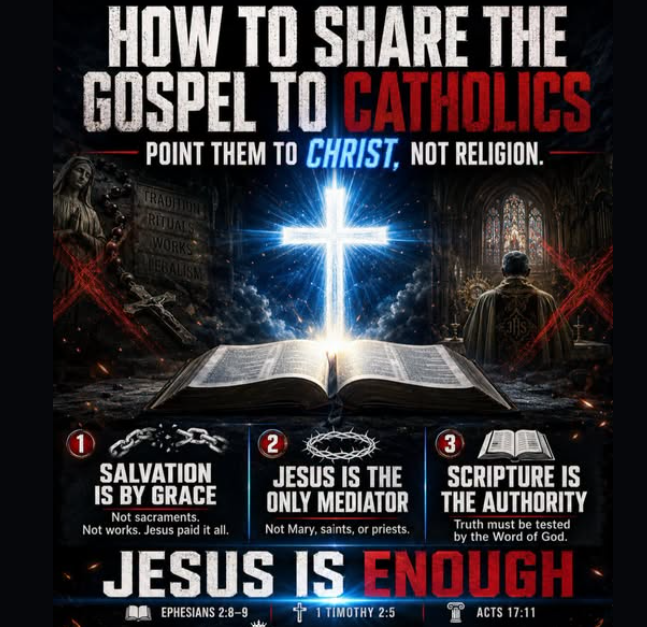
When sharing the gospel with a Catholic, don’t begin by attacking the pope, Mary, statues, confession booths or church traditions. Those conversations may eventually matter, but they aren’t the gospel.
Start with Jesus Christ.
Many Catholics sincerely believe in God. They believe Jesus is the Son of God, that He died on the cross and rose from the dead. The real question is where they’re placing their trust for salvation.
Are they trusting completely in the finished work of Jesus Christ, or are they also trusting in baptism, sacraments, confession, penance, good works and membership in the Catholic Church?
The gospel is clearly defined in Scripture:
“Moreover, brethren, I declare unto you the gospel which I preached unto you… How that Christ died for our sins according to the scriptures; And that he was buried, and that he rose again the third day according to the scriptures.”
-1 Corinthians 15:1, 3–4
Jesus Christ died for our sins, was buried and rose again. Salvation is received by faith in Him. It isn’t earned through religious performance.
“For by grace you are saved through faith; and that not of yourselves: it is the gift of God: Not of works, lest any man should boast.”
-Ephesians 2:8–9
Ask them a simple question:
“If you died today and stood before God, why should He allow you into heaven?”
Then listen carefully.
If they begin listing baptism, confirmation, communion, confession, good deeds, keeping commandments or belonging to the Catholic Church, lovingly explain that none of those things can remove sin.
Our best works can’t pay a debt that only the blood of Jesus Christ could pay.
When Jesus died on the cross, He said:
“It is finished.”
-John 19:30
He didn’t say, “I started it, and now you must complete it through the church.”
The price was paid in full.
There are three major errors that need to be addressed when sharing the gospel with a Catholic.
1. SALVATION ISN’T EARNED THROUGH SACRAMENTS OR RELIGIOUS WORKS
Catholicism teaches salvation through a system involving baptism, sacraments, confession, penance and continued faithfulness to the Church.
The Bible says salvation is the free gift of God, received by faith in Jesus Christ.
“For by grace you are saved through faith; and that not of yourselves: it is the gift of God: Not of works, lest any man should boast.”
-Ephesians 2:8–9
Good works should follow salvation, but they can’t produce salvation.
We aren’t saved because we were baptized, took communion, confessed to a priest or completed enough religious duties. We’re saved because Jesus Christ completely paid for our sins at the cross.
His work saves us. Our works don’t help Him finish it.
“For the wages of sin is death; but the gift of God is eternal life through Jesus Christ our Lord.”
-Romans 6:23
A gift is received. It isn’t earned, purchased or deserved.
2. JESUS CHRIST IS THE ONLY MEDIATOR
Catholics are often taught to pray through Mary, ask departed saints for intercession and confess sins to a priest.
Scripture says there is only one mediator between God and humanity.
“For there is one God, and one mediator between God and men, the man Christ Jesus.”
-1 Timothy 2:5
Mary was blessed among women, but she isn’t our mediator, our advocate or the queen of heaven. Departed saints aren’t instructed to receive our prayers. No earthly priest can take the place that belongs to Jesus Christ.
Every believer can come directly to God through Christ.
“Let us therefore come boldly unto the throne of grace.”
-Hebrews 4:16
Jesus is enough. We don’t need another mediator standing between us and Him.
3. THE BIBLE IS THE FINAL AUTHORITY, NOT CHURCH TRADITION
Catholicism places church tradition and official church teaching alongside Scripture as authorities for doctrine.
Jesus warned about religious traditions replacing the Word of God.
“Making the word of God of none effect through your tradition.”
-Mark 7:13
Church leaders can be wrong. Councils can be wrong. Traditions can be wrong. God’s Word is the standard by which every doctrine must be tested.
The Bereans were praised because they checked what they were being taught against Scripture.
“They received the word with all readiness of mind, and searched the scriptures daily, whether those things were so.”
-Acts 17:11
Ask your Catholic friend to do the same thing.
Don’t ask them to replace Catholic tradition with Protestant tradition. Ask them to open the Bible and see what God actually said.
The question isn’t, “What has my church always taught?”
The question is, “What does the Word of God say?”
Don’t make the conversation about whether Catholics are good or bad people. None of us are good enough. Every person, Catholic or Protestant, has sinned and needs the same Savior.
“For all have sinned, and come short of the glory of God.”
-Romans 3:23
The issue isn’t whether someone is religious. The issue is whether they’ve been born again.
Jesus told Nicodemus, a deeply religious man:
“Except a man be born again, he cannot see the kingdom of God.”
-John 3:3
A person can attend church, receive sacraments, memorize prayers, wear a cross and still never personally trust Christ for salvation.
Religion can teach someone about Jesus without teaching them to rest completely in Jesus.
Encourage them to read the Gospel of John for themselves. Don’t simply ask them to take your word over the Catholic Church. Ask them to compare every teaching with the Word of God.
The goal isn’t to win an argument, mock their family or embarrass them about their religion. The goal is to lead them away from trusting in a religious system and toward trusting completely in the Savior.
Be patient. Be direct. Open the Bible. Ask questions. Let Scripture do the heavy lifting.
Tell them the truth plainly..
Salvation isn’t found in Rome.
Salvation isn’t found in a denomination.
Salvation isn’t found in sacraments, priests, saints, traditions or religious works.
Salvation is found in Jesus Christ alone.
His blood is enough.
His sacrifice is enough.
His resurrection is enough.
His finished work is enough.
“Believe on the Lord Jesus Christ, and you shall be saved.”
-Acts 16:31


Comments