

Why I am a dispensationalist, premillennial & pre-Trib
Updated: Sep 6
Because I take the Bible literally, even when some kind of poetic language is used like symbol, or metaphor, something literal is being referenced. The Apostle Paul was chosen by God to be His Apostle with delegated authority to the Gentiles. And that, For the specific purpose of revealing the mystery of Salvation by Grace alone through faith alone as stated clearly in 1st Corinthians 15:3 and 4.. INCLUDING FOR THE FIRST TIME Gentiles into the plan of God. We see this plan unfolding very rapidly RIGHT NOW. I HAVE NEVER SEEN THE BIRTH PANGS OF MAJOR END TIME EVENTS, AS ARE COMING ON THE WORLD LIKE RIGHT NOW. ISRAEL IS AT THE CENTER JUST AS PROPHESIED, BEING PRESSURED BY THE WORLD TO COMPROMISE AND BACK DOWN. THE WORLD STAGE IS BEING SET FOR THE ANTICHRIST.. and the rapture is imminent like never before..

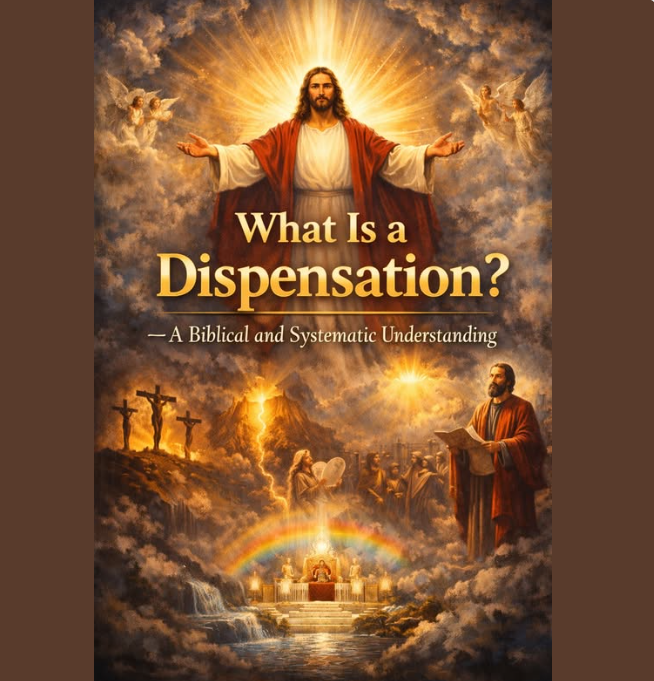
What is a Dispensation?
The Framework of God’s Dealings with Man
The Meaning of a Dispensation
To understand the Scriptures as a unified revelation, one must first grasp the principle by which God has ordered His dealings with mankind throughout history. That principle is the concept of a dispensation.
A dispensation is a period of time during which God administers His will toward humanity under a defined set of instructions. It is not merely a measurement of time, but a divine stewardship—a structured way in which God governs, reveals, tests, and guides His creation.
This concept is not the product of theological imagination; it is rooted in the very language of Scripture. The Apostle Paul writes:
“For if I do this thing willingly, I have a reward: but if against my will, a dispensation of the gospel is committed unto me.” (I Corinthians 9:17)
The word translated “dispensation” comes from the Greek oikonomia, meaning an administration, stewardship, or household management. It conveys the idea that God, as the sovereign Lord, distributes responsibilities and revelations in an orderly manner across different periods.
Paul uses this same term repeatedly:
“That in the dispensation of the fullness of times he might gather together in one all things in Christ…” (Ephesians 1:10)
“If ye have heard of the dispensation of the grace of God which is given me to you-ward:” (Ephesians 3:2)
“I am made a minister, according to the dispensation of God which is given to me for you, to fulfil the word of God;” (Colossians 1:25)
These passages establish a foundational truth: God has not dealt with humanity in the same way at all times. Instead, He has progressively revealed His will through distinct administrations.
Rightly Dividing the Word of Truth
The necessity of recognizing dispensations is anchored in a command:
“Study to shew thyself approved unto God… rightly dividing the word of truth.” (II Timothy 2:15)
To “rightly divide” is to discern distinctions where God Himself has placed them. It is to recognize that instructions given in one period may not apply in the same way in another.
Without this principle, Scripture becomes a mixture of commands, promises, and expectations that appear inconsistent. But when rightly divided, the Bible reveals a coherent and unfolding plan.
Consider the contrast:
• Jesus instructs His disciples:
“Go not into the way of the Gentiles… but go rather to the lost sheep of the house of Israel.” (Matthew 10:5–6)
• Later, Paul is told:
“I will send thee far hence unto the Gentiles.” (Acts 22:21)
Without dispensational understanding, this appears contradictory. With it, the distinction becomes clear: God has shifted His administration.
The Language of the Ages
To rightly divide Scripture, one must understand the terminology God uses concerning time and administration.
Ages (Aion)
The Greek word aion refers to an age—a period of time characterized by specific conditions or purposes.
Scripture speaks of:
• Past ages
“Which in other ages was not made known…” (Ephesians 3:5)
• The present age
“Who gave himself for our sins, that he might deliver us from this present evil world [age].” (Galatians 1:4)
• The age to come
“They which shall be accounted worthy to obtain that world [age]…” (Luke 20:35)
• Ages to come
“That in the ages to come he might shew the exceeding riches of his grace…” (Ephesians 2:7)
Thus, Scripture presents time not as a single undivided line, but as a series of divinely purposed ages.
World (Kosmos, Oikoumene, Aion)
The English word “world” translates several different Greek and Hebrew terms, each with distinct meanings:
• Kosmos — the ordered system or arrangement (John 3:16)
• Oikoumene — the inhabited earth (Luke 2:1)
• Aion — an age or period of time
Failure to distinguish these leads to misunderstanding. For example:
“Be not conformed to this world [age]…” (Romans 12:2)
This speaks not of the physical planet, but of the present moral and spiritual order.
Times and Seasons
Scripture also distinguishes between general time and appointed moments:
• Chronos — continuous time
• Kairos — a fixed or appointed season
“To every thing there is a season, and a time to every purpose under the heaven.” (Ecclesiastes 3:1)
God operates according to both—broad timelines and precise moments of fulfilment.
The Eternal Framework
Before examining human history, we must recognize the broader framework:
• The Eternal Past — before recorded time (Genesis 1:1; John 1:1)
• The Eternal Future — after all redemptive history is complete (Revelation 21–22)
Between these two lies the entire drama of creation, fall, redemption, and restoration.
Scripture also alludes to a pre-Adamic administration involving angelic beings:
“For by him were all things created… whether they be thrones, or dominions…” (Colossians 1:16)
“God spared not the angels that sinned…” (II Peter 2:4)
This indicates that God’s dealings extend beyond humanity alone, encompassing all free moral agents in His universe.
The Dispensations of Human History
Between the eternal past and eternal future, Scripture reveals a series of distinct dispensations in human history.
1. Innocence — The Garden of Eden
“Of the tree of the knowledge of good and evil, thou shalt not eat…” (Genesis 2:17)
Man was placed in a perfect environment with one command. The test was simple—obedience.
Failure came swiftly (Genesis 3), and judgment followed: expulsion from the Garden.
2. Conscience — From the Fall to the Flood
Man now lived with the knowledge of good and evil.
“Every imagination… was only evil continually.” (Genesis 6:5)
The result was universal corruption and the judgment of the Flood (Genesis 6–8).
3. Human Government — After the Flood
God instituted authority:
“Whoso sheddeth man’s blood, by man shall his blood be shed…” (Genesis 9:6)
Yet rebellion continued, culminating in Babel (Genesis 11), where God scattered humanity.
4. Promise — Abraham
God called one man and made covenant promises:
“In thee shall all families of the earth be blessed.” (Genesis 12:3)
This dispensation emphasized faith in God’s promises, yet led into bondage in Egypt.
5. Law — Moses to Christ
At Sinai, God gave Israel a detailed system of law:
“And God spake all these words…” (Exodus 20:1)
For centuries, Israel lived under this system. Yet they failed to keep it and rejected their Messiah:
“He came unto his own, and his own received him not.” (John 1:11)
This rejection culminated in the crucifixion and later judgment upon Jerusalem (Luke 21:24).
The Present Age and the Eternal Purpose
6. — The Dispensation of Grace
Following Israel’s rejection, a profound shift occurred.
In Acts 9, Saul of Tarsus was converted and commissioned:
“I will send thee far hence unto the Gentiles.” (Acts 22:21)
This marked the beginning of a new dispensation:
“The dispensation of the grace of God…” (Ephesians 3:2)
The message of this age is clear:
“How that Christ died for our sins… was buried, and… rose again…” (I Corinthians 15:3–4)
The requirement is equally clear:
“Believe on the Lord Jesus Christ, and thou shalt be saved…” (Acts 16:31)
Salvation is by grace alone:
“For by grace are ye saved through faith… not of works…” (Ephesians 2:8–9)
This dispensation forms the Body of Christ, composed of both Jew and Gentile:
“For he is our peace… to make in himself of twain one new man…” (Ephesians 2:14–15)
The Necessity of Testing Free Moral Agents
Why does God administer history through dispensations?
The answer lies in the nature of His creation. God has made beings with free will.
“I have set before you life and death… therefore choose life…” (Deuteronomy 30:19)
Each dispensation serves as a test—an opportunity for obedience or rebellion.
Through these tests, several truths are established:
• That God’s authority is just (Psalm 19:9)
• That sin brings judgment (Romans 6:23)
• That obedience leads to blessing (Isaiah 1:19)
God’s ultimate purpose is to prepare a creation that willingly submits to Him in righteousness.
Future Dispensations:
The Tribulation
After the present age concludes:
“The Lord himself shall descend… and we… shall be caught up…” (I Thessalonians 4:16–17)
God resumes His dealings with Israel, fulfilling prophecy:
“He shall confirm the covenant with many for one week…” (Daniel 9:27)
The Kingdom — The Millennium
Christ will reign on earth:
“They lived and reigned with Christ a thousand years.” (Revelation 20:4)
Satan will be bound:
“He laid hold on the dragon… and bound him a thousand years.” (Revelation 20:2)
Yet he will be released:
“Satan shall be loosed… to deceive the nations…” (Revelation 20:7–8)
Even in a perfect environment, mankind must choose obedience.
The Eternal State
Finally, all things are restored:
“And I saw a new heaven and a new earth…” (Revelation 21:1)
God’s purpose is fulfilled:
“That God may be all in all.” (I Corinthians 15:28)
The redeemed inherit all things:
“Heirs of God, and joint-heirs with Christ…” (Romans 8:17)
The Wisdom of God’s Plan
God’s dispensational dealings are not arbitrary—they are necessary.
They ensure:
• The testing of all free moral agents
• The demonstration of God’s justice and mercy
• The final removal of all rebellion
Scripture declares:
“To the intent that now… might be known… the manifold wisdom of God.” (Ephesians 3:10)
Even eternal judgment serves a purpose:
“They shall be an abhorring unto all flesh.” (Isaiah 66:24)
A Unified Revelation
From the Garden of Eden to the New Creation, God’s plan unfolds through distinct dispensations, each revealing another facet of His character.
A dispensation answers the question: What has God required of mankind at a given time?
When this principle is understood, Scripture is no longer a collection of disconnected teachings, but a unified revelation moving toward a glorious conclusion.
God has spoken. Man must respond.
And in rightly dividing the Word of truth, we do not divide Scripture—we uncover the divine order that has been there all along.


Comments